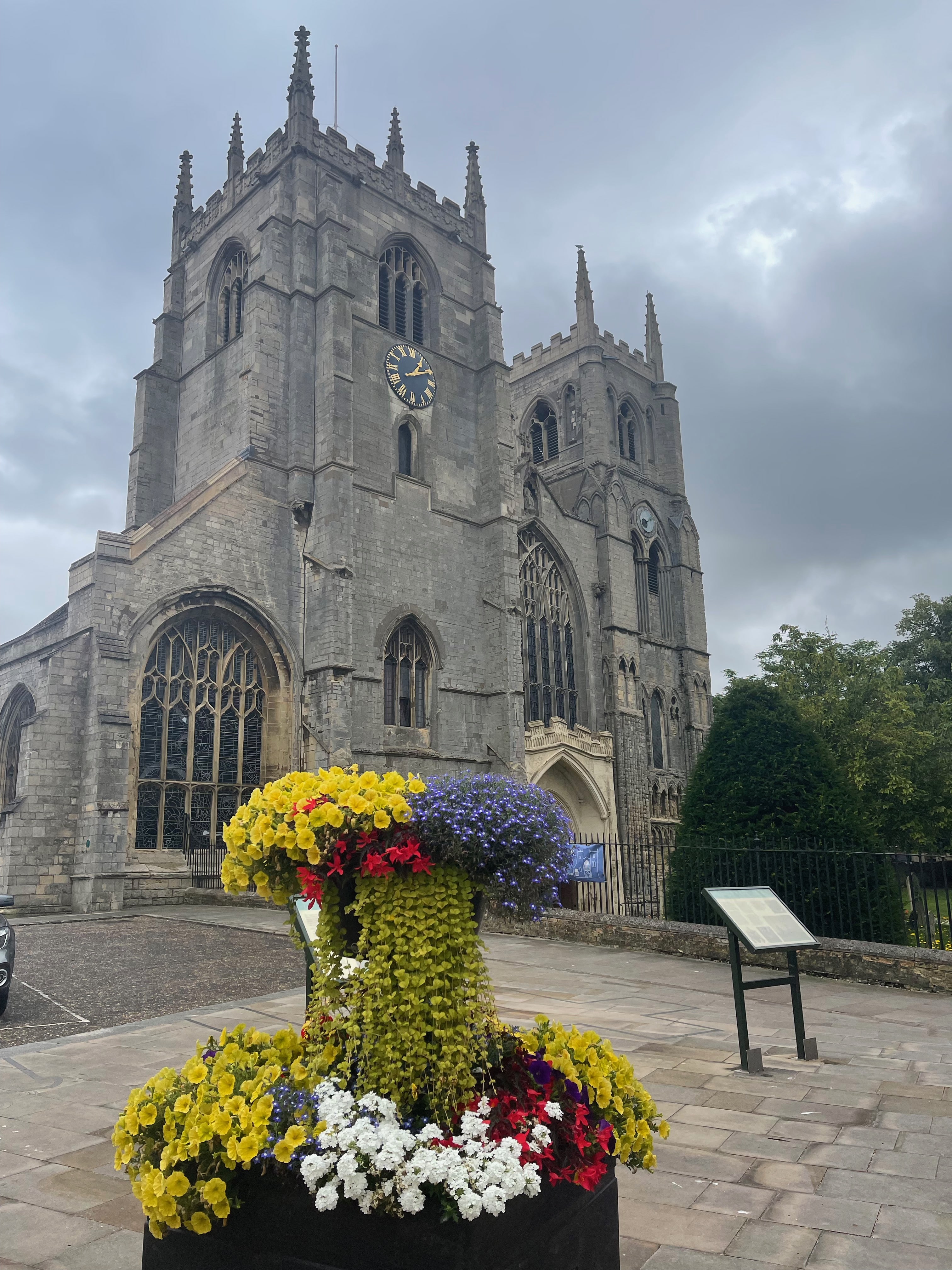

In this post, I will describe a day visiting the town of King’s Lynn and the attractions in the area. I have been to King’s Lynn many times, and my connections with the town are two houses I renovated as buy-to-let projects in the town. See my posts: “My Vanilla buy-to-let project 1” and “Project no. 2“.
Subscribe to my blog, so you will not miss any of my posts published every week.
If you are planning a trip to England and prefer to have everything organised by a tour, you should check the tours at Tourradar, which offers various tours to many places in England.
Tourradar has tours that suits every length of time and budgets and if you use my links to book your trip and enter code RoseG50 you will get a discount on your booking.

My frequent visits to King’s Lynn allowed me to appreciate its history, architecture and attractions. So, I took a day to only visit the attractions and discover all the town has to offer.
Below is a map of the places I visited in Kings Lynn that day:

A LITTLE BIT ABOUT KING’S LYNN
King’s Lynn is a port and market town in the west of Norfolk, England. Historically significant, it was founded as Bishop’s Lynn, it was a major member of the Hanseatic League, one of only a few English towns to be included. Its wealth peaked in the late Middle Ages from wool, salt, and trade with the Low Countries.

In 1537, during the Reformation, Henry VIII took control of the church and renamed it King’s Lynn. The Tudor and early Stuart periods were the town’s high point.

The modern town is a mix of preserved medieval architecture and post-war sprawl. The port still functions but has shifted to bulk cargo; it no longer matters strategically. Its economy is dominated by public sector employment (NHS, education, local government), retail, and logistics, with minor tourism.

VISITING KING’S LYNN
I started visiting the important buildings in the town centre. I parked the car near the Purfleet at the South Quay and took the opportunity to explore the Purfleet area, the port and the Custom House.

Afterwards, I explored the old streets of the centre until I arrived at the Saturday Market Place, where the Minster of King’s Lynn and the Guildhall are. The Museum “Stories of Lynn” is also located there, next to the Guildhall and I entered the museum to learn a bit of King’s Lynn history.

After the visit to the museum, I went back to the port and decided to have lunch at the “Marriott’s Warehouse”. It is a nice building refurbished to accommodate a nice restaurant from an old warehouse at the port.

The next stop was at the “Tuesday Market Place” where I moved the car to. On this square, turned into a car park, you can find the Corn Exchange Theatre and Cinema and nice, beautiful buildings such as the one for “The Maids Head” pub and the “Dukes Head” Hotel.

On that day, they were having a music show on the Market Place, and the area was full of people watching the band play. The sun was shining and there was a great atmosphere in the square.

From there, I walked to the “True’s Yard Fisherfolk Museum”, which, together with the “Stories of Lynn Museum”, tells the history of King’s Lynn very well. Two very interesting museums that are worth visiting.

After visiting the museum, I took the car and drove to “Castle Rising”, an old castle from “English Heritage”. The castle is about a 20-minute drive from the centre of King’s Lynn and on the outskirts of the town. This is another attraction that deserves a visit.

I ended my visit to King’s Lynn at the castle, but if you have more time, you can also visit “Norfolk Lavender” which is about 30 minutes’ drive. For an extended stay, or another visit, good options are the “Sandringham Estate” or the seaside towns of Wells-next-the-Sea and Cromer on the shores of Norfolk. Check out my posts on these towns on the links.

THE PURFLEET AND THE CUSTOM HOUSE
Purfleet isn’t a residential district—it’s the historic inlet and quay at the town’s commercial heart, where the River Purfleet branches off the Great Ouse. It functioned as a tidal basin and key port facility from the Middle Ages into the early modern period. Think of it as the logistical and economic hinge of Lynn’s mercantile power.

The Purfleet Quay faces the Custom House, built in 1683 as a merchants’ exchange and now a defining landmark. This proximity wasn’t incidental: the Purfleet was the point where goods were weighed, taxed, and shipped—wool, salt, wine, coal. Its basin allowed small seagoing vessels to moor right at the town centre, maximising trade efficiency before rail killed coastal shipping.
The inlet was later partially filled and modified, but you can still see the line of the quay and the civic pride embedded in its architecture. Symbolically, Purfleet represents Lynn’s participation in the North Sea trade networks, especially the Hanseatic League, which few English towns outside London could claim.
THE SATURDAY MARKET PLACE, THE MINSTER OF KING’S LYNN AND THE GUILDHALL
The Saturday Market Place is the civic and ecclesiastical centre of medieval King’s Lynn—a wide, open square framed by major institutional buildings. It functioned historically as a commercial hub, but also as a stage for public ceremonies, punishments, and proclamations. Its scale is unusually grand for a provincial town, reflecting King’s Lynn’s medieval importance as one of England’s leading ports.

On its west side stands the Minster (St. Margaret’s Church), founded in 1101 by Bishop Herbert de Losinga. Originally Romanesque, it’s been successively Gothicised—note the perpendicular towers, the vast nave, and the hammerbeam roof inside. It’s not just a parish church—it was, effectively, a symbol of ecclesiastical and civic legitimacy for the Bishop of Norwich, who controlled the town in competition with its merchant elite.

North of the square is the Guildhall of St George, built in 1406, England’s oldest surviving theatre and originally the hall of the Guild of St George, a lay religious fraternity that doubled as a business network. Its brick façade, timber hammerbeam roof, and internal stage speak to King’s Lynn’s late-medieval wealth and autonomy. Shakespeare’s company performed here; it’s now a performance space again after major restoration.

Together, the square, the Minster, and the Guildhall constitute a dense, layered example of medieval urban life—church, commerce, and community authority all compressed into one walkable node.

TUESDAY MARKET PLACE AND THE TRUE’S YARD FISHERFOLK MUSEUM
Tuesday Market Place is the Georgian counterpoint to the medieval Saturday Market. Laid out in the 12th century but rebuilt and expanded in the 18th, it became King’s Lynn’s main commercial and social space as the town modernised. It’s vast—one of the largest town squares in England. Bordered by elegant 18th- and 19th-century façades: banks, hotels, civic buildings. The Duke’s Head Hotel (1683) dominates the southern edge; it was built by Sir John Turner, a wealthy MP and merchant, signalling the shift from ecclesiastical to mercantile power.

This square absorbed functions that the Saturday Market lost: cattle trading, fairs, and public events. It reflects King’s Lynn’s peak Georgian prosperity, when inland waterways and early rail links still gave it national relevance.

In contrast, “True’s Yard Fisherfolk Museum”, a few minutes northwest, captures the lives of the working-class maritime community that King’s Lynn depended on but rarely commemorated. Set in surviving 18th–19th-century cottages in the North End, it documents the fishing families, their domestic interiors, tools, boats, and oral histories. The name comes from the True family, typical of the “Northenders”, independent, tight-knit, poor but skilled.

The museum is a rare case of urban heritage focused on labour rather than elites. It also shows spatial stratification: the fishermen lived literally outside the old walls, both socially and geographically marginal to the town’s merchant core.

CASTLE RISING
Castle Rising isn’t in King’s Lynn but just outside, about 4 miles northeast. It’s strategically placed on high ground overlooking the Babingley River, then navigable. Built c. 1138 by William d’Aubigny, a Norman baron who married into the royal family, it’s one of the best-preserved 12th-century keeps in England.

The keep is massive, Norman Romanesque with blind arcading and chevron ornament. But its real historical importance comes later: it was the residence of Queen Isabella, widow of Edward II and mother of Edward III, after her political fall. She lived there semi-exiled from 1330 until she died in 1358. The scale and comfort of the castle reflect this high-status imprisonment.

The surrounding earthworks are vast, possibly ceremonial as much as defensive. The adjacent planned village of Rising, laid out by d’Aubigny, was a classic example of seigneurial urbanism: lords imposing a town for profit. But it failed to grow, especially after King’s Lynn outcompeted it as a port.

Castle Rising’s decline parallels the centralisation of royal power and the obsolescence of private baronial fortresses.

CONCLUSION
My visit to King’s Lynn was greatly appreciated, and I discovered facts that I didn’t know about the town. I think it was once a very important town, and the beautiful, listed buildings show how powerful the town once was. It is a place worth visiting to understand how it was once central to England’s economy and politics, but today it does not have the same importance and relevance. You leave with a sense of a place that mattered deeply, and still does, if you know what to look for.
Below is a reel from The Travelling Surveyor Instagram account. Check it out and follow me on Instagram as well:

I hope this post will give you some idea of what can be done in a day in King’s Lynn and will help you plan your own visit there.
HOW TO MAKE THE MOST OF YOUR VISIT TO HIGH WYCOMBE
Below you will find a list of what to visit, where to stay and where to eat in King’s Lynn. I classified each place as follows:
BOLD – Visited, tried and recommended
NOT BOLD – Not visited or tried, but planning to visit or try and heard very good reviews
RED – Visited and tried but do not recommend, avoid or be cautious
*** – Excellent
** – Good
* – OK
£££ – Expensive
££ – Fair and affordable
£ – Cheap
PLEASE NOTE: Every hotel, restaurants and attractions I mention on my blogs are not sponsored reviews and we always paid the full price when visiting. We give our own opinion of the place and detail our experience, good or bad.
THINGS TO DO
ATTRACTIONS
1 – The Purfleet Quay and the Customs House – ***
2 – Saturday Market Place – ***
3 – The Guildhall – ***
4 – The Minster of King’s Lynn – ***
5 – The Stories of Lynn Museum – ***
6 – Tuesday Market Place – ***
7 – True’s Yard Fisherfolk Museum – ***
8 – Castle Rising – ***
WHERE TO STAY
ACCOMMODATION
1 – The Old Rectory – 4* – ££
2 – Duke’s Head Hotel – 4* – ££
3 – The Lodge – 3* – £
4 – Stuart House Hotel – 3* – £
5 – King’s Lynn Holiday Park – £
6 – Modern Studio Apartment – £
If you prefer to look for your own accommodation, search and book via the below widget:
I use affiliate links such as the links above for Booking.com, Get your Guide, Viator and others. It means that if you use any of my links to make a booking, I will get a small commission from the partners I’m affiliated with without any additional cost to you. Please, use the links provided when making a booking, this is a way of supporting blogs like this so we can continue writing informative and interesting posts. I’m very thankful for that.
BEST PLACES TO EAT
RESTAURANTS
1 – Marriot’s Warehouse – *** – ££
2 – Tipsy Teapot Restaurant – ££
3 – Middletons – ££
4 – Poco Lounge – ££
5 – Mem’s Kitchen – ££
6 – Nest Farmhouse – ££
If you tried any of my recommendations above, please send me a message and tell me about your experience good or bad, so I can update the list accordingly. Thanks!
If you enjoyed reading this post you might also like to read:

Leave a Reply