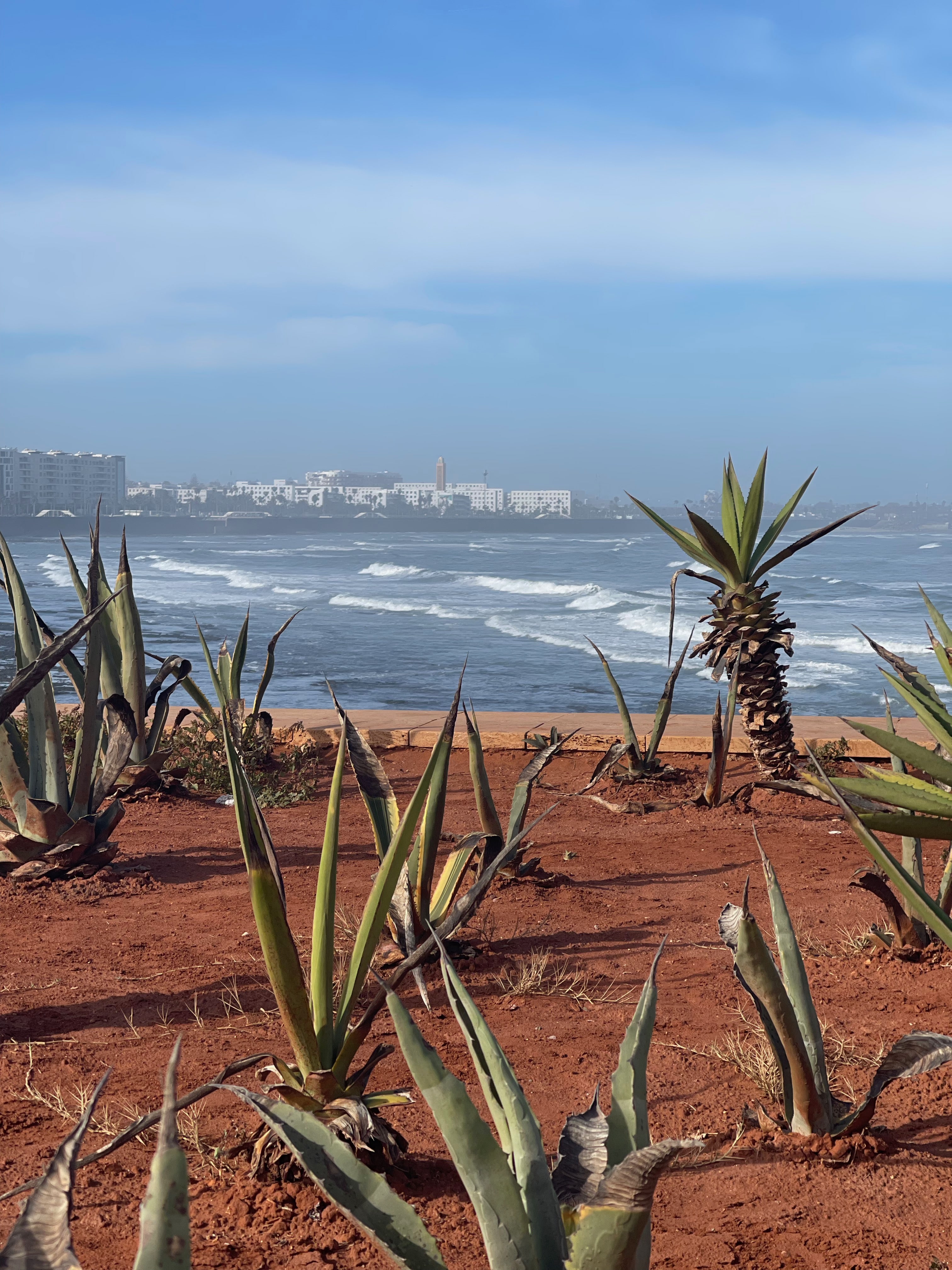

In this post, I will tell you about our day in Casablanca during our short break in Morocco in winter. I will describe what we visited and our honest opinion about the city.
We started the day very early in Marrakesh (read my post Morocco Day 1 and Morocco Day 2) and left our Riad at 7 am to catch a taxi we had booked the previous night to take us to the train station.
Subscribe to my blog, so you will not miss any of my posts published every week.
We were travelling independently, but if you prefer to have everything organised by a tour operator, before booking anything check the tours offered by Tourradar. They have a variety of tours to Morocco that suits the time and budget of everyone.
If you book any of Tourradar tours via my links and use code RoseG50 you will get a discount on your booking.
Our train was leaving at 7:50 am, and we wanted to have plenty of time to arrive at the station. For this reason, we missed breakfast at our Riad and dashed outside the medina to get our taxi.

The train station was close to our Riad, and at that time it took us just about 5 minutes to get there by taxi. We went to the station on the previous day to buy the tickets for the trip (see my previous post, Morocco in winter, is it worth? – Day 2), so we were already familiar with the building, which is very beautiful for a train station.

Once we arrived there, we had enough time to have some coffee at a café before boarding the train to Casablanca. The trip lasted 2:38 hours in a clean and comfortable compartment shared with other passengers in first class. We took the opportunity to have a bit of a snooze. We could not see the landscape as we were not sitting on the window seats. Before we knew it, we arrived in Casablanca.

Below is a map showing the places we visited in Casablanca:
Before telling you about our visit, let’s learn a little bit about Casablanca:
A LITTLE BIT ABOUT CASABLANCA
Casablanca is Morocco’s largest city and its economic and industrial powerhouse. It sits on the Atlantic coast and serves as the country’s primary port, commercial centre, and business capital. While it lacks the historical romance of cities like Fes or Marrakesh, it reflects modern Morocco, urban, ambitious, and globally connected.

The city’s most iconic site is the Hassan II Mosque, the largest in Africa and one of the few in Morocco open to non-Muslims. Built partially over the sea, it combines traditional craftsmanship with massive scale; its minaret is the tallest in the world.

Much of Casablanca was shaped during the French Protectorate (1912–1956), and it retains wide boulevards, Art Deco buildings, and French-influenced cafés.

Casablanca isn’t a tourist city in the classic sense. It’s gritty, sprawling, and often chaotic, but it’s where modern Morocco lives: finance, tech, fashion, and youth culture live together.

VISITING CASABLANCA
At Casablanca station (Casa Voyagers), we took a taxi to take us to the most famous attraction in town, the Hassan II Mosque. We bought our tickets on our arrival and had to wait about half an hour for the next tour in English with a guide from the mosque. In the meantime, we had a look at the museum they have next to the ticket area.

1 – HASSAN II MOSQUE
The museum is not very big; it exhibits Moroccan craftsmanship, architectural models, religious and cultural objects, among others. It is an interesting visit worth looking at, especially if you must wait for the next tour, as we did.


At the time, we joined the group and headed to the mosque, passing through the huge plaza surrounding the mosque. It is a statement of scale and symbolism. It can accommodate over 800,000 people.

The mosque on the outside is a combination of craftsmanship and high-tech materials such as titanium doors, computer-controlled lights and earthquake-resistant foundations.

The minaret is 210 metres high and is the tallest religious structure in the world. It doubles as a lighthouse and projects a laser beam toward Mecca. It is clad in green tiles and carved stones dominating the skyline of Casablanca.

Inside the Hassan II Mosque is a fusion of traditional Moroccan artistry and late-20th-century ambition. The prayer hall spans nearly 20,000 square meters. There is room for 25,000 worshippers, with no supporting pillars obstructing the space. The roof is retractable, opening in three minutes to reveal the sky.

The interior surfaces are covered in hand-carved cedarwood (from the Middle Atlas), marble, and stucco, all shaped using traditional techniques by thousands of Moroccan artisans. Zellige tilework forms geometric patterns across floors and columns. Enormous Venetian glass chandeliers hang from the ceiling, harmonised with local motifs.

A glass section of the floor shows the Atlantic below, reinforcing the mosque’s theological symbolism. The mihrab and minbar are carved with exceptional detail, combining Andalusian and Moroccan design.
There’s also a basement level with ablution fountains shaped like lotus flowers, and a hammam for public use.

We thought the complex was very impressive and appreciated all the care and thought they had put into producing a monumental building such as this one. Definitely, an architectural statement to be proud of.
You can have a skip-the-line ticket with a tour of the mosque (advisable if your visit is in a busy time of the year) by booking it HERE.
If you have enough time in Casablanca you might want to book the skip-the-line ticket with tour of the mosque + a tour of Casablanca. I’m sure it is a much nicer way of seeing Casablanca, we just didn’t do it due to little time in our programme. Book it HERE.

When we finished our visit to the mosque, it was about 1 pm and lunchtime. We decided to walk to Rick’s Café, another icon in Casablanca. We didn’t have a reservation, but thought it was worth going and see if we could have lunch there. They did have a table available for us, and we entered the café.

2 – RICK’S CAFÉ
Rick’s Café in Casablanca is a cinematic fiction turned real-world tourist magnet. Opened in 2004 by former American diplomat Kathy Kriger, it’s a re-creation of the bar from the 1942 film “Casablanca”, which was shot entirely in Hollywood and never depicted a real location in the city.

The café occupies a restored riad-style mansion near the medina. It mimics the film’s Art Deco–Moorish aesthetic: white arches, brass chandeliers, curved balconies, and a grand piano. The menu is upscale international-Moroccan fusion with tagines, steaks, fish dishes and French wines. A pianist plays standards, often including “As Time Goes By.”

It’s not historically authentic; it’s nostalgia tourism, packaging wartime Hollywood myth into a Moroccan setting. But it works: polished, atmospheric, and photogenic, very Instagramable. For many tourists, it’s the only part of Casablanca that matches the fantasy they arrived with.

We loved the building in an Art Deco style. The inside was also very attractive with the Moroccan-style decoration. The food was delicious and one of the few places that serves alcohol in Morocco. We had lovely salads and fish dishes that added to the list of one of the best meals we had in Morocco.


After lunch, we walked via Boulevard des Almohads, passing the Marina and entered the Old Medina.
3 – THE OLD MEDINA

We strolled inside the Medina, exploring the narrow streets and walking in the direction of Muhammad V Square.

This medina is not very attractive and looks very intimidating. Lots of men sitting at a square and cafés looking at you in a very suspicious way. One young man even told us, “Give me money,” and we said bluntly, “No”. We didn’t spend much time there and quickly left the area in the direction of the Muhammad V Square.

4– MUHAMMAD V SQUARE
Mohammed V Square is Casablanca’s administrative and symbolic core, built during the French Protectorate as part of Lyautey’s colonial urban plan. It’s surrounded by monumental buildings in the Moresque style, a hybrid of French Art Deco and Moroccan motifs, including the courthouse, the Bank of Morocco, the post office, and the Governor’s Office with its iconic clock tower.

The square was designed to project order, authority, and modernity, colonial power in architectural form. Today, it’s more ambivalent: a public space used for protests, celebrations, and daily loitering, with pigeons, fountains, and palm trees softening its authoritarian geometry.

When we arrived at the square, it was quite busy. Lots of people around the fountain taking photos and walking around. We also took various photos of the square but soon pressed on in the direction of the Casablanca Cathedral.

5 – CASABLANCA CATHEDRAL
Casablanca Cathedral, formally the Church of the Sacred Heart, is a relic of French colonial ambition and religious outreach. Built in 1930, it’s a striking example of Neo-Gothic architecture fused with Art Deco, designed by Paul Tournon. The cathedral’s vertical lines, sharp towers, and concrete façade reflect both spiritual aspiration and modernist confidence.

It was never just a church; it was a symbol of European presence, Catholic universality, and colonial order in a Muslim-majority country. After independence in 1956, it was deconsecrated and repurposed. Today, it functions sporadically as an event space for art exhibitions, concerts, and cultural gatherings.

Inside, the nave is cavernous and austere, with towering columns and stained-glass windows now dulled by time. It feels abandoned yet dignified, an architectural ghost, neither reclaimed nor erased.

The cathedral is close to Muhammad V Square, and when we arrived there, it was closing. The security guard allowed us to get in, which was incredibly generous of him and lucky for us.
We found the building, even though austere, a very beautiful piece of architecture and felt sorry that it is not used for its original function. The empty space seems a waste not to be used as a church anymore. However, it still sits proudly in its place as if it were still in full use.

6 – THE KING’S PALACE
When we left the cathedral, we took a taxi to the King’s Palace. We also wanted to visit the Mahkama of Pacha, a beautiful building near the King’s Palace that serves as a courthouse, but in the past was the residence of the pasha.
It is a majestic building that incorporates Moroccan design, Islamic artistry, and Moorish styles. However, we didn’t have time to stop there as it closed at 4 pm, and it was already 4 pm when we arrived at the Royal Palace.

The King’s Palace, or “Royal Palace of Casablanca”, is another beautiful building built in the 1920s. It is one of the residences of the King of Morocco and an exquisite piece of architecture in Casablanca. It is not possible to enter the palace to visit its interiors, but it is worth going to admire the exterior from outside the gates.

After a few photos of the outside, we thought it was time to walk back to the train station to catch the train back to Marrakesh. It was a good half-hour walk, but it was enjoyable, so we could see more of Casablanca on the way.
There is a guided city tour of Casablanca that includes the Mosque, Rick’s Café, La Corniche, Church of Notre Dame, Habbous, Mohammad V Square and the Old Medina market. It includes places we haven’t been, but seems a good tour covering many tourist points. Book this one HERE.

Below is a reel from The Travelling Surveyor Instagram account. Check it out and follow me on Instagram as well.
Our impression of Casablanca was not very good. It is not particularly beautiful. We found it very dirty and run-down. Apart from the mosque and the other buildings, there is nothing much more to appreciate in a day. It is still worth visiting, but it is not one of those places that I will rush to go back to.

We boarded our train to Marrakesh, and we arrived at about 9:30 pm. We took another taxi at the station that took us directly to a restaurant near our Riad called “La Terrace du Jardin”.

We had a lovely dinner there with very interesting and tasty dishes. No alcohol served at this restaurant, so we had a delicious mojito mocktail instead.


After dinner, we just walked to our Riad, looking forward to what the next day had to offer us, continuing to explore Marrakesh.

I hope this post will give you some idea of what can be done in a day in Casablanca and will help you plan your own visit there.
HOW TO MAKE THE MOST OF YOUR VISIT
Below you will find a list of what to visit, where to stay and where to eat in Casablanca. I classified each place as follows:
BOLD – Visited, tried and recommended
NOT BOLD – Not visited or tried, but planning to visit or try and heard very good reviews
RED – Visited and tried but do not recommend, avoid or be cautious
*** – Excellent
** – Good
* – OK
£££ – Expensive
££ – Fair and affordable
£ – Cheap
PLEASE NOTE: Every hotel, restaurants and attractions I mention on my blogs are not sponsored reviews and we always paid the full price when visiting. We give our own opinion of the place and detail our experience, good or bad.
THINGS TO DO
1 – Hassan II Mosque – ***
2 – Rick’s Café – ***
3 – The Old Medina – *
4 – Mohammad V Square – ***
5 – Royal Palace of Casablanca – ***
6 – Mahkama of Pacha
WHERE TO STAY
ACCOMMODATION
1 – Four Seasons Hotel Casablanca – 5* – £££
2 – Royal Mansour Casablanca – 5* – £££
3 – Kaan Casablanca – 4* – £££
4 – Family Aparthotel – 4* – £££
5 – The Shelter Residence – 3* – ££
6 – Olympic Inn – 3* – ££
If you prefer to look for your own accommodation, search and book via the below widget:
I use affiliate links such as the links above for Booking.com, Get your Guide, Viator and others. It means that if you use any of my links to make a booking, I will get a small commission from the partners I’m affiliated with without any additional cost to you. Please, use the links provided when making a booking, this is a way of supporting blogs like this so we can continue writing informative and interesting posts. I’m very thankful for that.
BEST PLACES TO EAT
RESTAURANTS
1 – Rick’s Café – *** – £££
2 – Mood’s Café – ££
3 – MonGrec – ££
4 – El Gousto – ££
5 – Le Gatsby – ££
6 – Dar Dada – £££
We only tried the ones in bold , the others are the result of my researches and ones that I would like to try. If you tried any of my recommendations above, please send me a message and tell me about your experience good or bad, so I can update the list accordingly. Thanks!
If you enjoyed reading this post you might also like to read:
Leave a Reply