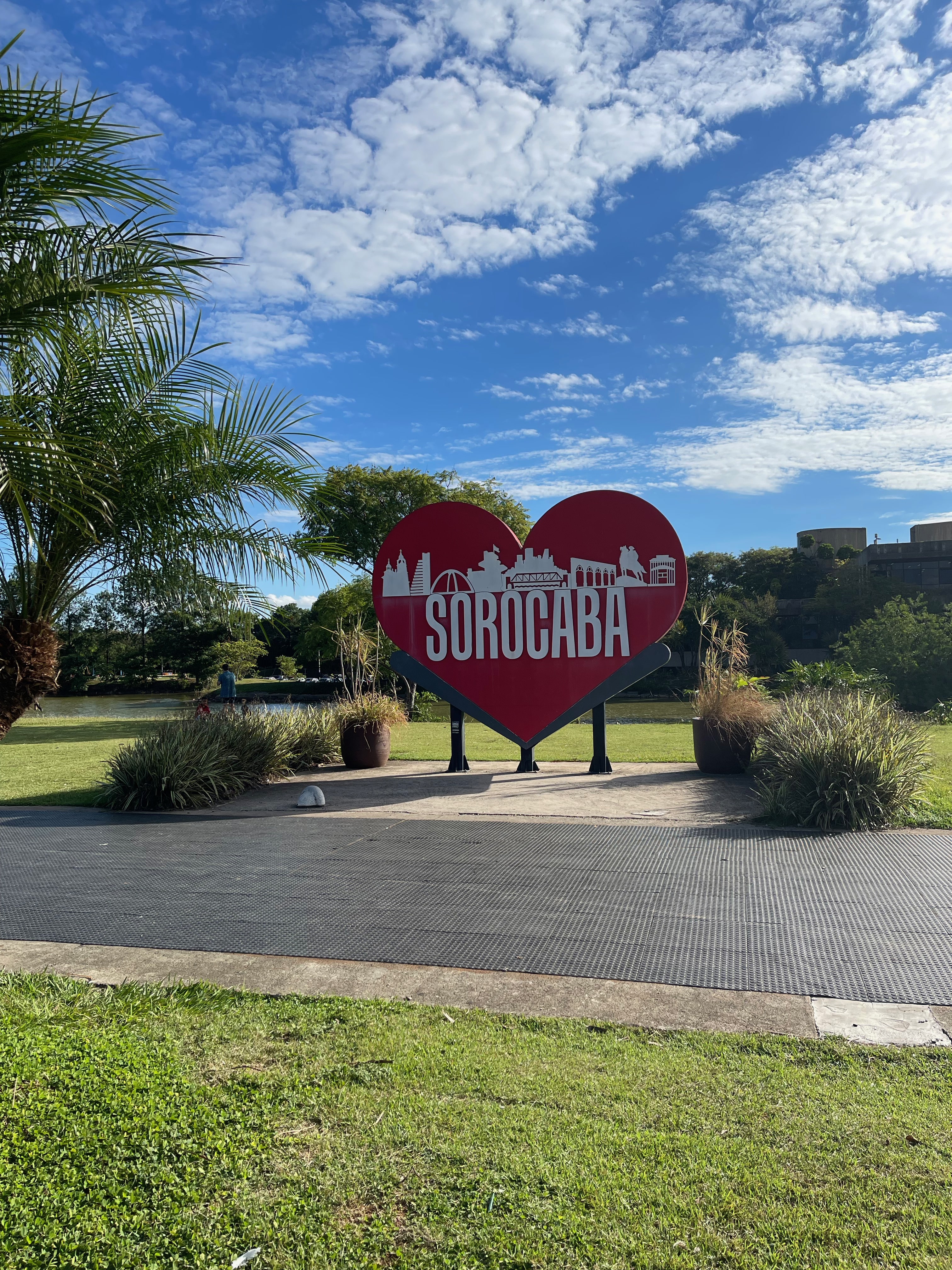

In this post, I will tell you about our visit to Sorocaba, a town in the interior of the state of São Paulo, Brazil.
We were on our annual trip to Brazil, based in São Vicente, SP. We left São Vicente to travel to different places while there. The first town we visited was Campos do Jordão, where we spent two days. Now it was time to move on, and the next stop was going to be Sorocaba.
We were travelling independently with a hired car as we are confident travellers and speak the language. However, if you prefer to be part of a tour and to have everything organised for you, I advise you to book a complete tour with Tourradar.
They have different kinds of tours that will fit your time and budget. If you book it via my links you can get a discount by using this code: RoseG50.
Subscribe to my blog, so you will not miss any new posts published every week.
My Mum was born in Sorocaba, and we still have family there. We also have some friends who live there, and every year we go to Sorocaba to see them.

We left Campos do Jordão early in the morning, and the trip to Sorocaba was due to take about 4 hours. However, it took more than that because we had so much traffic when we arrived in São Paulo.
We took the BR-116, and the part that runs along the “Marginal Tietê” (alongside the River Tietê) was very busy. On top of that, we had a very strong storm when passing through that area. The traffic only improved after we joined the BR-374 leading to Sorocaba.
After stopping at a service station for lunch, we continued the trip, but ended up arriving in Sorocaba around 4 pm.
We stayed at Ibis Styles Santa Rosália because it was close to my cousin’s house. After check-in and some freshening up, we went to my cousin’s house nearby. We stayed there for dinner and until late at night.

The next day, we returned to my cousin’s house in the morning, and we all went together to explore the sites in Sorocaba. But before I tell you what we did on that day, let me tell you a little bit about Sorocaba.
Below is a map showing the places we visited in Sorocaba on that day.
A LITTLE BIT ABOUT SOROCABA
Sorocaba is one of those Brazilian cities that hides in plain sight. It’s in São Paulo state, about 100 km from the capital, yet it rarely features on tourist itineraries. That’s odd, because Sorocaba sits at the intersection of colonial history, industrial might, and a surprisingly green urban layout.

The city’s origins go back to the 17th century, tied to” Bandeirantes” expeditions and trade routes. Its real transformation came in the 19th century, when Sorocaba became a textile hub, earning the nickname “Manchester Paulista.”
That industrial DNA remains today. Sorocaba is a logistics and tech centre, with factories, research parks, and one of the highest urban development indices in the state.

But Sorocaba isn’t just smokestacks and warehouses. The city has invested heavily in public parks and bike infrastructure. “Quinzinho de Barros” Zoo is a landmark, but the real surprise is the network of green corridors and cycling paths linking neighbourhoods.
It feels like a mid-sized city that was actually planned, which is rare in Brazil.

Culturally, Sorocaba reflects its working-class backbone. You don’t get Rio’s spectacle or São Paulo’s cosmopolitan excess, but you do get authenticity.
Local markets, football culture, and regional food lean heavily on “caipira” (countryside) traditions. The nightlife is more about samba circles and “sertanejo” (western music) bars than international DJs.
Would you like to visit? Depends on what you’re after. Sorocaba isn’t a bucket-list destination, but it’s a good lens on Brazil’s urban middle class. It is modern, functional, and a bit overlooked. If you’re already in São Paulo and want to see a different side of the state without going rural, it’s worth the trip.
VISITING SOROCABA
Our first visit of the day was to “Fazenda Ipanema” (Ipanema Farm). We went to Sorocaba so many times but never visited “Fazenda Ipanema”. This time, I wanted to make sure we visited, so I could tell you about it on this blog.

Fazenda Ipanema
Visiting “Fazenda Ipanema” (Ipanema Farm) near Sorocaba feels like stepping into a different chapter of Brazil’s history, one that most travellers never heard about.
Just a short drive from Sorocaba’s centre, the road leads you into the “Floresta Nacional de Ipanema”, a protected area where dense Atlantic Forest and old stone ruins exist side by side.

The main attraction is the remains of Brazil’s first ironworks, built in the early 1800s under Dom João VI. You walk among restored buildings that were once the iron factory and that once symbolised Brazil’s industrial ambitions. It’s a strange contrast: birdsong echoing through structures that were designed for fire, smoke, and iron.

The reserve is more than just ruins. There are hiking trails that wind into the forest, perfect for spotting toucans or just enjoying the quiet. One of the highlights is climbing toward Araçoiaba Hill, an extinct volcano that dominates the horizon. The view from up there makes it clear why this site was chosen: iron literally surrounds the area.

The reserve has controlled access, so you’ll need to check opening times before going. Bring water, decent shoes, and expect simple facilities. This isn’t polished tourism. It’s raw, and that’s the charm.

Fazenda Ipanema won’t be on any mainstream travel itinerary, but if you’re near Sorocaba it’s worth the detour. Few places combine Brazilian industrial history, ecological preservation, and natural beauty in quite the same way. Walking there, you feel like you’ve stumbled across a secret the country itself has forgotten.

When we arrived, we went straight to the Visitor’s Centre, where they had some rooms filled with large posters with explanations about the reserve.
We looked around to get acquainted with the place, and after that, went to explore the ruins of the iron factory. Some of the buildings were impressive, very large and imposing. They have been restored and are safe for entering and exploring each corner.
We walked around by ourselves; there was no guide on that day, but that was enough to understand the importance of those buildings at its time.

There are many derelict houses on the site as well. They were originally houses that were inhabited by the employees of the factory, but with the factory closure, they were left empty for years and now have lots of invasive plants growing on them.
The main road looks like a ghost town with all those abandoned houses. You can only imagine the busy street bubbling with activities when the factory was at its full glory.


The visit to the farm was very interesting, and I think it would be even nicer if we could go for the day and have time to explore the trails around the farm and have a picnic by the side of the lake.
As we had my Mum with us, we were a bit restricted on what to do as she is not very mobile. We were happy to explore only the factory area and the street where the abandoned houses were.


We drove back to the centre of Sorocaba and went to visit the Municipal Market, but before we stopped at “Santuário de Aparecidinha” a very famous church in Sorocaba and a point of pilgrimage for Catholics.
Santuário de Aparecidinha
The “Santuário de Aparecidinha”, officially “Santuário da Nossa Senhora da Aparecidinha de Sorocaba”, is one of the city’s most important religious landmarks.

Devotion there began in the late 18th century, when a small chapel was built in honour of Our Lady of “Aparecidinha”, a local variation of the Virgin of Aparecida (Brazil’s patron saint). Over time, the chapel became a pilgrimage site for rural populations around Sorocaba.
The current church reflects multiple construction phases, expanded throughout the 20th century. It combines colonial simplicity with neo-baroque decorative elements. The façade is modest, but the interior houses devotional images and altars tied to Marian worship.

The sanctuary is a focal point for January pilgrimages and Marian festivities, attracting thousands of faithful. It functions as a centre for Catholic celebrations, novenas, and processions.
Beyond liturgy, the site anchors local identity. “Aparecidinha” is one of Sorocaba’s historic neighbourhoods, and the sanctuary is a key reference point in its cultural landscape.
Mercado Municipal
The Mercado Municipal de Sorocaba is a traditional public market, inaugurated in 1938, located in the city’s historic centre. It was built in the late Vargas era as part of the broader wave of municipal markets across Brazil meant to modernise food distribution, centralise commerce, and impose sanitary standards on what had previously been a chaotic street-vendor system.

The building itself has a typical 1930s rationalist style, with high ceilings, broad aisles, and iron-and-masonry construction designed for ventilation. Functionally, it was intended as both a commercial hub and a civic symbol, bringing order to a rapidly industrialising city.
Sorocaba in the 1930s was shifting from its 19th-century textile base toward a more diversified industry; the market reflected that transition by linking the rural villages to the growing urban population.

Today, it continues to operate as both a food supply point and a cultural site. Vendors sell produce, meats, spices, and local specialities, alongside small eateries.
Like many Brazilian municipal markets, it has taken on a dual role: practical (cheap goods for residents) and touristic (a heritage site and gastronomic attraction).

The market was not very big, but it was very well supplied with many stalls selling the most diverse produce and products. We wandered the stalls, admiring the produce on sale and spent a good hour there.

Before going to the next visit, we stopped at a restaurant in the centre for some lunch. Nothing to impressive worth mentioning here.
Next was to see the old Train station, “Estação Ferroviária” and “Palacete Scarpa”.
Estação Ferroviária de Sorocaba
“Estação Ferroviária de Sorocaba” was inaugurated in 1875 as the terminus of the “Estrada de Ferro Sorocabana”, a railway financed largely by coffee profits and British capital. The line connected Sorocaba to São Paulo and later the interior, integrating the city into national and export markets.

Sorocaba had been a mule-trading hub in the early 19th century, then shifted into textiles; the railway was the key enabler of that industrialisation, bringing in raw cotton and exporting manufactured goods.
Architecturally, the station reflects late 19th-century eclectic styles: functional brick-and-iron industrial design with some ornamental European influence, signalling both utility and prestige.

Today, it’s largely heritage rather than infrastructure, with passenger service long discontinued.
Palacete Scarpa
“Palacete Scarpa” was built around 1920 by an elite local family tied to the textile boom. It exemplifies the “Belle Époque” aspiration of provincial Brazilian elites: eclectic architecture, European ornamentation, and a display of wealth derived from industry.
Later, it was repurposed for public use, including cultural events. Together, the railway station and “Palacete Scarpa” map the trajectory of Sorocaba’s elite: from transport entrepreneurs (railroad capitalists) to industrial magnates (textile barons) seeking cultural legitimacy.

The train station and the Scarpa Palace are both close to each other; however, they are both looking very tired and in need of a good restoration. There is nothing much to see there; you can only look at the buildings from the outside. Neither is a must-see attraction in town and can be skipped.
We headed to the “Prefeitura Municipal de Sorocaba” (City Hall) as I was curious to see the building in person. I’ve seen photos of it before, and it interested me.
Prefeitura Municipal de Sorocaba
The “Prefeitura Municipal de Sorocaba” is the city’s administrative headquarters, located in the Alto da Boa Vista district. The complex was inaugurated in 1981, designed in a late-modernist style characterised by exposed concrete, geometric lines, and open internal spaces typical of Brazilian public architecture from that period.

The site includes not only the main City Hall building but also adjacent facilities for municipal administration. Its location in Alto da Boa Vista established the area as a civic-administrative zone, which later concentrated other public institutions such as the “Fórum” (Court) and “Câmara Municipal” (Municipal Chamber).

The structure serves as the central office for the mayor, secretariats, and municipal services, functioning as the operational core of local government.
Architecturally, it reflects the design principles of the era: emphasis on monumentality, functionality, and integration with a broader urban master plan.

The building is very impressive with vertical lines, reinforced concrete and glass. It is visible from a distance, marking the surrounding landscaping.
There is a green area around it and a large lake in front with ducks swimming on it. From an architectural point of view, it is very imposing with its modernist style and clean geometric forms.

After this visit, we went back to my cousin’s house and met some other members of the family who came for a visit.
On the way back to the house, we stopped at “Igreja de Santa Rita” (Santa Rita Church). This is the church where my Mum got married. The old church is still on site, but it is not used for services anymore. They built a new church on the site, and that is where services are conducted nowadays.
Igreja de Santa Rita
The “Igreja de Santa Rita”, located in Sorocaba’s historic centre, is one of the city’s oldest surviving churches.

It was built in 1771, originally as a chapel dedicated to Saint Rita of Cassia. It was established by local residents as Sorocaba expanded during its mule-trade and early textile phases.

The church is a classic example of 18th-century colonial religious architecture in São Paulo’s countryside: simple rectangular floor plan, thick masonry walls, a single nave, a wooden choir loft, and a bell tower attached to the façade.
Ornamentation is non-existent nowadays, and only the restored floor was left from the original interior of the church.

It is considered the oldest standing church in Sorocaba and represents the period when religious institutions anchored urban growth around small chapels and parish churches.
Today, it functions as part of the city’s historic patrimony, often included in heritage tours and preservation programs.

There are other things to see in Sorocaba, but for us, that was all we had time for.
Sorocaba is well served with parks and green areas. For those who still have a few days to spend there, I advise visiting the “Parque Zoológico Municipal Quinzinho de Barros” (one of the country’s most important zoos), “Parque Natural da Água Vermelha”, “Parque Kasato Maru” (Japanese Garden), and the “Parque das Águas”.

We went back to our hotel to have a shower and went out again as we were going to meet some friends who lived in the UK but moved to Sorocaba a few years ago. We always meet them when we go to Sorocaba, and we always go to the same pizza place, Piomontes Pizzaria, for dinner, as the pizzas there are very good.

We had a lovely dinner there with our friends, and after dinner, we headed back to our hotel. We would have to start the day early the next day, as we would travel to “Pontal do Paraná”, to my brother’s house. It was going to be a long trip by car, about 7 hours + stops for the toilet and lunch.
Below is a reel from The Travelling Surveyor Instagram account showing photos of our day in Sorocaba. Check it out and follow me on Instagram as well:
We left Sorocaba at about 9 am, stopping at my cousin’s house to say goodbye. I will tell you about our next trip from the Pontal in my next post. We went to Foz do Iguaçu, where we visited one of the largest falls in the world.
I hope this post will give you some idea of what can be done in a day in Sorocaba and will help you plan your own visit there.
HOW TO MAKE THE MOST OF YOUR VISIT TO SOROCABA
Below you will find a list of what to visit, where to stay and where to eat around Sorocaba. I classified each place as follows:
BOLD – Visited, tried and recommended
NOT BOLD – Not visited or tried, but planning to visit or try and heard very good reviews
RED – Visited and tried but do not recommend, avoid or be cautious
*** – Excellent
** – Good
* – OK
£££ – Expensive
££ – Fair and affordable
£ – Cheap
PLEASE NOTE: Every hotel, restaurants and attractions I mention on my blogs are not sponsored reviews and we always paid the full price when visiting. We give our own opinion of the place and detail our experience, good or bad.
THINGS TO DO IN SOROCABA
ATTRACTIONS
1 – Fazenda Ipanema – ***
2 – Santuário de Aparecidinha – ***
3 – Mercado Municipal – ***
4 – Estação Ferroviária de Sorocaba – **
5 – Palacete Scarpa – **
6 – Prefeitura Municipal de Sorocaba – ***
7 – Igreja de Santa Rita – ***
WHERE TO STAY
ACCOMMODATION – Hotels in Sorocaba
1 – Ibis Styles Santa Rosália – 3* – ££ – **
2 – Hotel Golden Park Sorocaba – 3* – ££
3 – Transamerica Executive – 4* – £££
4 – All Inn Sorocaba – 4* – £££
5 – Hotel Dan Inn – 3* – ££
6 – Unity Hotel – 3* – ££
If you prefer to look for your own accommodation, search and book via the below widget:
I use affiliate links such as the links above for Booking.com, Get your Guide, Viator and others. It means that if you use any of my links to make a booking, I will get a small commission from the partners I’m affiliated with without any additional cost to you. Please, use the links provided when making a booking, this is a way of supporting blogs like this so we can continue writing informative and interesting posts. I’m very thankful for that.
BEST PLACES TO EAT
RESTAURANTS
1 – Piomontes Pizzaria – ££ – ***
2 – Coco Bambu – ££
3 – La Doc Gastronomia – £££
4 – Duo Bistro – £££
5 – La Cantina dell’italiano – ££
6 – Padaria Real – ££
We only tried the ones in bold , the others are the result of my researches and ones that I would like to try. If you tried any of my recommendations above, please send me a message and tell me about your experience good or bad, so I can update the list accordingly. Thanks!
If you enjoyed reading this post you might also like to read:
On this visit to Brazil:
3 – Sorocaba
4 – Foz do Iguaçu – Day 1 – Coming Soon
5 – Foz do Iguaçu – Day 2 – Coming soon
6 – Curitiba – Coming soon

Leave a Reply