
We had the absolute best long weekend away with friends in Suffolk, spending a gorgeous Saturday in Aldeburgh followed by a wonderful Sunday exploring Southwold. After one final, cosy night at Little Wisset, we checked out by 9:00 am on Monday morning, ready for one last adventure, Bury St Edmunds.
Read the previous posts via the links and don’t forget to subscribe to the site, so you will never miss a new post from The Travelling Surveyor.
We headed straight for Bury St Edmunds, a historic town that has been right at the top of our bucket list for ages. Since it is only about an hour and ten minutes’ drive from Aldeburgh, we knew we couldn’t pass up the chance to visit. It was Monday Bank Holiday giving us the perfect extra day off.
The map below shows the places we visited on that day:

As soon as we arrived, we parked up at the super convenient Ram Meadow Car Park, which sits just a stone’s throw from the Abbey Gardens.
Our main plan for the morning was to catch the daily 11:00 am guided tour.
It is a fantastic option that takes you right through the historic heart of the town. The tour includes a brilliant overview of the Abbey and its spectacular ruins.
At £10 per person, it is very good value for money. If you haven’t booked online in advance, you can simply pay the guide on the day.
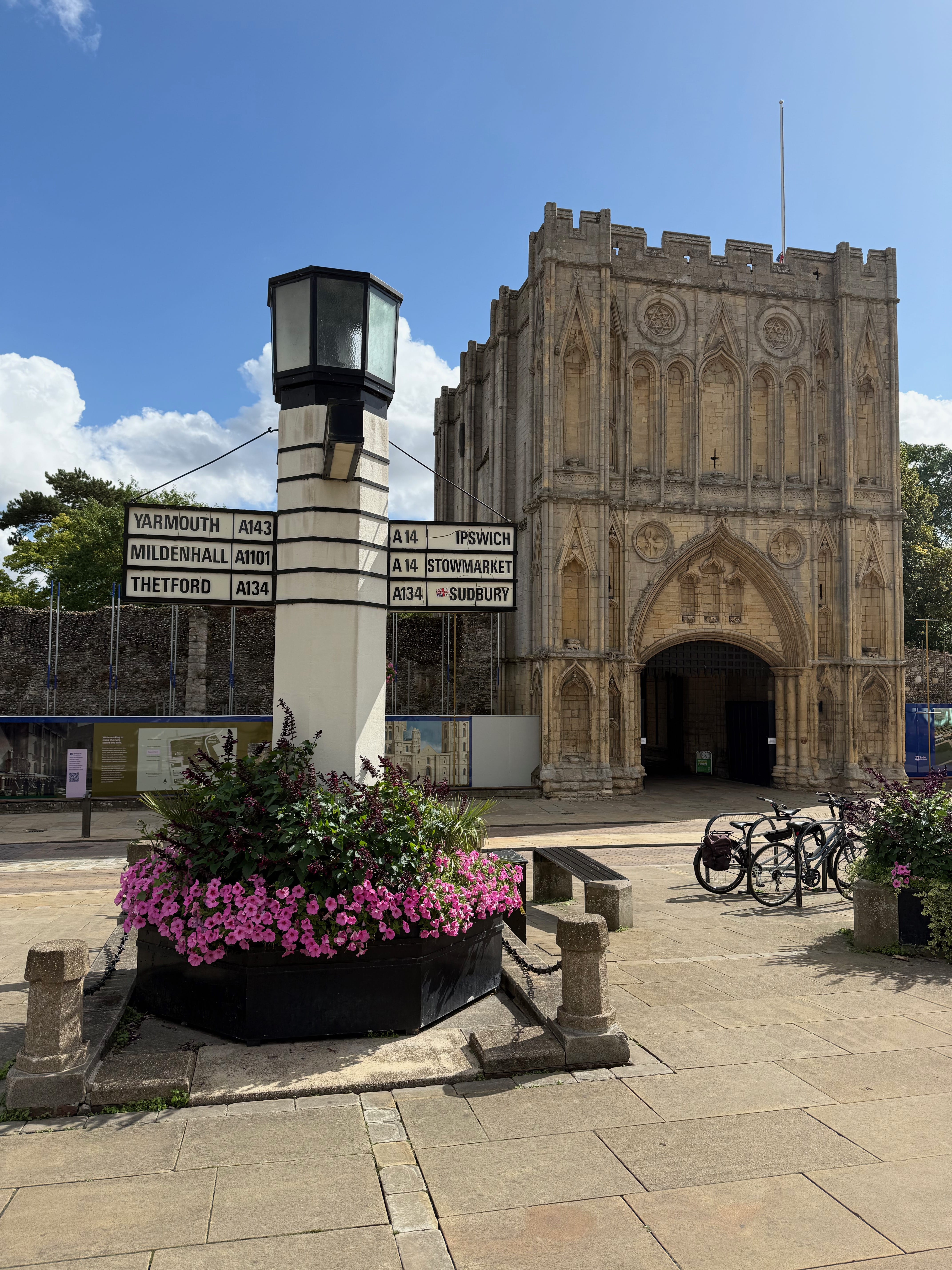
The meeting point is right by the famous “Pillar of Salt” signpost, which you can easily find by walking through the iconic Abbey Gate and into the gardens.

We happily joined the gathering group and waited for the tour to kick off.
Before we dive into how the tour went, let me share a little bit of the fascinating history behind Bury St Edmunds itself:
A LITTLE BIT ABOUT BURY ST EDMUNDS
Bury St Edmunds is a jewel in the crown of Suffolk, combining a thousand years of royal history with a vibrant modern lifestyle. Affectionately known by locals as just “Bury”, it is a historic market town famous for its magnificent monastic ruins, stunning floral displays, and thriving foodie scene.
It is also known for its rich heritage, beautiful architecture, and vibrant culture. It has a population of around 40,000 and is a popular destination for both tourists and locals.

Historical Significance of Bury St Edmunds
- Abbey Ruins: The town is famous for the ruins of the Benedictine Abbey of St Edmund, which dates back to the 11th century. It was once one of the most important religious sites in England.
- St Edmund: The town is named after St Edmund, the Saxon king and martyr, whose shrine was located here. The town celebrates his legacy with various events and festivals.

Must-See Sights in Bury St Edmunds
- The Abbey Gardens & Ruins: The remnants of the monastery sit within a multi-award-winning public park. Enter through the towering Abbey Gate to view the extensive stone ruins and immaculate lawns. These beautifully landscaped gardens are perfect for a leisurely stroll and see the remains of the Abbey. They also host events and festivals throughout the year.
- St Edmundsbury Cathedral: A stunning mix of architectural styles. The cathedral features beautiful stained glass, a unique tower, and serene atmosphere. Located right next to the ruins, this is Suffolk’s only cathedral. Its majestic millennium tower was actually completed in 2005.
- Pillar of Salt: Located on Angel Hill, this unique 1935 structure is thought to be the earliest example of an illuminated road sign in the UK and serves as a classic local meeting point.
- The Nutshell: Confirmed by the Guinness Book of Records as Britain’s smallest pub, its bar measures just 15 feet by 7 feet.
- The Market Place: A charming area filled with shops, cafes, and a bustling market, offering local produce and crafts.

Bury St Edmunds offers a delightful blend of history, culture, and modern amenities, making it a must-visit destination in Suffolk. Whether exploring its historic sites, enjoying its gardens, or tasting local food, there’s something for everyone in this charming town.
VISITING BURY ST EDMUNDS
The tour started where we were, with the guide explaining about the “Pillar of Salt”.
The Pillar of Salt
The sculpture draws its name from the biblical story of Lot’s wife, who was turned into a pillar of salt as a consequence of looking back at the destruction of Sodom and Gomorrah. It has a symbolism which serves as a reminder of the consequences of disobedience and the importance of looking forward rather than dwelling on the past.
The famous signpost was designed in 1935 by Basil Oliver, a Suffolk-born architect. He served as the official architect for the Bury St Edmunds Town Council at the time.
The sculpture is made from a variety of materials, primarily stone and metal, which give it a striking appearance. It is also one of the unusual structures that has been designated as a Grade II listed structure, like the zebra crossing on Abbey Road in London, where The Beatles crossed for their album “Abbey Road.”

We started walking on the High Street, where the guide pointed out some interesting buildings, important to the history of the town.
Lloyds Bank Building
We passed a branch of Lloyds Bank, the only one that kept an old sign showing the symbols of the time when the bank was created. The sign shows an oak tree representing the Oakes family, founders of the bank.
It also displays two pineapples, which were considerably rare and expensive at the time. They symbolise prosperity, wealth and hospitality. Located at the bottom, there is a beehive and a bee. This is a symbol of industriousness and thrift, which was the original emblem of Lloyds Bank when it was formed in 1765. It was used by the bank for over a century before being phased out in the early 20th century in favour of the famous black horse.

Moyses Hall Museum
We continued the tour, passing in front of Moyses Hall Museum, and the guide filled us with a little of the building’s history.
Moyse’s Hall is one of the oldest domestic stone buildings in England. Dating back to roughly 1180, this Grade I listed landmark has overlooked the Bury St Edmunds marketplace for nearly 900 years, transitioning from a mysterious medieval stronghold to a notorious local prison, and finally into a museum.

We visited the museum later, after the tour and after other places such as the Cathedral and St Mary’s Church.
The Nutshell
The Nutshell is a charming and historic pub located in the heart of Bury St Edmunds, Suffolk. Known for its unique character and cosy atmosphere, it holds the title of one of the smallest pubs in England.
The Nutshell was established in the late 19th century, with its roots dating back to around 1867.
The pub features traditional timber-framed construction, giving it a quaint and inviting appearance. Its interior is adorned with memorabilia, including old photos, beer mats, and other artefacts that reflect the local history.
The Nutshell is renowned for its small size, accommodating only a handful of patrons at a time. This intimate setting creates a warm and friendly environment. Its unique charm and inviting atmosphere make it a must-visit destination for anyone exploring the town.

Abbey Ruins & Gardens
We headed to the Abbey Ruins and entered via the Norman Tower and through the park, passing through the Statue of St Edmund & The Wolf, continuing until we arrived at the ruins of the Abbey.
The Abbey Ruins in Bury St Edmunds are the extensive, atmospheric remnants of the Abbey of St Edmund, which was once one of the largest, richest, and most powerful Benedictine monasteries in medieval Europe.
Today, the sprawling flint and stone rubble cores sit within the multi-award-winning Abbey Gardens, offering a unique blend of ancient history and beautifully manicured public parkland.

From Royal Shrine to Rubble Cores
- The Power of a Saint: Founded in 1020 by King Cnut, the abbey was specifically built to safeguard the shrine and miraculous remains of Saint Edmund, the martyred Anglo-Saxon King of East Anglia.
- Unparalleled Scale: At its peak in the 11th and 12th centuries, the Abbey Church stretched over 150 metres (505 feet) long, making it one of the three largest abbey churches in Europe.
- The Dissolution (1539): When King Henry VIII dissolved the monasteries, the abbey was stripped of its wealth and systematically dismantled. The pristine dressed limestone blocks were looted by locals to build houses around the town, leaving behind the massive, rugged flint-and-mortar structural cores that stand today.

What to Look Out For in Bury St Edmunds
- The Great Gate & Norman Tower: Unlike the main church, these two massive, defensive medieval gatehouses survived completely intact. The 12th-century Norman Tower still serves as the functional bell tower for the neighbouring St Edmundsbury Cathedral.

- The Crypt and High Altar: You can walk straight through the floor plan of the immense church, where stone plaques mark the original location of the high altar and the long-lost, gemstone-encrusted shrine of St Edmund.
- The Abbots’ Tombs: In 1903, famous ghost-story writer and antiquarian M.R. James used medieval manuscripts to accurately locate the lost graves of five historic abbots. These stone-lined tombs are fully exposed and visible within the Chapter House ruins.
- Houses in the Ruins: In a fascinating architectural twist, several 18th- and 19th-century houses were built directly into the massive, semi-circular stone arches of the abbey’s original West Front.

After the visit to the Abbey Ruins, the tour finished, and we went our own way. We wandered through the beautiful garden and went to the Cathedral.
St Edmundsbury Cathedral
St Edmundsbury Cathedral (formally the Cathedral Church of St James and St Edmund) stands proudly as Suffolk’s only cathedral. Located in the historic core of Bury St Edmunds, this breathtaking landmark beautifully blends a centuries-old Tudor past with remarkable modern 21st-century architectural feats.
History & Architecture
Unlike many historic English cathedrals that remained structurally fixed after the medieval era, St Edmundsbury Cathedral has been constantly growing and transforming:

- The Monastic Ground: The cathedral stands on land originally belonging to the great, sprawling 11th-century Abbey of St Edmund. After the Abbey was mostly destroyed during the Reformation, the adjacent parish church of St James stepped into prominence.

- The Tudor Nave: The main body of the church was built in 1503 by the renowned master mason John Wastell. Wastell was the architectural genius who also worked on the vaults of King’s College Chapel in Cambridge.
- Becoming a Cathedral: It was officially elevated from a parish church to a full cathedral in 1914 following the founding of the local diocese.
- The 2005 Millennium Tower: For decades, the building lacked a central tower. Between 2000 and 2005, the magnificent, 150-foot Millennium Tower was finally built using traditional stone-masonry techniques. Its brilliant, multi-coloured vaulted ceiling, painted in deep hues of red, blue, green, and gold, was completed in 2010 to crown the space.

What to See Inside
- Stained Glass & Roof Beams: The interior is renowned for its vast, brightly lit spaces, intricate historic wooden roof beams, and magnificent stained-glass art stretching across the monumental windows.

- The Font: A beautifully sculpted, ornate stone baptismal font serves as a primary visual landmark near the entrance of the nave.

We enjoyed the visit to the cathedral and confirm it is one of the attractions in “Bury” which can’t be missed.
The next visit was to St. Mary’s Church, close by.
St Mary’s Church
St Mary’s Church is widely recognised as one of the largest and most architecturally significant parish churches in England. Serving as the civic church for the town, this majestic Perpendicular Gothic structure rivals the scale of several cathedrals and stands as an integral part of the ancient Abbey of St Edmund’s history.

The Royal Burial of a French Queen
The church’s most famous historical distinction is serving as the final resting place of Mary Tudor, Queen of France.
Henry VIII’s Favourite Sister: Mary Tudor (younger daughter of King Henry VII) married King Louis XII of France. Following his death, she secretly married Charles Brandon, Duke of Suffolk.
Saved from the Reformation: When Mary died in 1533, she was originally buried in the great Abbey Church nearby. However, when Henry VIII dissolved the monastery a few years later, her body was safely moved and reinterred at St Mary’s. Her marble tomb is located in the sanctuary just north of the altar.

The Royal Window: Visitors can view the beautiful Mary Tudor Window in the South Chapel, which was gifted to the church by Queen Victoria in 1881 to honour her royal ancestor.
Architectural Treasures to Spot
- The Famous ‘Angel Roof’: Spanning the 140-foot-long nave is one of the finest medieval hammerbeam roofs in the world. It features 11 pairs of life-sized, beautifully preserved angels carved by Suffolk craftsmen over 500 years ago, depicting a holy procession.

- The Massive West Window: Measuring over 35 feet high, this is believed to be the largest west window of any parish church in Great Britain. It was paid for by local landowners in 1854 as a grand thanksgiving for a bumper harvest.

- The Baret Cadaver Monument: Inside the aisles sits the haunting 15th-century tomb of John Baret, a wealthy local cloth merchant. His effigy is carved as a gaunt cadaver, serving as a classic medieval “memento mori”.
- Suffolk Regimental Chapel: The church houses the dedicated regimental chapel, war memorials, and historical flags honouring the deep sacrifices of local service members
This is another attraction that should not be missed when visiting “Bury”.
Lunch
It was quite late, and we were hungry. We went back to the centre and looked for Wright’s Café.
Wright’s is a wildly popular, independent culinary hotspot in the heart of Bury St Edmunds town centre. Originating as a simple local market stall, it has evolved into a staple café and destination eatery celebrated for its irreverent decor, exceptional speciality coffee, and legendary “posh cheese toasties”.
We tried one of their toasts, and we gave our thumbs up to them. They were a filling and tasteful lunch.


After lunch, we decided to go to the Moyses Hall Museum as our last visit of the day.
Moyses Hall Museum
The 900-Year-Old Building, dating back to approximately 1180, Moyse’s Hall is one of the oldest domestic stone structures left standing in England. Over its exceptionally long life, the building has served many purposes:

- The Origins: Originally built at immense expense, it likely served as a wealthy merchant’s residence or a high-status lodging for the neighbouring Abbey of St Edmund.
- The Dark Eras: In 1626, it was converted into a local Workhouse and Bridewell (town prison). Cells were crammed into the upper hall, and an original heavy iron prison door is still mounted inside. It later functioned as the town’s primary police station.
- The Museum Shift: Saved from being turned into a fire station, it officially opened as a museum in May 1899. Famed Victorian architect Sir George Gilbert Scott oversaw its restoration, adding the iconic exterior clock turret.
Fascinating Exhibits to Explore
- Crime and Punishment Gallery: A favourite for families, this section features interactive “Terrible Tales” displays created alongside Terry Deary, the author of “Horrible Histories”. It holds gruesome local artefacts, including the actual murder weapon, death mask, and a book bound in the skin of William Corder from the infamous 1827 Red Barn Murder.

- World-Class Horology: The museum contains one of the finest clock and timepiece collections in the United Kingdom. Bequeathed by musician Frederic Gershom-Parkington, the gallery showcases rare longcase clocks and intricate pocket watches.

- Witchcraft & Superstition: Displays details of the region’s dark history with the Witchfinder General, Matthew Hopkins. The trials held in Bury St Edmunds actually set the legal precedents later utilised during the Salem Witch Trials in America.

- Fine Art & Treasures: The gallery proudly features works by Suffolk-born Mary Beale, widely regarded as England’s first professional female painter, alongside rare local archaeology, like a medieval locket containing a strand of hair from Mary Tudor.

Walking through those ancient Norman stone rooms really brought the town’s vibrant, sometimes dark, and utterly fascinating history to life. It was another very interesting visit.
We still walked to The Royal Theatre, but we could not visit inside as it was a Monday, and they don’t run visits on a Monday. However, we could see the building from the outside and were able to snap a few photos.

As it was already the end of the afternoon, it was time to end our visit to Bury St Edmunds.
As we wrap up our visit to Bury St Edmunds, it’s clear that this charming town offers a delightful blend of history, culture, and community spirit.
From the stunning architecture of the Abbey ruins to the cosy atmosphere of The Nutshell, every moment spent here has been filled with warmth and wonder.
Whether exploring the vibrant markets or enjoying a stroll through the Abbey Park, Bury St Edmunds leaves a lasting impression that beckons us to return.
I hope this post will give you some idea of what can be done in a day in Bury St Edmunds and will help you plan your own visit there.

HOW TO MAKE THE MOST OF YOUR VISIT TO BURY ST EDMUNDS
Below you will find a list of what to visit, where to stay and where to eat in Bury St Edmunds. I classified each place as follows:
BOLD – Visited, tried and recommended
NOT BOLD – Not visited or tried, but planning to visit or try and heard very good reviews
RED – Visited and tried but do not recommend, avoid or be cautious
*** – Excellent
** – Good
* – OK
£££ – Expensive
££ – Fair and affordable
PLEASE NOTE: Every hotel, restaurants and attractions I mention on my blogs are not sponsored reviews and we always paid the full price when visiting. We give our own opinion of the place and detail our experience, good or bad.
THINGS TO DO IN BURY ST EDMUNDS
ATTRACTIONS
1 – Tour of the Historic Centre and Abbey Ruins – ***
2 – The Pillar of Salt – ***
3 – Lloyds Bank Building – ***
4 – Moyses Hall Museum – ***
5 – The Nutshell – ***
6 – Abbey Ruins and Gardens – ***
7 – The Cathedral – ***
8 – St Mary’s Church – ***
WHERE TO STAY IN BURY ST EDMUNDS
ACCOMMODATION
1 – The Abbey Hotel & Apartments – 4* – ££
2 – The Bushel by Greene King Inns – ££
3 – Dog and Partridge by Greene King Inns – 4* – ££
4 – Charming 2 bedroom property – ££
5 – Historic Pub with a modern twist – 4* – ££
6 – Tower Cottage – Medieval Grid Townhouse – 3* – ££
If you prefer to look for your own accommodation, search and book via the below widget:
I use affiliate links such as the links above for Booking.com, Get your Guide, Viator and others. It means that if you use any of my links to make a booking, I will get a small commission from the partners I’m affiliated with without any additional cost to you. Please, use the links provided when making a booking, this is a way of supporting blogs like this so we can continue writing informative and interesting posts. I’m very thankful for that.
BEST PLACES TO EAT
RESTAURANTS
1 – Wright’s Café – *** – ££
2 – Belotta – £££
3 – Canto – ££
4 – Primavista – ££
5 – Maison Bleue – £££
6 – Edmunds Restaurant – £££
We only tried the ones in bold , the others are the result of my researches and ones that I would like to try. If you tried any of my recommendations above, please send me a message and tell me about your experience good or bad, so I can update the list accordingly. Thanks!
If you enjoyed reading this post you might also like to read:



Leave a Reply