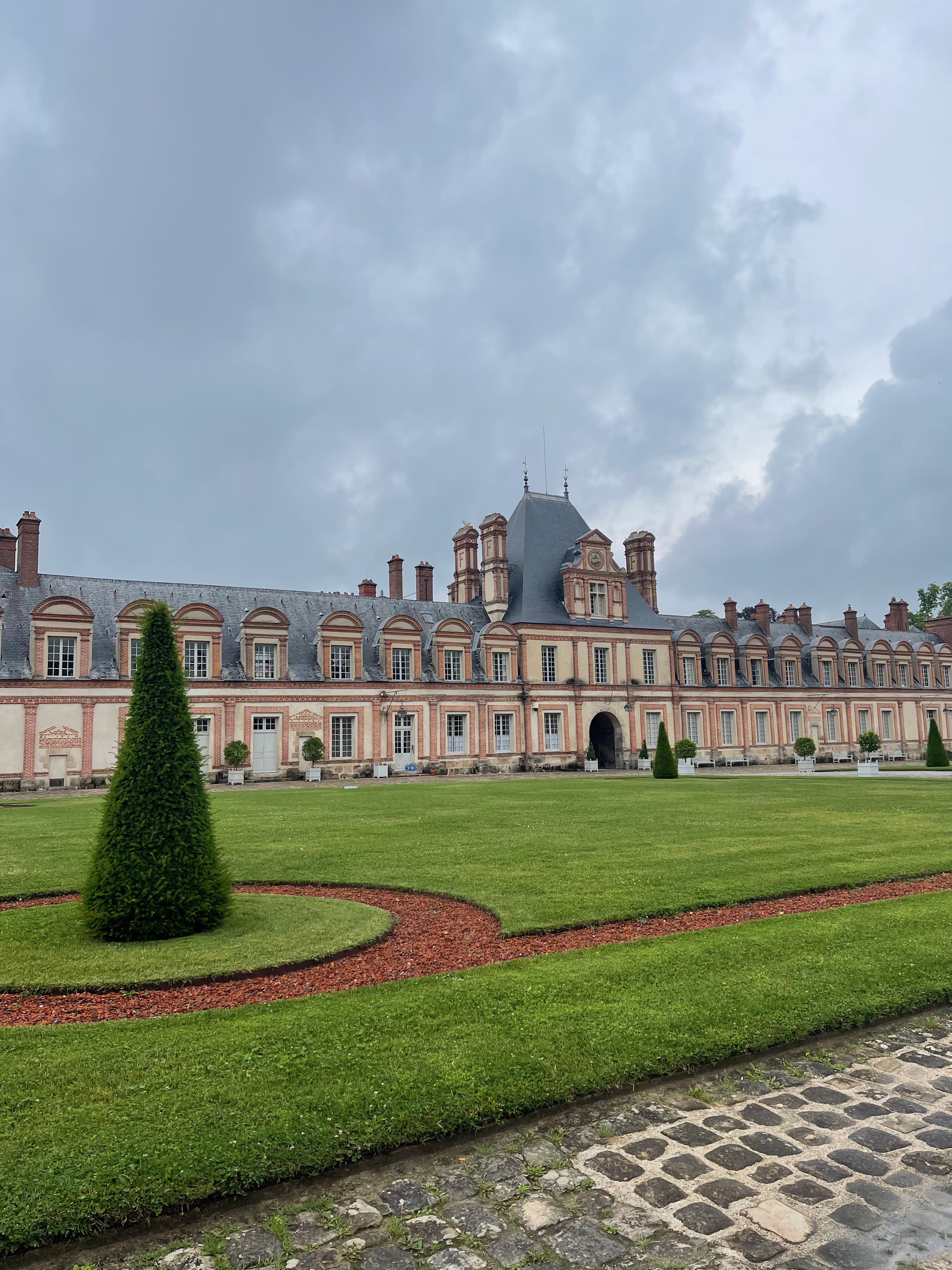

In this post, I will describe our visit to Château de Fontainebleau during our last trip to France.
Subscribe to my blog, so you will not miss any of my posts published every week.
After breakfast at Hôtel des Halles, we left Dijon at about 9 am and continued heading north. It took us about two and a half hours to get to Fontainebleau. Once we arrived, we parked at Parking Interparking Marché on Rue Grande, close enough to the Château.
It was raining, the first time we saw rain on this trip, and we had been travelling for about two weeks. Overall, we were very lucky weather-wise on this trip.
We were travelling independently in France with a car as we are confident travellers and speak a bit of the language. However, if you prefer to be part of a tour and to have everything organised for you, I advise you to book a complete tour with Tourradar.
Tourradar has different kinds of tours that will fit your time and budget. If you book it via my links you can get a discount by using this code: RoseG50.
Below is a map showing where Fontainebleau and the château is:
We bought our tickets and entered the château, but before telling you about it, let me tell you a little bit about Fontainebleau.

A LITTLE BIT ABOUT FONTAINEBLEAU
Fontainebleau is best known for its vast and opulent château, a former royal residence that played a central role in French history. Located about 55 km southeast of Paris, it has been a seat of power since the 12th century, with every French monarch from François I to Napoleon III leaving their mark on it.

Beyond the château, Fontainebleau is surrounded by one of the largest forests in France, historically used as a royal hunting ground and now a prime destination for rock climbers, hikers, and nature lovers.
The town itself, while small, has long been associated with artistic and intellectual figures, including writers, painters, and military leaders. Napoleon famously abdicated at Fontainebleau in 1814, delivering his farewell to the Old Guard in the château’s courtyard.

The name “Fontainebleau” came from an old fountain called “Fontaine Belle-Eau” located not very far from the château. It means “Spring of beautiful water”
VISITING THE CHÂTEAU
After parking the car, we strolled down Rue Grande in the direction of the château. We stopped for lunch at Paul’s, a nice chain of bakeries throughout France and there was one just in front of the château. They sell many types of pastries, sandwiches, etc. We had eaten there before, and we quite liked it. After lunch, we entered the château and started our visit.

The Château de Fontainebleau is one of France’s most historically significant palaces, often overshadowed by Versailles but arguably more important in shaping French royal culture. It was a favoured residence of monarchs for over 700 years, evolving from a medieval fortress into a grand Renaissance and classical palace.

François I (1515–1547) was the key figure in its transformation, inviting Italian artists like Rosso Fiorentino and Primaticcio to create what became the School of Fontainebleau, a major artistic movement blending French and Italian Renaissance styles.

Henri IV expanded the palace further, adding courtyards and gardens. Louis XIV, though focused on Versailles, still made renovations. But Fontainebleau’s most dramatic moment came in 1814 when Napoleon I abdicated there, giving his farewell speech to the Old Guard before going into exile in Elba. He later used the palace as a residence during his brief return in the Hundred Days.

Today, the château is a UNESCO World Heritage site, notable for its Renaissance frescoes, grand staircases and lavishly decorated apartments that reflect centuries of royal tastes. It’s also unique in that it was continuously inhabited by monarchs from the Middle Ages to the Second Empire, making it a living document of French history.

We started the visit and entered the most important rooms which I will describe below:
The Château de Fontainebleau is a labyrinth of grand apartments, ceremonial halls, and private chambers, reflecting centuries of royal taste. Here are some of its most remarkable rooms:
Galerie François I
One of the château’s masterpieces, this long corridor was decorated in the 1530s by Italian artists Rosso Fiorentino and Primaticcio, marking the birth of the School of Fontainebleau. The walls are covered in elaborate frescoes framed by intricate stuccoes, celebrating the king’s reign and classical mythology.

Salle de Bal (Ballroom)
Commissioned by Henri II in the mid-16th century, this massive hall features coffered ceilings and frescoes by Primaticcio. It was used for royal celebrations, with its grandeur meant to impress court visitors.

Throne Room (Former King’s Bedroom)
This is the only surviving throne room in France still with its original furniture. Originally François I’s bedroom, it was converted into a throne room by Napoleon I, who placed his imperial throne beneath a gilded canopy with the “N” emblem and bees, symbols of his reign.

The Chapel of the Trinity
This richly decorated chapel, completed under Louis XIII, features a painted ceiling with “trompe-l’œil” (deceiving the eye) effects and frescoes by Martin Fréminet. It hosted royal baptisms, weddings, and important ceremonies.

The Apartments of Napoleon I
Napoleon made Fontainebleau his residence and renovated several rooms, including his private study, where he drafted key laws and wrote his abdication letter in 1814. His bedroom remains furnished with his Empire-style canopy bed, reflecting his taste for neoclassicism.

Marie Antoinette’s Boudoir
This small, intimate room is one of the finest examples of the late 18th-century rococo style, with delicate wood panelling and elegant furniture. It was originally designed for Madame de Pompadour and then redecorated for Marie Antoinette.
Gallery of Diana
This 80-meter-long gallery was originally a Renaissance corridor, later redesigned under Napoleon III. Its ceiling is decorated with paintings depicting the myth of Diana, the Roman goddess of the hunt, paying tribute to Fontainebleau’s origins as a royal hunting lodge.

The Grand Staircase (Escalier en Fer-à-Cheval)
Located in the main courtyard, this dramatic horseshoe-shaped staircase was built in the 17th century. It became famous in 1814 when Napoleon stood there to bid farewell to his troops before his exile to Elba.
Each room reflects a different era of the French monarchy, making Fontainebleau an architectural and artistic timeline.

We spent about three hours visiting the palace but had to cut our visit short because we still needed to drive to Paris as our friends were waiting for us. We didn’t have time to visit other parts of the château and the gardens, but it was an excellent visit and gave us a good idea of how the royals of those days lived.


Fontainebleau seems to be a very attractive town, and I would return in future to explore more of the palace, visit the forest in a carriage and explore the centre of town. There is also another palace near Fontainebleau that is worth visiting, Château de Vaux-le-Vicomte, which I would have loved to have visited if I had the time.
The story behind Château de Vaux-le-Vicomte is that when Louis XIV was invited by his finance minister to a party at his château, the king became very envious and enraged by the beauty and luxury of it. In revenge, he imprisoned his minister for life and hired an architect, artist and gardener to create something even more beautiful: Versailles.
You can take a tour from Paris to Fontainebleau & Vaux-le-Viscomte that will last the full day. You will visit both palaces with an audio guide and it includes skip the line tickets. Book this tour HERE.
Alternatively, you can take the train from Paris and take a semi-private guided tour in English of Château de Fontainebleau only that will last 2 hours with tickets included. You can book this one HERE.

Below is a reel from The Travelling Surveyor Instagram account showing photos of Fontainebleau. Check it out and follow me on Instagram.
It took us another hour to drive to Châtillon, where we were going to stay as guests at our friend’s flat. After arriving at their place, we had dinner together but soon had to leave as we were going to “Gare du Nord” to pick up our daughter, who was arriving from London by Eurostar to spend the weekend with us.
The next day, Saturday, was the “Fête de la Musique” (The Music Day). It is an annual celebration, and everybody is encouraged to enjoy various events of music in public spaces and parks. However, they started celebrating on Friday, and the “metro” was packed with people going out to the events taking place in town.

The train arrived a bit late, but she finally arrived safe and sound, and we made the way back to Chatillon to my friend’s flat.
The next three days we would spend exploring Paris. This was not our first time in Paris, we have been there many times before. I blogged about our last trip to Paris on The Travelling Surveyor, and you can read my previous posts: Paris Day 1, Paris Day 2 and Paris Day 3.
This visit to Paris will cover some places we have visited before and some new places. I will tell you all about it in my next three posts. Until the next post!
I hope this post will give you some idea of what can be done in half a day in Fontainebleau and will help you plan your own visit there.
HOW TO MAKE THE MOST OF YOUR VISIT TO FONTAINEBLEAU
Below you will find a list of what to visit, where to stay and where to eat in Fontainebleau. I classified each place as follows:
BOLD – Visited, tried and recommended
NOT BOLD – Not visited or tried, but planning to visit or try and heard very good reviews
RED – Visited and tried but do not recommend, avoid or be cautious
*** – Excellent
** – Good
* – OK
£££ – Expensive
££ – Fair and affordable
£ – Cheap
PLEASE NOTE: Every hotel, restaurants and attractions I mention on my blogs are not sponsored reviews and we always paid the full price when visiting. We give our own opinion of the place and detail our experience, good or bad.
THINGS TO DO IN FONTAINEBLEAU
ATTRACTIONS IN FONTAINEBLEAU
1 – Château de Fontainebleau – ***
2 – The Forest of Fontainebleau
3 – The centre of Town
4 – Château de Vaux-le-Viconte
WHERE TO STAY IN FONTAINEBLEAU
ACCOMMODATION IN FONTAINEBLEAU
1 – Aigle Noir Fontainebleau MGallery – 4* – £££
2 – Mercure Château de Fontainebleau – 4* – £££
3 – Hôtel de Cavoye – 4* – £££
4 – Campanile Fontainebleau – 3* – ££
5 – Hôtel & Spa Napoléon – 4* – £££
6 – Le Richellieu Bacchus – ££
If you prefer to look for your own accommodation, search and book via the below widget:
I use affiliate links such as the links above for Booking.com, Get your Guide, Viator and others. It means that if you use any of my links to make a booking, I will get a small commission from the partners I’m affiliated with without any additional cost to you. Please, use the links provided when making a booking, this is a way of supporting blogs like this so we can continue writing informative and interesting posts. I’m very thankful for that.
BEST PLACES TO EAT IN FONTAINEBLEAU
RESTAURANTS IN FONTAINEBLEAU
1 – Paul – £ – ***
2 – ADMA – ££
3 – La Salamandre – ££
4 – L’Under – ££
5 – Le Bar’back – Steak House – ££
6 – Inalis – ££
If you tried any of my recommendations above, please send me a message and tell me about your experience good or bad, so I can update the list accordingly. Thanks!
If you enjoyed reading this post you might also like to read:
On this trip to France:
1 – Lyon – Day 1
2 – Lyon – Day 2
6 – Saint-Tropez/Port Grimaud/Grimaud
7 – Monaco
8 – Cannes
10 – Camargue and Arles
11 – Avignon
12 – Dijon
13 – Fontainebleau
14 – Paris – Day 1 – Coming Soon
15 – Paris – Day 2 – Coming Soon
16 – Paris – Day 3 – Coming Soon

Leave a Reply