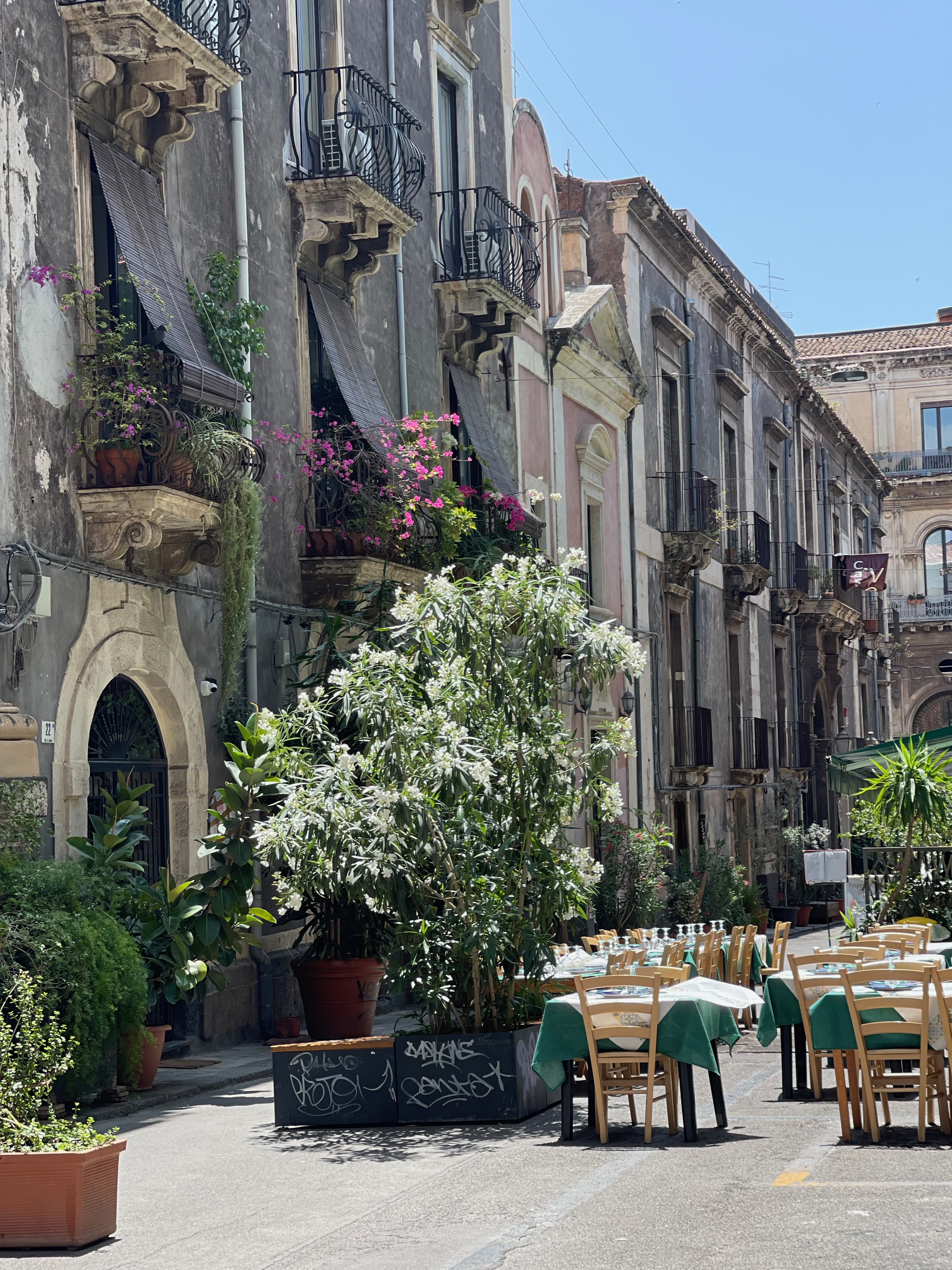

Are you planning a trip to Sicily? In doubt whether to start in Palermo or Catania, as these are the main airports? We spent 16 days travelling in Sicily and started our trip in Catania. We had two days in the city, and it was a good amount of time to see everything we wanted to on our first trip.
My previous post “Sicily – How to visit the island in 16 days” is already published and will give you a general idea about the towns we visited in Sicily. Now, I’m starting the series of posts on Sicily that will be published every week. Catania – Day 1 being the first one. Subscribe to the blog, so you will not miss any of them.
We arrived in Catania at 11 pm, very late to do anything on that day, so we just went straight to our booked B&B and started our exploration the following day.

We booked a transfer from the airport with Booking.com, which offered a very good value for money for the transfer. We were offered a transfer by our accommodation for 90 Euros, and I found it a bit too much as I knew the airport was only about 15 minutes from the centre of Catania.
I found a transfer with Booking.com for only £35 (pounds), a considerable saving from what I had been offered by our accommodation, so, booked it straight away.

Our driver was already waiting for us at the arrivals at the airport, and we had a very quick transfer in a nice, new, hybrid car driven by a polite and helpful driver. It was very worth booking this transfer.
You can go to the centre of Catania with the Alibus which will take about 30 minutes and costs only 4 Euros. We didn’t use it because we arrived too late at night and we had our suitcases, so thought it was better to be picked up by a transfer. Book it HERE.
Our Accommodation
The accommodation we booked was in the centre of Catania on Via Antonino di Sangiuliano, a charming street full of trees in bloom with pink flowers.

The accommodation was called Opera Boutique and a 3-star accommodation. It was a small building with only 4 rooms and a small communal kitchen area.
The room was very nice with all the modern comforts you expect from a holiday accommodation, air conditioning, smart TV, internet, power shower, and a balcony facing the road in a very well decorated and clean room.


The manager who communicated with me was very attentive and responded to all our questions very quickly and promptly. We never met anyone from there or even the other guests. We had a code to get access to the building and the room.

There was no breakfast provided by the accommodation, but there was a communal kitchen area where it was possible to prepare some light meals and coffee.
After a very calm and restful night, we woke up for our first day in Catania. On the same street, just a block away, there is a café called Nuts Catania, and that is where we stopped for breakfast every day.
We were travelling independently with a hired car we booked via Discover Cars, we are very confident travellers and speak a bit of the language. However, if you prefer to be part of a tour where they will take care of all your accommodation, tours, meals, and transport, you should check the tours available at Tourradar.
They have one that covers Palermo, Catania, Monreale, Cefalú, Catania, Mount Etna and Taormina. This tour can be booked HERE. If you book it via my link you can get a discount by using this code: RoseG50.

VISITING CATANIA
After breakfast, we went on our first visit of the day. From there, we walked to Teatro Massimo Bellini. We were planning to visit the theatre inside, but it can only be visited accompanied by a guide, and the next tour was only at 11 o’clock. It was a bit too early, and we didn’t want to wait, so we only looked at the theatre from the outside.
The building architecture is very beautiful, and it is in a beautiful square as well. After some photos of the theatre and the square, we continued to our next visit, the Palazzo Biscari.
If you are into classical music and opera you can’t miss this Opera Concert – Bellini and Vivaldi’s Four Seasons. It is performed by The Catania Chamber Orchestra and takes place in a prestigious church in the centre of Catania.
Below is a map showing the places we visited on Day 1 in Catania:

However, before I continue telling you about our visits, let me tell you a little bit about Catania.
A LITTLE BIT ABOUT CATANIA
Catania is Sicily’s second-largest city. It sits at the foot of Mount Etna, Europe’s most active volcano, and thrives on its energy. Rebuilt in Baroque style after a 1693 eruption, it’s a city of dark lava stone, grand architecture, and constant motion.
Piazza del Duomo anchors the city with its elephant fountain and Cathedral of Sant’Agata, while Via Etnea cuts straight towards the volcano, lined with cafés, markets, and life.

Catania mixes grit and beauty: ancient ruins beside buzzing nightlife, volcanic beaches alongside refined theatres. The local spirit is intense, loud, warm, and unapologetically Sicilian. It’s a place where danger and vitality coexist, giving the city its distinctive pulse.
DAY 1 IN CATANIA
We continued walking through the streets in the centre of Catania in the direction of Palazzo Biscari. We arrived there at 10 am, and the first tour was only at 10:30, so we decided to visit the palace on our own, without the tour.

1 – Palazzo Biscari
Palace Biscari, in Catania’s historic centre, is the city’s most opulent Baroque palace. Built after the 1693 earthquake for the Biscari princes, its construction spanned the 18th century under successive family patrons, notably Ignazio Paternò Castello, who made it a symbol of aristocratic revival amid volcanic ruin.
The façade facing Via Museo Biscari is restrained, but the interior is extravagant with frescoed halls, mirrors, stuccoes, and a grand ballroom with a curved gallery designed for concerts and receptions. Artists like Matteo Desiderato and Sebastiano Lo Monaco contributed to its decoration.

Palazzo Biscari is still privately owned by the Paternò Castello family but is open to visitors through guided tours, typically lasting about 45 minutes to an hour. Tours must usually be booked in advance, either through the palace’s website or local tour operators in Catania.
However, we were offered the tour when we bought the tickets at the entrance, so I suppose if the tour is not full it is possible to join on the day.


The visits cover the grand staircase, ballroom, frescoed halls, and terrace overlooking the sea. It also occasionally hosts concerts, exhibitions, and private events, which can limit access on certain days.

It is a very beautiful palace, and we really enjoyed our visit to this palace.
After the visit, we headed to Piazza del Duomo, which is a 5-minute walk from the palace. On the way, we stopped at “Chiesa della Badia di Sant’Agata” (Abbey Church of Saint Agata), a 17th-century church with views of Mount Etna.

2 – Chiesa della Badia di Sant’Agata
The “Chiesa della Badia di Sant’Agata” stands beside Catania’s cathedral and is one of the finest works of Giovanni Battista Vaccarini, the leading architect of Catania’s post-1693 Baroque reconstruction.
It was built between 1735 and 1767 for Benedictine nuns devoted to Saint Agatha, the city’s patron saint, it fuses elegance with theatricality.
The church’s oval plan and luminous white-stone façade contrast with the darker lava architecture around it. Its highlight is the domed terrace, accessible to visitors, offering one of the best panoramic views of Catania and Mount Etna.
Inside, the space is serene and symmetrical, an architectural expression of spiritual clarity within Baroque exuberance.

Today, it functions both as a place of worship and a major tourist site, symbolising the city’s resilience and devotion to its saint after the 1693 earthquake.
We didn’t climb to the terrace, so we didn’t see the views of Catania or Mount Etna from there. But the church is pretty and deserves a visit when visiting “Piazza del Duomo” (Duomo Square).
At the “piazza” you will encounter the “Cattedrale di Sant’Agata” (Saint Agata Cathedral). When we arrived, there was a mass going on, so we looked around the square and the famous “Fontana dell’Elefanti” (Elephant fountain). When the mass finished, we entered the cathedral.

3 – Cattedrale di Sant’Agata
The “Cattedrale di Sant’Agata” (Saint Agata Cathedral), Catania’s principal church, dominates Piazza del Duomo and embodies the city’s cycle of destruction and rebirth. Originally built over the Roman Baths of Achilles in 1091 by the Normans, it has been repeatedly rebuilt after earthquakes and eruptions, most notably after 1693.

Giovanni Battista Vaccarini’s Baroque façade with white Carrara marble framed by dark lava stone, captures this duality of purity and catastrophe. Inside lie the tombs of Aragonese kings and the composer Vincenzo Bellini.

The cathedral enshrines the relics of Saint Agatha, Catania’s patron, whose martyrdom in the 3rd century remains the emotional and civic heart of the city.

Every February, the Festival of Sant’Agata transforms the cathedral and its piazza into a vast religious procession, one of the Mediterranean’s largest, merging faith, spectacle, and civic identity.
Also, a beautiful cathedral, but the other one, the “Chiesa”, seemed more beautiful than the cathedral. Both are worth visiting, though.

When we left the cathedral, we visited the “Term Achilliane” (Roman Achillean Baths), just underneath the cathedral. The entrance to the baths is just to the right side, in front of the cathedral.

4 – Roman Achillean Baths
The “Terme Achilliane”, or “Achillean Baths”, are the underground ruins of an ancient Roman thermal complex hidden beneath Catania’s Piazza del Duomo. Dating from the 4th to 5th centuries AD, they offer a remarkable glimpse into Roman urban life beneath the city’s modern heart.
The Achillean Baths were one of the principal public bath establishments in Roman Catania, along with the “Terme dell’Indrizzo” and the “Terme della Rotonda”. The complex was a significant structure during the city’s Roman imperial age.

Much of the bath complex was destroyed or damaged by earthquakes, particularly the devastating one in 1693, and volcanic eruptions over time. The baths were gradually buried by new construction and the accumulation of lava stone and debris, only to be rediscovered during later archaeological excavations.
After the baths were abandoned, the Normans built the first Catania Cathedral on the same site in 1088, incorporating some of the Roman remains into its foundations.
A rectangular central hall is the focal point of the visit. It features vaulted ceilings supported by four pillars and once had marble flooring. You can still see fragments of the original marble and mosaic.

A series of ancient water channels and tanks, fed by the underground Amenano River, is also visible. These were part of the bath complex’s sophisticated water system.

While the baths were largely stripped of their precious materials for later construction, some original decorative elements survive. Look for traces of stucco wall decorations featuring cupids and vines on the walls and ceiling.
The site is relatively small, with most visits lasting 20 to 30 minutes, but it is an atmospheric and historically significant experience. We enjoyed and appreciated the importance of this historical site.

5 – Palazzo degli Elefanti and Palazzo dei Chierici
At “Piazza del Duomo” you will also find the “Palazzo degli Elefanti” (Elephant Palace), a 17th-century palace used as the current town hall. It was going through refurbishment when we were there, but the entrance hall was open to the public with some old carriages on shown. The rest of the building was not accessible to the public.


In front of “Palazzo degli Elefanti”, there is also “Palazzo dei Chierici”, which I think is also part of the Town Hall, as there was a wedding coming out of it when we passed. Only the entrance hall is open to the public on this one as well.

Next to this palace, you will see the Carrara marble “Fontana dell’Amenano” from 1867.
6 – Fontana dell’Amenano
The “Fontana dell’Amenano”, also known in the local dialect as “‘acqua a linzolu,” meaning “the bedsheet water,” is a prominent fountain in Catania.

The fountain was created in 1867 by the Neapolitan sculptor Tito Angelini and is made of Carrara marble. It allegorically represents the Amenano River as a young man holding a cornucopia, from which the water flows.
It is situated on the southwest corner of Piazza del Duomo, overlooking the square on one side and providing access to the famous La Pescheria fish market on the other.
The fountain is one of the few visible signs of the Amenano River, which flows mostly underground beneath Catania after a volcanic eruption in 1669.

Water pours from the cornucopia and cascades over a rounded marble basin, creating a sheet-like effect, which is why it earned its popular nickname. From the basin, the water flows into the underground river, which is visible at a lower level.
Below is a reel from the Travelling Surveyor Instagram account showing the fountain. Check it out and follow me on Instagram as well.
7 – The Fish Market “La Pescheria” and the “La Fiera” Market
From the fountain, we entered the fish market, called “La Pescheria”. We explored the fish market until the fish turned into vegetables and various other market produces.

This was “La Fiera”, a large general street market. We walked through the market and explored all the stalls. It was lunch time, and we were hungry, so we stopped at a place near the market called “Mannu Arancinu” where they sell all kinds of Arancine and only Arancine, nothing else to eat.

Arancine is a Sicilian street food made of deep-fried rice balls, the shape looks like the Brazilian “Coxinha” (however “, coxinha” is nicer!).
Arancini can have different fillings, but the most popular one is the one filled with ragú, a meat sauce made with tomatoes, peas, and the filling also includes mozzarella or another type of cheese. It is delicious, and we had a few of them for lunch, accompanied by a refreshing Aperol Spritz!
If you want to try a good selection of Sicilian food, you will enjoy this Street Food Guided Walking Tour. You will get the chance to try: Arancini, Sicilian Caponata, Fried fish cone, Catanese cipollina, cartocciata, Sicilian Cannoli and Sicilian Granita.

We enjoyed our lunch break, but after lunch quickly went to the “Monastero dei Benedettini di San Nicolò l’Arena” (Saint Nicolò Monastery) as we had tickets booked for a tour of the monastery at 1 o’clock, the only time they had a tour in English.

8 – Monastero dei Benedettini di San Nicolò l’Arena
The “Monastero dei Benedettini di San Nicolò l’Arena” in Catania is one of Europe’s largest Benedictine complexes and a UNESCO World Heritage Site, included among the “Late Baroque Towns of the Val di Noto”.

Founded in 1558 by Benedictine monks, it was expanded over centuries and rebuilt after the 1693 earthquake, blending Renaissance foundations with exuberant Sicilian Baroque and later Neoclassical elements.

The complex centres on two vast cloisters, monumental staircases, and richly decorated halls. The adjacent Church of San Nicolò l’Arena, unfinished but imposing, reflects both the monastery’s ambition and the city’s turbulent history under volcanic and seismic forces.

Since the late 20th century, the monastery has housed part of the University of Catania’s Department of Humanities, restored under architect Giancarlo De Carlo as a model of adaptive reuse.
Visitors can tour the cloisters, subterranean Roman remains, and panoramic terraces. It is an architectural palimpsest expressing Catania’s endurance and synthesis of faith, intellect, and art.

We followed the tour throughout the monastery, and we found it very useful and full of interesting information. We particularly liked the Roman remains and the Church of San Nicolò, but the whole visit was very enriching.
To book the same tour that we booked in English, book via this LINK.

After leaving the monastery, we walked to the Greek-Roman Theatre on Via Vittorio Emanuele II. It is near the monastery, just about an 8-minute walk.
9 – Greek-Roman Theatre
The Greek-Roman Theatre of Catania, located near Via Vittorio Emanuele, is one of Sicily’s most striking examples of layered antiquity. Originally built in the 5th century BCE as a Greek theatre and later expanded by the Romans in the 2nd century CE, it embodies Catania’s continuous urban evolution.

Constructed largely from local lava stone and marble, the theatre could once seat about 7,000 spectators. The semicircular “cavea” (Latin term for the tiered seating area), orchestra, and stage area follow the classical model, but much of the structure now lies embedded within later medieval and Baroque buildings—an architectural palimpsest typical of the city.

Excavations revealed Roman baths, cisterns, and mosaics beneath, showing the site’s adaptation across eras. Today, it functions as an archaeological park and occasional venue for performances, visually merging Greek form, Roman engineering, and Catania’s volcanic material culture.

Another interesting visit in Catania that should not be missed, especially if you are interested in history.
Continuing our explorations of Catania we walked to “Porta Garibaldi” as the architectural importance of the gate was appealing to me.
10 – Porta Garibaldi or Porta Ferdinandea
Porta Garibaldi, also known as Porta Ferdinandea, is one of Catania’s most distinctive Baroque monuments. Built in 1768 to celebrate the marriage of King Ferdinand IV of Bourbon and Maria Carolina of Austria, it was designed by architects Stefano Ittar and Francesco Battaglia.

Unlike typical triumphal arches, it alternates black lava stone and white limestone, creating a stark volcanic contrast symbolic of Catania itself, born from eruption and ruin. The façade features royal coats of arms, trophies, and allegorical figures, crowned by a double-headed eagle representing the Habsburgs.

Originally serving as a ceremonial gate at the city’s western edge, it opened onto the road to Palermo and functioned as a symbol of loyalty to the Bourbon crown. Today, Porta Garibaldi anchors the Piazza Palestro area and stands as a visual reminder of 18th-century Catania’s ambition to project resilience, order, and grandeur amid its volatile landscape.
From Porta Garibaldi, we continued walking in the direction of “Castello Ursino” (Ursino Castle). I knew it could be closed as I checked online, but we went anyway because we enjoy walking through towns and admiring the buildings on the way.
Upon arrival, we had confirmation that the castle was indeed closed because they were refurbishing. We just walked around the castle and admired it from the outside and took many photos.

11 – Castello Ursino
Ursino Castle is Catania’s medieval fortress, built between 1239 and 1250 by Emperor Frederick II of Hohenstaufen to consolidate imperial control over Sicily. Designed in austere Swabian style, it originally stood on a coastal cliff, surrounded by sea; after the 1669 Mount Etna eruption, lava flows reshaped the coastline, leaving the castle inland.

The structure is a square bastion with four cylindrical towers, embodying Frederick’s rational, geometric approach to military architecture, functional, symmetrical, and symbolic of imperial order. It served as a royal residence, later an Aragonese stronghold, then a prison under the Bourbons.
Since 1934, it has housed the Civic Museum of Catania, exhibiting ancient sculptures, medieval art, and Renaissance paintings. Castello Ursino thus encapsulates Catania’s history of shifting power, from empire to kingdom to modern civic identity. It is literally surrounded by the frozen remnants of volcanic destruction.

12 – Via Cruciferi
After that, we walked back to our B&B, via the “Via Cruciferi”. Via Crociferi is one of the most famous and picturesque streets in Catania, celebrated for its magnificent Sicilian Baroque architecture.
This tranquil 18th-century street was rebuilt after the devastating 1693 earthquake, and the grand, harmonious design of its palaces and churches is a prime example of the city’s UNESCO World Heritage-listed historic centre.
Within a few hundred meters stand the Church of San Benedetto with its ornate “Staircase of the Angels,” the Jesuit College, and San Giuliano, each a study in theatrical Baroque spatial rhythm.

The “Arco di San Benedetto” symbolically links the monastic buildings, forming one of Italy’s most cohesive 18th-century streetscapes.


On “Via Cruciferi” we stopped at “Chiesa di San Francesco Borgia” (SanFrancesco Borgia Church)
13 – Chiesa di San Francesco Borgia
The Church of San Francesco Borgia is a magnificent Roman Catholic church located on the picturesque Via Crociferi. A prime example of Sicilian Baroque architecture, it is part of a larger Jesuit complex rebuilt after the 1693 earthquake.

The devastating 1693 earthquake completely destroyed the Jesuit complex. The church was rebuilt on its original site between 1698 and 1736, with design work attributed to the architect Fra’ Angelo Italia.
After the Society of Jesus was expelled from the Kingdom of the Two Sicilies in 1767, the church became royal property. The Jesuits never regained ownership.
The church is primarily used for exhibitions and events, though it still holds much of its original Jesuit artwork.

You can have a guided walking tour of Catania in English that will take you to many places I describe on this post. It includes: Catania Cathedral, the Fish Market, Ursino Castle, Via Cruciferi and Piazza dell’Università
Our B&B was very close to Via Cruciferi, so soon we arrived at our room and relaxed for the rest of the afternoon.

14 – Docalquadrato
I found the restaurant “Docalquadrato” online, it was only 4 minutes walk from our B&B and had very good reviews, so, we decided to have dinner there that evening.

We arrived there at about 8 pm, and the restaurant was quite empty. We sat outside as it was a nice evening, and outside was more pleasant.
On looking at the menu, it seemed different from the menu I saw online and most of the dishes were based on fish and raw fish. I’m not a fan of raw fish, nor was my husband, so it was a bit difficult to find a dish that would please us both.
We ended up ordering a salad that seemed to be very well served with some cuts of meat on top as well.


It was a huge dish, and the salad was nice, but too much. I lose all interest in the food if it is presented in front of me in a big dish. I like to eat in small portions and serve myself for more if I want to.
Of course, I couldn’t finish it, but what I had was enough for me. I wish we had picked another restaurant with more dish options not so focused on fish and seafood. The wine we picked was very good and saved the night.
After dinner all we had to do is walk down the street and after a few minutes we were in bed, tired, but looking forward to the next day.

I hope this post will give you some idea of what can be done in a day in Catania and will help you plan your own visit there.
Don’t forget to check the tours of Sicily and other places available at Tourradar, I’m sure you will find the perfect tour that will fit your requirements and budget. If you book it via my link you can get a discount by using this code: RoseG50.
HOW TO MAKE THE MOST OF YOUR VISIT TO CATANIA
Below you will find a list of what to visit, where to stay and where to eat around Catania. I classified each place as follows:
BOLD – Visited, tried and recommended
NOT BOLD – Not visited or tried, but planning to visit or try and heard very good reviews
RED – Visited and tried but do not recommend, avoid or be cautious
*** – Excellent
** – Good
* – OK
£££ – Expensive
££ – Fair and affordable
Advertisement
£ – Cheap
PLEASE NOTE: Every hotel, restaurants and attractions I mention on my blogs are not sponsored reviews and we always paid the full price when visiting. We give our own opinion of the place and detail our experience, good or bad.
THINGS TO DO IN CATANIA – DAY 1
ATTRACTIONS
1 – Teatro Massimo – ***
2 – Palazzo Biscari – ***
3 – Chiesa della Badia di Sant’Agata – ***
4 – Cattedrale di Sant’Agata – ***
5 – Roman Aquillean Baths – ***
6 – Piazza del Duomo – ***
7 – Fontana dell’Elefanti – ***
8 – Palazzo degli Elefanti – ***
9 – Palazzo dei Chierici – ***
10 – Fontana dell’Amenano – ***
11 – La Pescheria Fish Market and La Fiera Market – ***
12 – Monasterio dei Benedettini di San Nicolò l’Arena – ***
13 – Greek-Roman Theatre – ***
14 – Porta Garibaldi – ***
15 – Castello Ursino – ***
16 – Chiesa di San Francesco Borgia – ***
17 – Via Cruciferi – ***
WHERE TO STAY
ACCOMMODATION
1 – B & B Opera Boutique – 3* – ££ – *** – (We stayed here)
2 – Etna Agathae Suite – 3* – ££
3 – B & B Palazzo Perrota – 4* – ££
4 – Il Sovrano – 4* – ££
5 – Duomo Suites & Spa – 4* £££
6 – Palazzo Sangiorgio – 5* – £££
If you prefer to look for your own accommodation, search and book via the below widget:
I use affiliate links such as the links above for Booking.com, Get your Guide, Viator and others. It means that if you use any of my links to make a booking, I will get a small commission from the partners I’m affiliated with without any additional cost to you. Please, use the links provided when making a booking, this is a way of supporting blogs like this so we can continue writing informative and interesting posts. I’m very thankful for that.
BEST PLACES TO EAT
RESTAURANTS
1 – Docalquadrato – ££ – ** – (We ate here)
2 – Ciauru – ££
3 – Concezione – £££
4 – Due Pistacchi Restaurant – £££
5 – Deliziosa – ££
6 – Ciurma – ££
We only tried the ones in bold , the others are the result of my researches and ones that I would like to try. If you tried any of my recommendations above, please send me a message and tell me about your experience good or bad, so I can update the list accordingly. Thanks!
If you prefer to be part of a tour that will take care of all your accommodation, guides, meals, and transport, don’t forget to check the tours available at Tourradar. They have one that covers Palermo, Catania, Monreale, Cefalú, Catania, Mount Etna and Taormina. This tour can be booked HERE.
If you enjoyed reading this post you might also like to read:
On this trip to Italy:
1 – Catania – Day 1
2 – Catania – Day 2
3 – Taormina
4 – Cefalú
5 – Palermo – Day 1
6 – Palermo – Day 2
8 – Punta Secca
9 – Ragusa – Day 1
10 – Ragusa – Day 2
11 – Modica
12 – Noto
13 – Siracusa – Day 1
14 – Siracusa – Day 2 – Coming soon
15 – Catania and Conclusion – Day – 3 – Coming soon
Leave a Reply