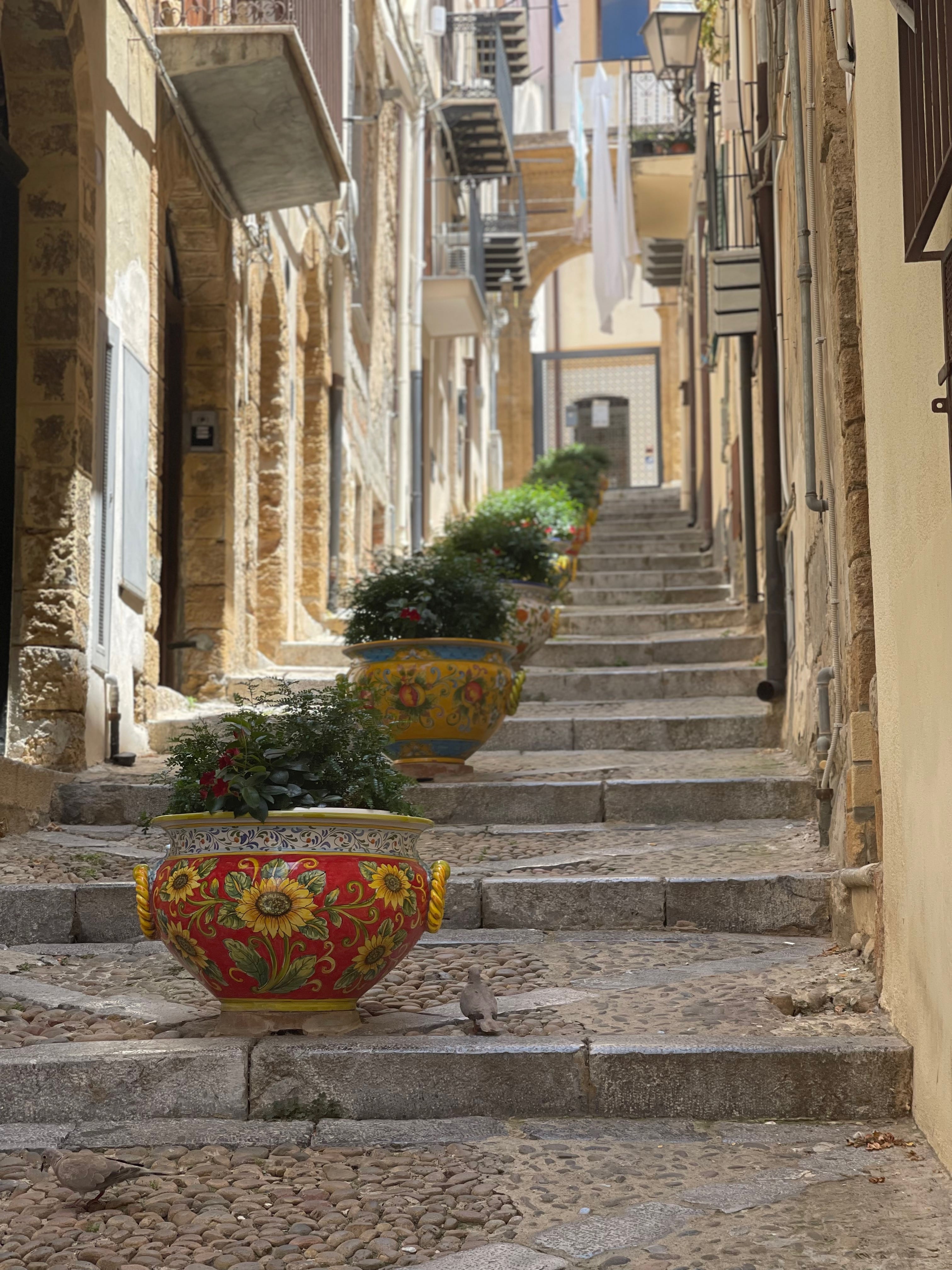

Are you planning a trip around Sicily? Are you wondering where to go and which cities to include on your trip?
Every year In June, my husband and I travel somewhere to spend his birthday travelling. Last year we travelled around France, (check out the posts on the France page). This year we went to Sicily and travelled around the island for 16 days. We’ve never been there and were looking forward to discover the magic of the island.
We arrived in Catania, rented a car (booked via Discover Cars) and after staying in Catania for 2 days, drove to Taormina, Cefalú, Palermo, Corleone, Agrigento, Punta Secca, Ragusa, Modica, Noto, Siracusa and back to Catania.
Below is a map of the places we visited in this trip to Sicily, we basically went around the island:
In this post, I will give you a general idea of each of these places, but I will tell you in detail about each one of them in a series of posts after this one. Each post will be released every week in the coming weeks about each town we visited. Make sure you subscribe to the site so you will not miss any of them.

We were travelling independently with a hired car we booked via Discover Cars, we are very confident travellers and speak a bit of the language. However, you prefer to be part of a tour that will take care of all your accommodation, tours, meals, and transport, you should check the tours available at Tourradar.
Tourradar has tours that will fit every length of time and budget. If you book any tours via my links and use code RoseG50 you will get a discount on your booking.
A LITTLE BIT ABOUT SICILY
Sicily isn’t just an island; it’s a layered civilisation adrift in the Mediterranean. Greek temples, Arab domes, Norman cathedrals, and Baroque palaces coexist here like geological strata of history. Each era left its mark, and none ever fully erased the last.

At its core, Sicily is a contradiction: rugged yet refined, ancient yet restless. Palermo, the chaotic capital, feels like a living museum of the Mediterranean with markets that smell of citrus and fried arancini, Byzantine mosaics glowing in dim churches, and a rhythm of life that ignores haste. In contrast, Taormina clings elegantly to cliffs above the Ionian Sea, and its Greek theatre framing Mount Etna in the distance is a view unchanged for millennia.

Etna itself defines the island’s energy. Europe’s most active volcano, it simultaneously destroys and nourishes, feeding the vineyards and orchards that thrive in its fertile soil. The island’s wines, especially Etna Rosso, capture that duality: volcanic, austere, and alive.

Sicily’s diversity extends to its cuisine. Centuries of conquest made the kitchen an archive of influence: Arab spices, Norman meats, Spanish sweets. You taste history in every dish, pasta alla Norma, cannoli, granita with brioche.

Beyond its beauty, Sicily tells a deeper story about resilience and adaptation. Empires came and went; the island absorbed them all. What remains is a culture that defies simplification, a place that refuses to choose between Europe and Africa, antiquity and modernity.
To visit Sicily is to walk through the ruins of the past while hearing the pulse of the present. It’s not polished, but it’s real, an island where history never stops happening.

VISITING SICILY
You will notice lots of churches and Palazzos listed in every town. Not all palaces can be visited; they are only mentioned because of their interesting architecture, worth admiring from the outside. All churches are worth entering and admiring their beautiful decorations, as they tend to be very ornate and full of interesting things to appreciate.

Let’s start with Catania, the first town we visited in Sicily.
CATANIA
Catania, Sicily’s second-largest city, sits at the foot of Mount Etna, Europe’s most active volcano, and thrives on its energy. Rebuilt in Baroque style after a 1693 eruption, it’s a city of dark lava stone, grand architecture, and constant motion. Piazza del Duomo anchors the city with its elephant fountain and Cathedral of Sant’Agata, while Via Etnea cuts straight toward the volcano, lined with cafés, markets, and life.
Catania mixes grit and beauty: ancient ruins beside buzzing nightlife, volcanic beaches alongside refined theatres. The local spirit is intense, loud, warm, and unapologetically Sicilian. It’s a place where danger and vitality coexist, giving the city its distinctive pulse.

The best things to see and do in Catania are: Teatro Massimo Bellini, Palazzo Biscari, Cathedrale di Sant’Agata, Fontana dell’Elefanti, Roman Achillean Baths, Palazzo dei Chierci, Monastero dei Benedettini di San Nicolò l’Arena, Palazzo degli Elefanti (City Hall), Chiesa della Badia de Santa Agatha, Fontana dell’Amenano, the Fish Market, Greek-Roman Theatre, Chiesa di San Nocolo l’Arena, Porta Garibaldi, Castelo Ursino, a visit to Mount Etna, Via Etnea, Piazza Universita, Basilica della Colegiata, Piazza Stesicoro, Roman Amphiteater of Catania, Chiesa di San Benedetto and Bellini Gardens.
One of the best tours in Catania – Mount Etna, trek, cable car and jeep
One of the best 5* hotels in Catania – Palazzo Sangiorgio
One of the best 3* hotels in Catania – Opera Boutique (We stayed here)
One of the best restaurants in Catania – Concezione
TAORMINA
Taormina, perched high above the Ionian Sea on Sicily’s eastern coast, is the island’s most elegant hill town. Its narrow medieval streets open to sweeping views of Mount Etna and the turquoise coast below. The ancient Greek Theatre, still used for performances, offers one of the most dramatic settings in Europe.
Known for its refined atmosphere, boutique hotels, and lush gardens, Taormina has long attracted writers, artists, and travellers seeking beauty and calm. Despite its popularity, the town retains a timeless charm, Sicilian warmth wrapped in classical grandeur. It became even more famous after the series “White Lotus” was filmed there, showing all the beautiful scenes of Taormina.

The best things to see and do in Taormina: Castello di Taormina, Chiesa Madonna della Rocca, Cable Car to Mazzaro Beach, Isola Bella, Belvedere di Via Pirandello, Villa Communale di Taormina, Piazza IX Aprile, Belvedere di Taormina, Church of San Giuseppe and San Pancrasio, Duomo di Taormina, Porta Catania, Corso Humberto, Teatro Antico di Taormina, Belvedere del Teatro, Palazzo Corvaia
One of the best tours in Taormina: Naxos: Isola Bella, Blue Grotto & Mazzarò Bay Boat Tour
One of the best 5* hotels in Taormina: San Domenico Palace (White Lotus Hotel)
One of the best 3* hotels in Taormina: Hotel Casa Adele
One of the best restaurants in Taormina: Ethica Chef’s Table and Garden
CEFALÚ
Cefalù, on Sicily’s northern coast, is a postcard-perfect town where medieval charm meets the Mediterranean. Dominated by the towering Rocca cliff and its Norman cathedral, it offers a blend of history, sea, and simplicity. Narrow cobblestone streets lead to golden beaches, lively piazzas, and centuries-old stone houses.
Once a fishing village, Cefalù now balances tourism with authenticity, morning markets, evening strolls, and the rhythm of Sicilian life intact. It’s one of the island’s most photogenic and relaxing destinations, where history and the sea constantly meet.

The best things to see and do in Cefalú: Climb the Rocca, walk in the alleys of Cefalú, Vicolo Caracciolo, Osterio Magno, Duomo di Cefalú, Bastione di Capo Marchiafava, Old harbour via Porta Pescara, Lavatoio Medievale, Cefalú Beach, Mandralisca Museum
One of the best tours of Cefalú: Walking Tour with authentic Sicilian Aperitivo
One of the best 5* hotels in Cefalú; Villa Dei Melograni Boutique Hotel
One of the best 3* hotels in Cefalú: Al Pescatore Suites
One of the best restaurants in Cefalú: Cortile Pepe (We ate here)
PALERMO
Palermo, Sicily’s vibrant capital, is a city of extremes, chaotic, beautiful, and endlessly layered with history. Founded by the Phoenicians and shaped by Arabs, Normans, and Spaniards, it reflects a fusion of cultures visible in its architecture, cuisine, and street life.
Arab-Norman cathedrals stand beside bustling markets like Ballarò and Vucciria, where voices, scents, and colours collide. Baroque palaces, crumbling facades, and modern art coexist in a dense urban fabric that feels alive at every corner.
Palermo’s essence is contradiction, decay and splendour, order and anarchy, sacred and profane, all woven into one of the Mediterranean’s most compelling cities.

Best things to see and do in Palermo: Mercato del Capo, Teatro Massimo, Palermo Cathedral, Villa Bonanno Park, Palazzo dei Normani, Capela Palatina, Chiesa di San Giovani degli Eremiti, Chiesa di San Giuseppe Cafasso, Quatro Canti, Fontana Pretoria, Chiesa di Santa Caterina d’Alessandria, Chiesa del Gesú di Casa Professa, Chiesa della Martorana, Chiesa San Cataldo, Ballaro Market, Vucciria Market, Catacombe dei Cappuccini
One of the best tours in Palermo: NO Mafia Walking Tour
One of the best 5* in Palermo: Grand Hotel Et Des Palmes
One of the best 3* in Palermo: Heritage Collection Palermo B & B (We stayed here)
One of the best restaurants in Palermo: Quattroventi
CORLEONE
Corleone is a small town in western Sicily, about 60 km south of Palermo. Historically, it was a stronghold of Arab and Norman powers, later known for its rugged, insular character shaped by geography, isolated valleys ideal for both agriculture and concealment. In the 19th and 20th centuries, Corleone became notorious as a centre of the Sicilian Mafia; several major bosses, including Luciano Leggio, Totò Riina, and Bernardo Provenzano, came from there. Despite this legacy, modern Corleone has tried to rebrand itself, promoting anti-Mafia activism and agritourism. Its name endures globally through fiction; the “Corleone” family in “The Godfather” cemented its mythic association with organised crime.

The best things to see and do in Corleone: Anti-Mafia Museum, Anti-Mafia laboratory, walk through the alleys of Corleone, Scala del Turchi (on the way to Agrigento).
One of the best tours in Corleone: From Palermo: Half-day Corleone Excursion
One of the best 4* in Corleone: Suite S. Lucia
One of the best 3* in Corleone: Chiosi Country Club
One of the best restaurants in Corleone: Taberna Casanostra
AGRIGENTO
Agrigento, on Sicily’s southern coast, was founded by Greek colonists from Gela around 580 BCE as “Akragas”. It became one of the richest cities of Magna Graecia, renowned for its grand temples, especially the remarkably preserved Temple of Concordia in the Valley of the Temples, now a UNESCO World Heritage site. After periods under Carthaginian, Roman, Byzantine, Arab, Norman, and later Bourbon rule, Agrigento declined but retained its cultural prestige.
Today, it’s a mid-sized provincial capital known for archaeology, olive and almond cultivation, and tourism. Despite economic stagnation and emigration, it remains one of southern Italy’s most symbolically important cities, embodying the continuity between ancient Greek civilisation and modern Sicilian identity.

Best things to see and do in Agrigento: Valle dei Templi
One of the best tours in Agrigento: Valley of the Temples skip-the-line guided Tour
One of the best 5* in Agrigento: Doric Eco Boutique Resort & Spa
One of the best 3* in Agrigento: Belmonte Hotel
One of the best restaurants in Agrigento: Cozzitorto Osteria Del Capitano
PUNTA SECCA
Punta Secca is a small seaside village on Sicily’s southern coast, in the province of Ragusa. It began as a fishing settlement, strategically located near the ancient port of Caucana. The village is modest, with whitewashed houses, narrow streets, and a 19th-century lighthouse that marks the southernmost tip of the island’s Ragusan coastline.
Economically, it relies on seasonal tourism and small-scale fishing. Its modern fame comes largely from television: it serves as the fictional “Marinella” in the “Inspector Montalbano” series, drawing visitors to the “Casa di Montalbano.” Culturally, it exemplifies the coastal micro-villages that preserved traditional Sicilian maritime life into the late 20th century before being transformed by media and tourism.

Best things to see and do in Punta Secca and around: Ponente Beach, Montalbano House, The Lighthouse, Castello di Donnafugata, Scicli, Donnalucata, Sampieri, Fornace Penna
One of the best tours in Punta Secca: From Catania: Southeast Sicily Inspector Montalbano Tour
One of the best 4* in Punta Secca: Dimora Storica Torre Scalambri
One of the best 3* in Punta Secca: Sempreverde Atelier B & B
One of the best restaurants in Punta Secca: Il Varo a Mare
RAGUSA
Ragusa, in southeastern Sicily, sits atop a limestone ridge divided into two parts: “Ragusa Ibla”, the historic core, and” Ragusa Superiore”. “Ragusa Ibla” was devastated by an earthquake in 1693, and it led to a new city being rebuilt, called “Ragusa Superiori” after the earthquake. The disaster led to a Baroque architectural renaissance, churches like San Giorgio and ornate palazzi made Ragusa a cornerstone of the “Late Baroque Towns of the Val di Noto,” a UNESCO World Heritage site.
Economically, Ragusa evolved from agriculture and stonework to a service-based economy with tourism, light industry, and dairy (notably “Ragusano” cheese). Its relative isolation preserved much of its local dialect, architecture, and traditions. Culturally, it’s now central to the Montalbano tourism circuit and represents one of Sicily’s best examples of post-seismic urban resilience blended with aesthetic revival.

Best things to see and do in Ragusa: Antico Mercato, Palazzo de La Rocca, Duomo di San Giorgio, Teatro Dona Fugata, Palazzo Arezzo, Portale di San Giorgio Vechio Giardino Ibleo, Porta Walter, Villa Arezzo, Chiesa delle Santissime Anime dei Purgatorio, Palazzo Cosentini, Chiesa di Santa Maria dell’Itria, Palazzo della Cancelleria, Chiesa di Santa Maria delle Scale, Ragusa viewpoint, Belvedere di Santa Lucia, Palazzo Zacco, Palazzo Bertini, Poste Italiane, Palazzo Vescovile Schinina di Sant’Ella, Cathedrale di San Giovani Battista, Ponte Nuovo, Ponte Vecchio
One of the best tours in Ragusa: Noto, Modica and Ragusa: The Baroque Tour from Catania
One of the best 5* in Ragusa: Relais Antica Badia
One of the best 4* in Ragusa: B & B Giardino Di Pietra (We stayed here)
One of the best restaurants in Ragusa: I Banchi (We ate here)
MODICA
Modica, in southeastern Sicily’s Ragusa province, lies in a deep valley carved by two rivers and framed by baroque architecture. Like Ragusa, it was rebuilt after the 1693 earthquake, becoming one of the finest examples of Sicilian Late Baroque urbanism, its twin hills crowned by San Giorgio and San Pietro churches.
Historically wealthy from agriculture and trade, Modica was also a regional administrative centre under Spanish rule. Its most distinctive legacy is culinary: “cioccolato di Modica”, a cold-processed chocolate derived from Aztec techniques transmitted via Spain, now a PDO product and cultural emblem.
Today, Modica combines tourism, artisanal food production, and heritage conservation, representing the synthesis of baroque grandeur and rustic Sicilian identity.

Best things to see and do in Modica: Chiesa di San Giovanni Evangelista, Duomo di San Giorgio, Palazzo Polara, Castelo dei Conti, Corso Humberto, Museo Casa Natale Salvatore Quasimodo, Chiesa San Nicolo Inferiore, Duomo di San Pietro, Antica Dolceria Bonajuto, Palazzo della Cultura, Palazzo Leva, Teatro Garibaldi
One of the best tours in Modica: Noto, Modica and Ragusa: The Baroque Tour from Catania
One of the best 4* in Modica: Modica Boutique Hotel
One of the best 3* in Modica: Le Magnolie Hotel
One of the best restaurants in Modica: Lorenzo Ruta
NOTO
Noto, in southeastern Sicily, is the quintessential Baroque city of the Val di Noto. Destroyed by the 1693 earthquake, it was rebuilt from scratch on a nearby hillside in an idealised late-Baroque plan with broad, axial streets, honey-coloured limestone façades, and harmonious urban symmetry. The architects Rosario Gagliardi and Vincenzo Sinatra made it a masterpiece of 18th-century urban design.
Its centrepiece is Corso Vittorio Emanuele, lined with palazzi and churches culminating in the Cathedral of San Nicolò. The decline in the 19th century preserved its integrity, and the restoration after the 1996 cathedral collapse revived interest.
Today, Noto thrives on cultural tourism, hosting art festivals and the “Infiorata” flower festival each May. It represents the apex of post-earthquake Sicilian Baroque, planned beauty born from catastrophe.

The best things to see and do in Noto: Chiesa di San Francesco d’Assisi all’Imaculata, Chiesa di Santa Chiara, Chiesa di San Salvatore, Cathedrale di San Nicolo, Palazzo Ducezio, Palazzo Landolina, Palazzo Nicolaci dei Principi di Villadorata, Chiesa di San Carlo al Corso, Teatro Comunale Tina di Lorenzo, Chiesa di San Domenico, Palazzo Castellucio, Palazzo Astuto, Palazzo Trigona, Corso Vitorio Emanuele, Porta Real, Giardini Pubblico
One of the best tours in Noto: Noto, Modica and Ragusa: The Baroque Tour from Catania
One of the best 4* in Noto: Embrace Sicily Guest House
One of the best 3* in Noto: Incanto Siciliano
One of the best restaurants in Noto: Anche gli Angeli (We ate here)
SIRACUSA
Siracusa (Syracuse), on Sicily’s southeastern coast, was one of the greatest cities of the ancient Greek world. Founded by Corinthian colonists in 734 BCE, it grew into a major power in Magna Graecia, home to tyrants like Dionysius and thinkers like Archimedes. Its prosperity was built on maritime trade, fertile hinterlands, and strategic dominance of the eastern Mediterranean.
The ancient core, Ortygia Island, still preserves Greek, Roman, Byzantine, and Baroque layers, the Temple of Apollo, the cathedral built into a former Greek temple, and medieval fortifications. Under Rome, it remained influential; later came Byzantine, Arab, Norman, and Spanish control.
Modern Siracusa is a provincial capital and UNESCO World Heritage site, mixing tourism, light industry, and a port economy. It embodies Sicily’s historical continuity, from classical rationalism to Mediterranean hybridity.

Best things to see and do in Siracusa: Porta Ubica, Templo di Apolo, Fontana di Diana, Chiesa di Santa Lucia alla Badia, Cathedrale della Navita di Maria Santissima, Mitorage Sculpture, Castelo Maniacenni Battista, Lungomare Alfeo, Fonte Aretusa, Giardino Aretusa, Foro V Emanuele II, Palazzo Storico dei mercato, Antico Mercato di Ortigia, Mercato di Ortigia, Forte San Giovannello, Chiesa di San Filippo Apostolo, Bagno Ebraico, Chiesa di San Giovanni Battista, Palazzo Impellizzeri Vianisi, Teatro di Pupi, Palazzo Bonano Landoline, Forte Vigliena, Parco Neapolis, Catacombs of San Giovanni, Santuario Madonna delle Lacrime, Basilica Santa Lucia
One of the best tours in Siracusa: Neapolis and Greek Theatre guided tour
One of the best 4* in Siracusa: Maniace Boutique Hotel Ortigia
One of the best 3* in Siracusa: Ortigia Boutique Palace
One of the best restaurants in Siracusa: Concezione
FINAL THOUGHTS
These are the towns we visited on this trip in Sicily. We found the island incredibly beautiful, and we had a brilliant time there. There is still a lot to see that we could not cover on this trip. We will certainly go back to Sicily to explore other towns such as Messina, Trapani, San Vito lo Capo and others.
I hope this post gives you inspiration to plan your own visit to Sicily, I’m sure it will not disappoint wherever you decide to go.
Below is a reel from the Travelling Surveyor Instagram account showing more photos of Sicily. Check it out and follow me on Instagram as well.
Don’t forget to check the tours of Sicily and other places available at Tourradar, I’m sure you will find the perfect tour that will fit your requirements and budget. If you book it via my link you can get a discount by using this code: RoseG50.
I have other posts on the site covering Italy mainland that are also worth checking out. Check out the Italy page as well.

I use affiliate links such as the links above for Booking.com, Get your Guide, Viator and others. It means that if you use any of my links to make a booking, I will get a small commission from the partners I’m affiliated with without any additional cost to you. Please, use the links provided when making a booking, this is a way of supporting blogs like this so we can continue writing informative and interesting posts. I’m very thankful for that.
Leave a Reply