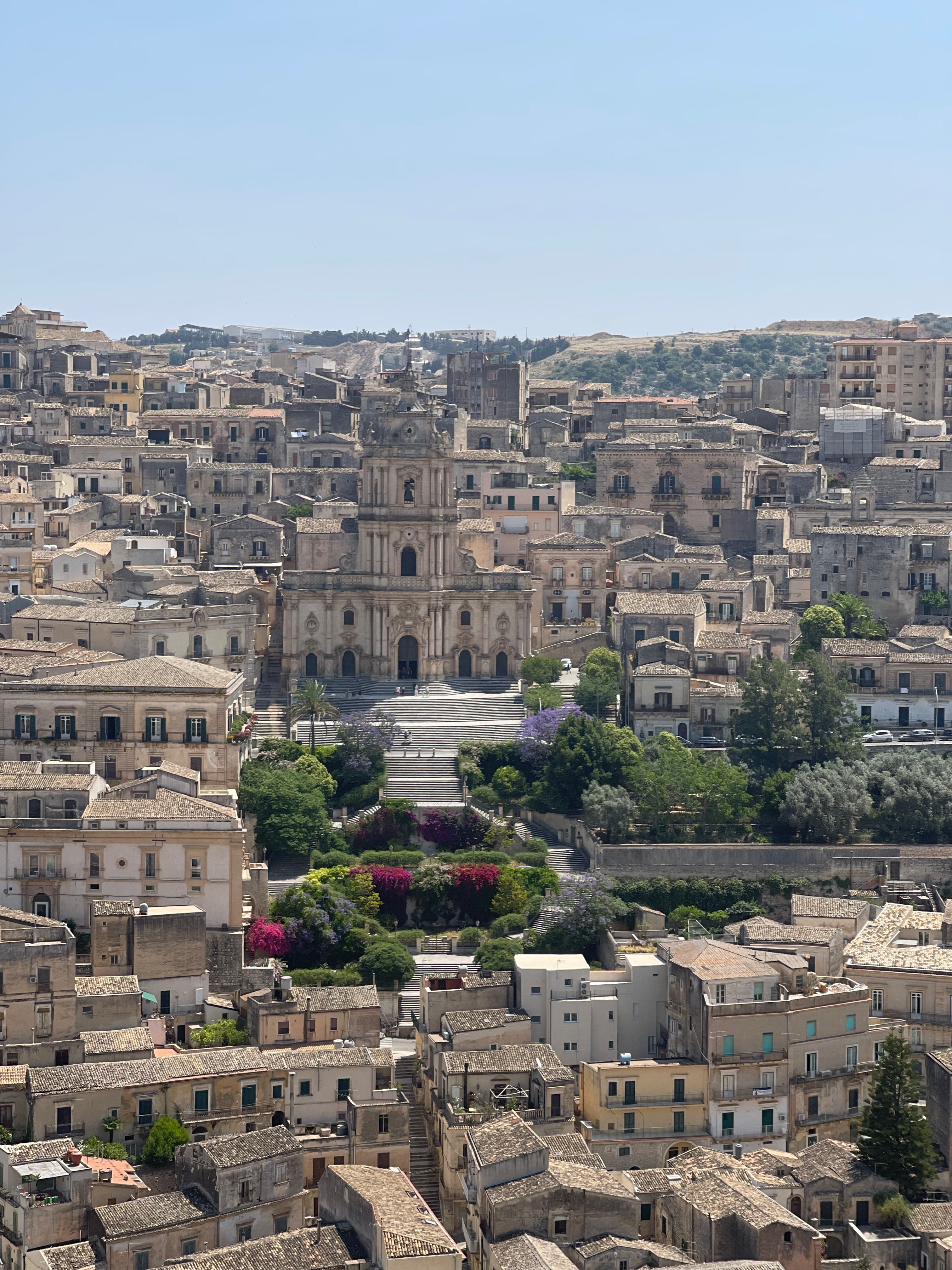

Are you planning your trip to Sicily? Would you like to know more about what to see on the island? Read on. In this post, I will tell you what we did on a day visiting Modica and what is there to see and include in your own itinerary.
On this trip we had already visited Catania, Taormina, Cefalù, Palermo, Corleone & Agrigento, Punta Secca, and Ragusa. Check these posts via the links.
Don’t forget to subscribe to the site so you will not miss any of the future posts on Sicily or other places by The Travelling Surveyor.
We were travelling independently around the island with a hired car we booked via Discover Cars, as we are confident travellers and speak a bit of the language. However, if you prefer to be part of a tour and to have everything organised for you, I advise you to book a complete tour of the island with Tourradar.
They have different kinds of tours that will fit your time and budget. If you book it via my link you can get a discount by using this code: RoseG50.
We woke up at “Giardino di Pietra B&B” after a peaceful and comfortable night. It was time to leave Ragusa, so we finished packing and went to the terrace for our last breakfast.
After breakfast, we checked out, packed the car and drove in the direction of Modica.

Modica is 16 kilometres, about 25 minutes from Ragusa, so we arrived there quite quickly. We parked in a car park near the entrance of the town. It was a free public parking on “Piazzale Falcone e Borsellino”. It is close to a bus stop with buses that take you further down into the centre, but we opted to walk down “Corso Humberto I” and start exploring.
Below is a map of the places we visited in Modica on that day:
We passed “Teatro Garibaldi” on “Corso Humberto I”. At that time, it was closed, but the theatre is a thriving cultural hub, hosting a diverse array of events such as plays, concerts, operas, ballet, musicals and other cultural activities.

TEATRO GARIBALDI
The Teatro Garibaldi is the historic and cultural heart of Modica, renowned for its elegant 19th-century architecture and vibrant schedule of live performances. Located along the central Corso Umberto I, this charming opera house is a significant landmark with a rich history.

- Origins and Name: The theatre’s initial construction began around 1815-1820 as the “Real Teatro Ferdinandeo,” combining a warehouse and a noble house. Following the unification of Italy, it was renamed in honour of the Italian national hero, Giuseppe Garibaldi.
- Inauguration and Style: The current building was largely completed and inaugurated in 1857 with a performance of Verdi’s “La Traviata”. The facade exhibits an elegant neoclassical style with Art Nouveau details, featuring a balustrade and a sculptural panel decorated with musical instruments.
- Interior Design: The interior is a smaller but beautiful reproduction of great 19th-century Italian opera houses, with a classic horseshoe shape, a wide stall, and multiple tiers of boxes. The ceiling is finely frescoed and was enhanced in 2000 by an artistic creation from Piero Guccione during restoration efforts.
- Restoration: After a period of decline and a long closure, the theatre was extensively restored and reopened in June 2000, and again after further roof damage in the early 2000s, to become fully functional once more.
MUTUA CARLO PAPA
Continuing down Corso Humberto we passed in front of the “Mutua Carlo Papa” building, where there is a statue of Carlo Papa in front.

Carlo Papa was a significant historical figure, including a writer, deputy, and mayor of Modica. He was instrumental in the unification of Italy and the establishment of public schooling in the area.
The building is associated with the historical “Mutua Carlo Papa” organisation. It is a notable landmark in the historic centre of Modica.
Close to the Carlo Papa building is another building of architectural interest. It is the “Liceo Musicale & Coreutico Giovanni Verga”. For decades, it was the primary teacher-training college in the province, producing generations of educators. It is current use is focused on music, dance and the human sciences in high school curriculum.

CHIESA DI SANTA MARIA DEL SOCCORSO
In front of the Liceo Musicale building, you will find the “Chiesa di Santa Maria del Soccorso”. This church is also known as “Nostra Signora del Soccorso”. It is a 17th-century church located in Modica, and It stands as a testament to the city’s rich history and architectural heritage.

Key Features
- Baroque Architecture: The church features a single nave and a distinctive convex facade, built in the Jesuitical Baroque style. This architectural approach is characteristic of many structures in the Val di Noto region, which is recognised as a UNESCO World Heritage site for its exquisite Late Baroque towns.
- Historical Context: While many churches in Modica were rebuilt in the Baroque style following the devastating 1693 earthquake, this church dates to the 17th century.
- Notable Artworks: The interior houses significant religious art, including:
- A marble statue of “Nostra Signora del Soccorso,” attributed to Giorgio da Milano (15th century).
- A wooden group sculpture of “Saint Peter and the paralytic” by Benedetto Civiletti (1845-1899), located in a niche in the right aisle.
The church is an important religious landmark, contributing to Modica’s reputation as the “city of a hundred churches”.
PALAZZO NAPOLINO-TOMMASI ROSSO
Just a little further down, you will find the “Palazzo Napolino-Tommasi Rosso” (also known as Palazzo Tommasi Rosso Tedeschi). It is an elegant 18th-century Baroque palace, considered a stylish example of civil architecture in the city.

Architectural Highlights
- Style: The palace is a significant testimony to late-Baroque architecture in the Val di Noto region, a UNESCO World Heritage site.
- Façade Details: Its façade is notable for a beautiful entrance portal flanked by columns from which elegant stone-carved draperies emerge from the mouths of two lions.
- Balconies: A wonderful wrought-iron balcony is situated above the portal, supported by corbels decorated with various masks and animal faces, including old men, flute players, cherubs, dolphins, and sirens.

Originally commissioned by the noble Lorefice family in the second half of the 18th century, the palace later passed to the Napolino barons and finally to the Tommasi Rosso family, who still own it today.
The building remains private property and is currently not open to the public for visits, though the exterior architecture can be admired.
DUOMO DI SAN PIETRO APOSTOLO
A few more metres down the road is the “Duomo di San Pietro”. This is the church shown from above in the opening credits of the series “Inspector Montalbano”.

The Duomo di San Pietro Apostolo (Cathedral of St. Peter), also known as the “Cattedrale di San Pietro”, is one of the most significant Baroque monuments in Modica and the entire Val di Noto region. It is recognised as a UNESCO World Heritage site and stands as an emblem of Iblean Baroque architecture and the city’s rebirth after the devastating earthquake of 1693.

Architecture and Exterior
The facade of the Duomo is a triumph of Baroque architecture, divided into two orders and richly decorated. Access is gained via a monumental and scenic staircase of approximately 50 steps, which is lined with large stone statues depicting the Twelve Apostles. The statues are arranged in dynamic and realistic poses, making the ascent a unique visual experience.

Interior and Artworks
The interior of the church, with a basilica plan and three naves, features rich decorations and a considerable number of valuable works of art. Among the masterpieces housed within are:

- Statue of St. Peter and the Paralytic: An exquisite sculptural group in wood and canvas from the 19th century, created by Benedetto Civiletti.
- Ceiling Frescoes: The central nave is characterised by round frescoes depicting the Fathers of the Church.
- Pinacoteca and Mazzara Museum: The church also hosts an art gallery (Pinacoteca) with 18th-century paintings and the Mazzara Museum, which preserves the most important artworks from the Duomo.

At the time we went to the Duomo, a mass was going on, so visits had stopped until the mass finished. So, we continued down Corso Humberto and looked for “Chiesa di Santa Maria dell’Annunziata”. We found it on Piazza Matteotti, but they were refurbishing the exterior and the church was covered in scaffolding. We entered the church and visited the interior.

CHIESA DI SANTA MARIA DELL’ANNUNZIATA
The “Chiesa di Santa Maria dell’Annunziata”, (Church of St. Mary of the Annunciation) in Modica is actually the same church as the “Chiesa Santa Maria del Carmine”, a historic 15th-century structure known for being one of the few buildings in the city that largely survived the devastating 1693 earthquake. This makes it a rare example of pre-Baroque architecture in Modica.

Architecture and History
- Gothic Survival: The church and adjoining Carmelite convent were established by 1390. Its survival of the earthquake means it retains valuable architectural traces from the late Gothic and Romanesque periods, contrasting with the dominant Baroque style of post-earthquake Modica.
- Notable Features: Key external features include a pointed portal and a magnificent rose window, characteristic elements of the Gothic style.
- Interior: Inside, a significant feature is the Cappella Celestri (Celestri Chapel), which contains late-15th-century carvings and remnants of frescoes.

On Piazza Matteotti is the starting point for taking the “Trenino Barocco Modica” (The Little Baroque Train). We decided to take the train as it takes you to other places in Modica that are a bit further to go on foot. To save time (and stamina), it is an excellent option to see other parts of town.
The train ride takes about half an hour, and besides taking you via Corso Humberto to show all the important buildings on the road, it takes you to a high viewpoint on the other side of town, where you can take beautiful photos of Modica. It also passes the high bridge called “Ponte Guerrieri (also known as the (Viadotto Guerrieri) and shown in the opening credits of the series Inspector Montalbano.
PONTE GUERRIERI
The “Ponte Guerrieri”, (Guerrieri Bridge), is a massive modern feat of engineering in Modica, Sicily, best known for being one of the earliest and highest road bridges in Italy and, at the time of its opening, reportedly the tallest road bridge in Europe.

Engineering and Design
- Structure and Height: Completed and opened to traffic in 1967 (or 1968), the viaduct extends approximately 550 meters (1,804 ft) across the deep valley carved by the “Fiumara di Modica” river. It reaches a maximum height of around 137 meters (450 ft) above the valley floor.
- Engineering Landmark: The prestressed concrete structure, supported by a series of tall, closely spaced piers, was a significant advancement in Italian infrastructure development during the post-war reconstruction period.
- Naming: The bridge is named after Emanuele Guerrieri, a local lawyer and member of parliament who was a passionate advocate for its construction.

Significance and Function
The primary function of the Ponte Guerrieri is to connect the modern suburbs of Modica, such as the Sorda and Dente districts, effectively linking the old and new parts of the city. This connection greatly facilitated urban development and modern transport in the area, as it forms part of the national road SS115 connecting Ragusa and Modica.

The bridge also offers breathtaking panoramic views of the historic, ancient city of Modica Bassa, which some describe as a “river of stone” at the bottom of the gorge. The view at night is particularly famous, often compared to a traditional Christmas nativity scene.

Back at the centre, we passed “Palazzo San Domenico”, where the Modica Town Hall is. It is a building dating back several centuries and a historical landmark in Modica. It is not open to the public for visits.

We went back to the Duomo di San Pietro to see it inside, as we couldn’t see it when we passed earlier because of a mass going on at the time.


It is a beautiful church, richly decorated and worth visiting. After the visit to the interior, we climbed the hill to see another important cathedral in Modica, the “Duomo di San Giorgio (St. Giorgio Cathedral).
DUOMO DI SAN GIORGIO
The “Duomo di San Giorgio” (St. George’s Cathedral) in Modica is one of the most iconic and magnificent examples of Sicilian Baroque architecture. It is a UNESCO World Heritage site, celebrated for its dramatic façade, monumental staircase, and rich artistic heritage.

Architecture and Exterior
- Location and Grandeur: The Duomo is prominently situated in Modica Alta and reached by a majestic 250-step staircase, enhancing its imposing visual effect and offering stunning views of the city.
- Baroque Masterpiece: Considered by many to be the masterpiece of architect Rosario Gagliardi, the façade rises over 60 meters high and features a towering central bell tower and a neoclassical dome.
- Façade Details: The convex, three-tiered façade is richly decorated with intricate carvings, columns, and statues of saints, showcasing the pinnacle of 18th-century Baroque artistry.

Interior and Artworks
The opulent interior is divided into five naves with Corinthian capitals and lavish stucco decorations.

- Polyptych: The apse features a large polyptych attributed to Bernardino Niger (1573), depicting scenes from the life of Christ and St. George.
- Statue of St. George: One chapel houses a revered equestrian statue of St. George slaying the dragon, which is carried through the town during the annual festival in April.

- Monumental Organ: The cathedral is home to a monumental pipe organ, built between 1885 and 1888 by Casimiro Allieri, with 3,000 pipes and four keyboards, still in perfect working order.
- Sundial: A rare and fascinating feature is a floor-mounted sundial in the transept, designed by mathematician Armando Perini in 1895.

We climbed the front staircase and visited the church. It is very impressive and another one that the visit shouldn’t be missed.
When out of the church, we turned left in the direction of “Castello dei Conti” (castle of the Counts). It was lunch time, and the castle was closed when we passed in front of it, so we only took some photos (the castle also had scaffolding around) and started our way down to “Museo Casa Natale Salvatore Quasimoto”.
CASTELLO DEI CONTI
The Castello dei Conti (Castle of the Counts) is a historic medieval fortress perched dramatically on a rocky spur overlooking the town of Modica. For centuries, it was the powerful political and administrative heart of the County of Modica.

History and Architecture
- Origins: Mentioned as early as 1255 in a papal bull, the castle’s construction as a residence and defensive structure was largely completed by 1350 under the Chiaramonte family.
- Feudal Power: The castle was later acquired by the Cabrera family, Counts of Modica, who gave their name to the building and ruled from here for centuries. It hosted notable figures, including Emperor Charles V in 1535.
- Decline and Restoration: The devastating earthquake of 1693 caused significant damage, and the castle was largely abandoned after the unification of Italy in 1861 when its administrative functions were moved. Painstaking restoration efforts over recent decades have partially revitalized the site for visitors.
- Structure: The castle has a rhomboidal plan and features different towers, including a high square tower (“Torre Maestra”) once used for prisoners and a lower one for sentries. Archaeological excavations have revealed traces from Hellenistic, Roman, and Arab periods.
Visiting and What to See
Today, the Castello dei Conti is an essential historical landmark offering breathtaking panoramic views of Modica Bassa (Lower Modica) and the surrounding valley, especially at sunset. While the interior can be bare due to ongoing restoration, the views from the ramparts and the sense of history are well worth the visit.
Key features include:
- “Torre dell’Orologio” (The Clock Tower): An iconic 18th-century clock tower built on the remains of a previous lookout tower destroyed in the 1693 earthquake.

- Prisons and Grottoes: Visitors can explore the remains of medieval prisons, including a deep pit for the most notorious criminals, and a series of grottoes carved into the rock.
- Museums: The site is intended to include several small museums, such as the Ethnographic Museum, a Museum of Wine and Traditions, and a permanent exhibition of traditional Sicilian puppets (Pupi).
When we arrived at the Museum Salvatore Quasimoto it was also closed, even though there was a sign at the doors of the opening times and it should have been open at that time. We just continued on our way down via the back streets of Modica and arrived in front of the “Duomo di San Pietro” again.


At that time, we were hungry and thought we had seen enough of Modica, so we walked back to Corso Humberto and made our way back to the car.


On the way back, we stopped at a chocolate shop and bought some of the famous Modica chocolate to bring back to my Mum and our kids.
We also stopped at “Osteria Ricotta & Co Mangiare di casa” on Corso Humberto I, 261, for some lunch. The place was very busy, but we managed to get a table on the terrace.
We ordered an antipasti board with local cheeses, meats and vegetables to share between us. We were so hungry and liked it so much that I forgot to take a photo of the board before we attacked it. There is a photo of my plate, though. We enjoyed our lunch very much. We find this type of lunch ideal, as we don’t feel too full afterwards.


After lunch, we took the car and travelled in the direction of Noto. On the way, we stopped at “Marina di Modica” to have a look around. After some photos, we continued, and as it was still early, we decided to visit “Villa del Tellaro”.

MARINA DI MODICA
The “Marina di Modica” is a popular seaside resort and beach area located on the southern coast of Sicily, approximately 20 kilometres (12 miles) from the historic town of Modica. Known for its wide, golden sandy beach and a lively summer atmosphere, it is a key destination for tourists and locals seeking sun, sea, and relaxation.

Beach and Atmosphere
- Sandy Shores: The resort features a large bay with a wide, sandy beach that is well-maintained and suitable for all ages, particularly families.
- Summer Vibe: While peaceful during the off-season, Marina di Modica becomes bustling and vibrant in July and August, when Italians flock to the coast for their summer holidays.
- Amenities: The beach is equipped with both free access areas and lidos (private beach clubs) offering sunbed and umbrella rentals, bars, showers, and restaurants along the seafront promenade.

Marina di Modica is particularly renowned as a prime location for water sports such as surfing and windsurfing. The consistent winds in the bay create ideal conditions for surfing, windsurfing, and kitesurfing, attracting enthusiasts from all over.
The seafront promenade is perfect for an evening stroll (passeggiata), where visitors can enjoy local cuisine at restaurants, bars, and seasonal street food stalls.

After looking around “Marina di Modica”, we pressed on and went to “Villa del Tellaro”.
VILLA TELLARO
The “Villa Tellaro” near Modica is actually the significant archaeological site known as the Villa Romana del Tellaro, an elaborate Roman villa from the 4th century AD, renowned for its exquisite, well-preserved mosaics.

The site is located in the province of Syracuse, south of Noto near the Tellaro river, not within the immediate Modica city area, but often visited as part of a tour of the region.
Key Features of Villa Romana del Tellaro
- Remarkable Mosaics: The villa’s primary attraction are its floor mosaics, which are comparable in artistic quality to those at the more famous Villa Romana del Casale in Piazza Armerina. Key mosaics include:

- The Hunt Mosaic: An expansive scene depicting Roman soldiers and servants capturing wild African animals for amphitheaters, featuring a personification of the Roman province of Mauretania.

- The Ransom of Hector: A detailed scene from the Iliad portraying figures like Odysseus and Achilles arranging the exchange of Hector’s body.

- Geometric and Bacchic Mosaics: Other areas feature intricate geometric patterns and scenes related to Bacchus, the god of wine, with satyrs and maenads.

- Historical Context: The villa was built after 350 AD and later destroyed by fire in the 5th century. The remains were discovered in 1971 beneath an 18th-century farmhouse, which has been preserved as part of the unique site, showcasing multiple layers of history.

- Location and Access: The site is a hidden gem located in a fertile agricultural area with views over the landscape and down to the sea. It is easily accessible by car from Noto.

Continuing our trip from the villa our next stop was at Marina di Noto.
MARINA DI NOTO
“Marina di Noto”, also commonly known as Lido di Noto, is the coastal counterpart to the Baroque city of Noto, located approximately 5 to 8 kilometres (3–5 miles) from the historic centre. Purpose-built in the 1930s as a beach destination, it is now a popular summer resort known for its family-friendly atmosphere and golden sands.

Beach and Sea
- The Shoreline: The main beach stretches for over a kilometre and features fine yellow sand and crystal-clear turquoise waters. It is divided by a small rocky promontory and has a gently sloping seabed, making it ideal for children and swimmers.
- Amenities: The area offers a mix of “Spiaggia Libera” (free public beach) and managed “lidos”(beach clubs) where visitors can rent sunbeds and umbrellas. Services include showers, boat rentals, and water sports equipment like kayaks.

- Awards: The beach has frequently received the “Cinque Vele” (Five Sails) award from Legambiente for its water cleanliness and quality of tourist services.
Activities and Exploration
- Promenade and Dining: A palm-lined promenade runs along the coast, offering views of the Ionian Sea. It is home to numerous cafes, pizzerias, gelato shops, and bars, such as the popular Bar Girlando.

- Nearby Coastal Gems:
- Vendicari Nature Reserve: Located just south, this reserve features pristine beaches like Calamosche and Marianelli, as well as the ruins of a historic tuna cannery (tonnara).
- Scoglio Bianco: A nearby beach characterized by white cliffs and rocky outcrops rather than traditional sand.
- Eloro: To the north, visitors can find the ancient Greek archaeological ruins of Eloro overlooking the sea.

We stopped for a drink and photos, but soon continued to Noto where we were going to stay for the night.
On arrival in Noto, we went straight to “B&B “Zioli”. The idea was to unload the car and to go to the car park recommended by the B&B, which was a bit far from it. However, our navigator took us to the most difficult route, and we ended up in the narrow streets of the town centre.
The streets became so narrow that there was a point where we thought we would need to return on reverse because the car would not fit there. With the help of locals, we were able to pass through, but that was a heart-fainting experience.
In the end, we arrived on a pedestrianised road, and we were not supposed to drive there. However, to go back was not an option, so we continued driving there, thinking we were going to get another fine for driving on a pedestrian street. We finally arrived at the B&B, left the luggage and drove to the car park. Uff! We managed to do it, and we didn’t get a fine!

After such a busy day, we opted to rest a bit in our room, and we just went out later on for dinner as we had a reservation at a restaurant called “Anche gli Angeli” (Even the Angels) at 8 pm.

We arrived at the restaurant, which looked very fancy and were sat at a table outside. There weren’t many people there, and we thought that maybe the food was not going to be very good.
My husband chose an egg dish as a starter, and I chose a fish dish. For the mains, my husband chose a pasta dish, and I chose the beef steak. I also had a dessert and a glass of Grillo wine.
The food was delicious, and we truly enjoyed all our dishes. This was at the same level as our favourites on this trip so far, Cortile Pepe in Cefalù and I Banchi in Ragusa. It was not very expensive either, and we left feeling very satisfied.


We walked through the streets of Noto at night on our way back to our B&B and had a sample of the beautiful town of Noto.


I will tell you about our day visiting Noto on the following day in my next post.
I hope this post will give you some idea of what can be done in a day in Modica and will help you plan your own visit there.
Below is a reel from the Travelling Surveyor Instagram account showing more photos of Modica. Check it out and follow me on Instagram as well.
HOW TO MAKE THE MOST YOUR VISIT TO MODICA
Below you will find a list of what to visit, where to stay and where to eat in Modica. I classified each place as follows:
BOLD – Visited, tried and recommended
NOT BOLD – Not visited or tried, but planning to visit or try and heard very good reviews
RED – Visited and tried but do not recommend, avoid or be cautious
*** – Excellent
** – Good
* – OK
£££ – Expensive
££ – Fair and affordable
PLEASE NOTE: Every hotel, restaurants and attractions I mention on my blogs are not sponsored reviews and we always paid the full price when visiting. We give our own opinion of the place and detail our experience, good or bad.
THINGS TO DO IN MODICA
ATTRACTIONS
1 – Teatro Garibaldi – ***
2 – Mutua Carlo Papa – ***
3 – Chiesa di Santa Maria del Soccorso – ***
4 – Palazzo Napolino-Tommasi Rosso – ***
5 – Duomo di San Pietro Apostolo – ***
6 – Chiesa di Santa Maria dell’Annunziata – ***
7 – Ponte Guerrieri – ***
8 – Duomo di San Giorgio – ***
9 – Castello dei Conti – ***
10 – Marina di Modica – ***
11 – Villa Tellaro – ***
12 – Marina di Noto – ***
13 – Noto – ***
WHERE TO STAY
ACCOMMODATION
1 – La Picola Locanda – 4* – ££
2 – Palazzo II Cavalliere – 4* – ££
3 – Terraza Campailla – 4* – ££
4 – San Giorgio Modica Hotel – 4* – ££
5 – B&B II Giardino Dei Mandarin – 3* – ££
6 – Candelieri19 – 3* ££
If you prefer to look for your own accommodation, search and book via the below widget:
I use affiliate links such as the links above for Booking.com, Get your Guide, Viator and others. It means that if you use any of my links to make a booking, I will get a small commission from the partners I’m affiliated with without any additional cost to you. Please, use the links provided when making a booking, this is a way of supporting blogs like this so we can continue writing informative and interesting posts. I’m very thankful for that.
BEST PLACES TO EAT
RESTAURANTS
1 – Osteria Ricotta & Co Mangiare di casa – *** – £ (We ate here)
2 – Trattoria da Fabio – ££
3 – Ristorante Lorenzo Ruta – £££
4 – 35mm Osteria di Quartiere – ££
5 – Rappa Enoteca Autentica – ££
6 – Roots – The Osteria di Accursio – £££
We only tried the ones in bold , the others are the result of my researches and ones that I would like to try. If you tried any of my recommendations above, please send me a message and tell me about your experience good or bad, so I can update the list accordingly. Thanks!
If you enjoyed reading this post you might also like to read:
On this trip to Italy:
1 – Catania – Day 1
2 – Catania – Day 2
3 – Taormina
4 – Cefalú
5 – Palermo – Day 1
6 – Palermo – Day 2
8 – Punta Secca
9 – Ragusa – Day 1
10 – Ragusa – Day 2
11 – Modica
12 – Noto
13 – Siracusa – Day 1
14 – Siracusa – Day 2 – Coming soon
15 – Catania and Conclusion – Day – 3 – Coming soon



Leave a Reply