
Welcome back! Today, we are diving into Day 3 of our Tenerife adventure.
Are you currently plotting your own Canary Islands escape but losing sleep over the itinerary? Specifically, are you staring at the map wondering, “Should I actually bother with Santa Cruz de Tenerife and San Cristóbal de La Laguna?”
The short answer is yes. The practical answer is that because these two northern towns sit right next to each other, marrying them into a single-day trip is incredibly easy.
If you have time to spare, I highly recommend giving each city its own dedicated 24 hours. However, we were on a mission to conquer Tenerife in seven days. This meant our itinerary demanded a disciplined, speed-dating approach: half a day for each.
Below is a map showing the places we visited on that day:

Subscribe to the blog, so you will not miss any of the future posts on Tenerife and other places. Tenerife Day 1 and Day 2 are already published, check them out.
Freedom vs. Fuss: How to Get Around in Santa Cruz de Tenerife
We absolutely loved the ultimate freedom of exploring Tenerife independently with our rental car. There is nothing quite like driving past dramatic volcanic landscapes while passionately butchering the lyrics to Spanish radio hits.

However, if your idea of a vacation does not involve navigating foreign roundabouts or hunting for parking, you can easily skip the logistical headache. For a completely stress-free experience where all the planning, driving, and guiding are handled for you, I highly recommend checking out TourRadar.
They offer a fantastic variety of curated tours across the Canary Islands designed to fit every budget and travel style.
You can browse their incredible itineraries right here through my exclusive link. Even better, if you book using my special code RoseG50 at checkout, you will score a great discount on your next adventure!
The Morning Launch: From Paradise to Parking
Day 3 began like all good days should: waking up to the stunning coastal views from our rented flat, “Atlantic Window,” in Playa Paraíso. After a quick breakfast and minimal faffing, we hit the road.

The drive north takes just under an hour on a straightforward, easy-to-navigate motorway. We pointed our GPS straight toward Plaza de España, which conveniently sits atop a massive underground car park. We tucked our rental car safely away into the belly of the earth, as Santa Cruz is incredibly pedestrian-friendly and best explored entirely on foot.
Before we lace up our walking shoes and dive into the colourful streets, let’s take a quick look at the history and personality of Santa Cruz de Tenerife.
A LITTLE BIT ABOUT SANTA CRUZ DE TENERIFE
A Quick History Lesson (Without the Nap) – Santa Crux de Tenerife
Santa Cruz did not start as the glamorous, bustling capital it is today. Back in the 15th century, it was a humble, dirt-poor fishing village serving the high-society aristocrats up the mountain in San Cristóbal de La Laguna.

Over the centuries, as pirate threats faded and global trade boomed, wealth shifted dramatically down to the waterfront. A major turning point occurred in 1706, when a volcanic eruption destroyed the nearby prosperous port of Garachico. Santa Cruz stepped up to handle the shipping traffic, grew exponentially, and ultimately stole the crown from La Laguna in 1833, becoming the island’s official capital.
What to See and Visit in Santa Cruz de Tenerife
- Plaza de España
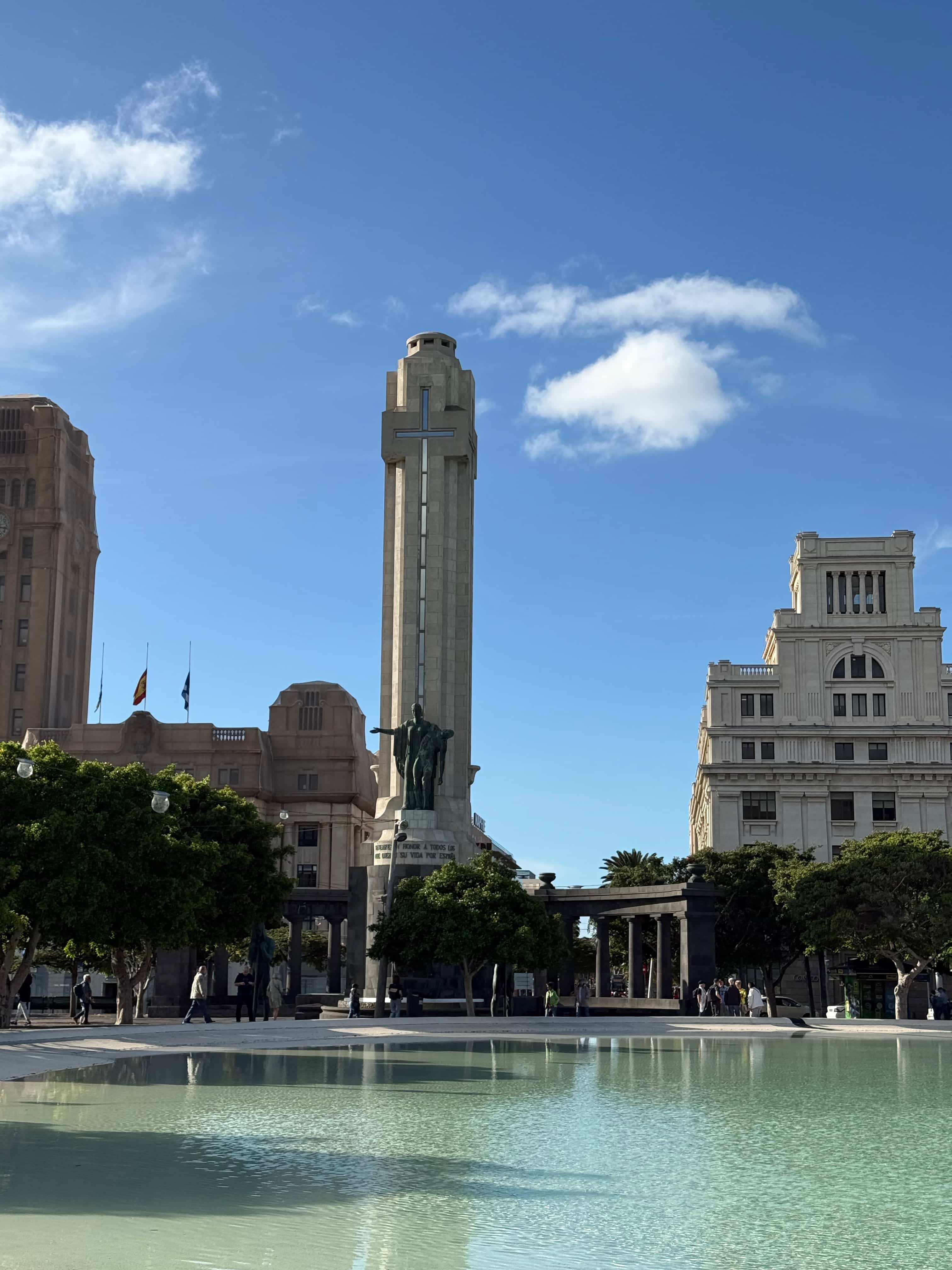
The beating heart of the city features a massive, striking lake-like fountain. If you peer closely at the fountain, you will see black lines tracing the silhouette of the historic San Cristóbal Castle, the ruins of which you can actually visit for free in an underground gallery directly beneath the square.

- Auditorio de Tenerife
Designed by architect Santiago Calatrava, this magnificent white structure looks like a cross between a giant wave and the Sydney Opera House. It stands as a striking emblem of modern Canarian architecture right on the oceanfront.

- Mercado de Nuestra Señora de África
This beautiful, neo-colonial market is the ultimate sensory playground. Head inside to check out rows of vibrant, home-grown tropical fruits, local cheeses, fresh seafood, and fiery bottles of traditional Canarian “mojo” sauce.

- MUNA (Museum of Nature and Archaeology)
Housed in an elegant old neoclassical building, this world-class museum holds the secrets of the island’s pre-colonial past. It is famously home to the oldest and best-preserved “Guanche mummies”, the indigenous people who inhabited the islands long before the Spanish arrived.

- Iglesia de Nuestra Señora de la Concepción
This is the city’s oldest church, recognisable by its iconic, towering whitewashed bell tower. Inside, it still houses the original wooden cross planted by the conquistadors in 1494.

Fun Facts
- The “Chicharreros” Nickname: Locals from Santa Cruz are proudly called “Chicharreros”. Originally, this was a savage insult thrown by the wealthy elite of La Laguna, mocking the poor coastal fishermen who could only afford to eat a cheap, tiny fish called “chicharro”. The locals embraced the insult, wore it like a badge of honour, and today the name is used proudly by everyone in the capital.
- Where Nelson Lost His Arm: In 1797, British naval hero Rear-Admiral Horatio Nelson tried to invade Santa Cruz. The local defence successfully repelled the attack, and a well-aimed cannonball shattered Nelson’s right arm, leading to its amputation. The legendary cannon responsible, named “El Tigre” (The Tiger), is still on display in the city today.
- The World’s Second-Biggest Carnival: If you think Rio de Janeiro is the only place to party, think again. The annual Carnival of Santa Cruz de Tenerife is considered the second most popular and spectacular carnival in the entire world, flooding the streets with millions of colourful feathers, sequins, and satirical street performers.
VISITING SANTA CRUZ DE TENERIFE
Our Walking Tour of Santa Cruz: The Speed-Dating Edition
Because we parked our car at Plaza de España, exploring the city entirely on foot was incredibly easy: Armed with nothing but our walking shoes and an ambitious timeline, we set out to conquer the sights of Santa Cruz.

Plaza de España
Our adventure started right above our parking spot at Plaza de España. The square is dominated by the colossal “Monumento a Los Caídos”, a towering structure surrounded by a few strategically placed statues of naked soldiers that certainly command lots of attention.

Naturally, we couldn’t resist snapping a picture of the giant “I Love Santa Cruz” sign nearby. The square also features a beautiful, lake-sized pond and a handful of architectural marvels, including one eye-catching restaurant sporting a roof so wonderfully strange it defies description.


The Historic Dash
Leaving the plaza behind, we marched south along “Calle de Bravo Murillo”. Our self-guided walking route turned into a rapid-fire cultural highlight reel as we sailed past:
- Plaza de la Iglesia
- Iglesia Matriz de Nuestra Señora de la Concepción
- MUNA (Museum of Nature and Archaeology)

Did we step inside any of them? Absolutely not. While those ancient Guanche mummies at “MUNA” sounded fascinating, doing them justice would have swallowed up a massive chunk of our day. We had miles to cover!

Mercado Nuestra Señora de África – Santa Cruz de Tenerife
If there is one absolute rule I travel by, it is this: Never skip a local market. Missing out on “Mercado Nuestra Señora de África” simply wasn’t an option.

This place is an absolute gem. The beautiful, arched architecture alone makes it worth the detour, but the real magic is inside.

We spent an hour completely mesmerised by the stalls, vibrant produce, and unique local merchandise. It was a sensory playground, but our tight itinerary eventually tapped us on the shoulder, reminding us it was time to move on.

The Modern Waterfront – Santa Cruz de Tenerife
Next, we marched toward the ocean to greet the legendary “Auditorio de Tenerife”. Up close, the architecture is absolutely striking. The sweeping plaza surrounding it is perfectly laid out for ocean gazing, people watching, and questioning how an engineered wave of concrete stays standing.

Just a stone’s throw away sits the historic “Castillo de San Juan Bautista” and the nearby “Parque Marítimo César Manrique”. We also spotted the famous “Palmetum”, a botanical garden containing just about every species of palm tree known to humanity.

We explored the rugged castle grounds and the edges of the park, but passed on entering the “Palmetum,” partly due to time and partly because our feet were starting to stage a protest, though we still had a lot of ground to cover in Santa Cruz.

The Loop Back
To complete our grand loop, we bypassed the main tourist paths and headed back into the city centre via the back roads.

Our urban hike took us across “Puente Galcerán”, right past the vibrant “Casa del Carnaval” (where the island’s party spirit lives), and straight into the charming, tiled oasis of “Plaza de los Patos”, (Duck Square).

The “Plaza de los Patos” (officially named “Plaza 25 de Julio”) is widely considered the most charming little square in Santa Cruz de Tenerife.

Tucked away inland from the bustling waterfront, it acts as a peaceful, shaded oasis perfect for some rest. We took some time to admire the beautiful tiled ceramic benches and catch our breath.

From there, we let our inner shoppers guide us, meandering through the bustling pedestrian shopping streets of the city centre until we magically popped back out where we started at “Plaza de España”.

The entire walking loop took just over an hour of brisk, satisfying exploration, leaving us thoroughly impressed, slightly out of breath, and ready for our next stop, “San Cristóbal de la Laguna”.
You can take a guided bike tour of Santa Cruz that will take you to all the places I mention here and more. At the end you savour an authentic Canarian tapas. Book this tour HERE.

The drive to San Cristóbal de la Laguna was about 15 minutes.
A LITTLE BIT ABOUT SAN CRISTÓBAN DE LA LAGUNA
San Cristóbal de La Laguna – Stepping into a Time Machine
After our whirlwind morning in Santa Cruz, we hopped back into the rental car for a quick, fifteen-minute drive up the mountain to “San Cristóbal de La Laguna” (known simply as “La Laguna” to the locals).

If Santa Cruz is the island’s modern, energetic heart, La Laguna is its sophisticated, historic soul. The contrast is instant. You leave behind the coastal breeze and step straight into a cooler, misty, cobblestone dreamland.

A Quick History Lesson: The Original Capital
La Laguna was founded in 1496 by the conqueror Alonso Fernández de Lugo and served as the original capital of Tenerife until 1833.
The founders deliberately built the city up in the valley, away from the coast, to keep it safe from the rampant pirate raids plaguing the Atlantic at the time. It was the undisputed intellectual, religious, and political powerhouse of the Canary Islands.

In 1999, UNESCO declared San Cristóbal de La Laguna a World Heritage Site, and for a very fascinating reason: it was the world’s first unfortified, planned colonial city.
The Blueprint for the Americas: Architecture & Grid Layout
When you stroll through the town centre, you might get a sudden wave of “dejá vu” if you have ever travelled to Latin America. That is not a coincidence!

La Laguna was built using a strict, geometry-based grid layout instead of the messy, winding streets typical of medieval Europe. The Spanish liked this clean layout so much they used it as the exact architectural blueprint for building colonial cities in the New World, including Havana (Cuba), Cartagena (Colombia), and Old San Juan (Puerto Rico).
As you walk the pedestrianised streets, keep an eye out for:
- The Traditional Canarian Patios: Peek through the heavy wooden front doors of the grand mansions. Inside, you will glimpse breathtaking hidden courtyards featuring lush plants and intricate balconies carved from fragrant Canary Island pine “Pino Canario”.
- The Vibrant Façades: The streets are an absolute pastel paradise, lined with impeccably preserved 15th- to 18th-century pastel pink, deep red, and bright blue aristocratic homes.

What to See and Visit
The historic centre is beautifully compact and entirely pedestrian-friendly. Here is what you cannot miss:
Plaza del Adelantado
The beautiful town square where it all began. It is surrounded by historic buildings, shaded by centuries-old trees, and features an elegant marble fountain dating back to 1843.
Catedral de San Cristóbal de La laguna
The town’s striking cathedral. While it looks ancient from the outside, the main concrete dome was actually rebuilt in the 20th century. It is the final resting place of the city’s founder, Alonso Fernández de Lugo.

Iglesia de la Concepción
You can spot its iconic, seven-story stone bell tower from almost anywhere in the city. For a couple of euros, you can climb to the top for the absolute best panoramic view of La Laguna’s tiled rooftops and the surrounding mountains.

Palacio Salazar
Stunning example of grand, traditional palatial homes. Walk right into its courtyard to admire the breathtaking woodwork and historic architecture.

Fun Facts
- The Mystery of the Disappearing Lake
The city’s name literally translates to “Saint Christopher of the Lagoon.” But if you look around today, you will notice a distinct lack of water. When the city was founded, a massive natural lake stood right next to it. Over the centuries, due to agricultural drainage and urban expansion, the lagoon completely dried up. Today, the only time you see the “lagoon” is when a heavy rainstorm hits, and the streets temporarily remember their aquatic roots.
- The Incorrupt Body of the Little Servant
Inside the “Convento de Santa Catalina de Siena” lies one of the island’s most legendary mysteries. The convent houses the miraculously preserved, incorrupt body of Sister María de León Bello y Delgado (affectionately known as “La Siervita”). She passed away in 1731, but her body has remained completely intact without mummification. Once a year, on February 15th, the convent opens its doors, and thousands of pilgrims queue up to catch a glimpse of her glass coffin.
- A University Town with a Ghostly Vibe
La Laguna is home to the oldest university in the Canary Islands, injecting a lively, youthful student energy into these centuries-old streets. It also gives the city a brilliant café culture. However, because of its high altitude, a thick, eerie fog locally called “la harina” (the flour) often rolls in out of nowhere in the late afternoon, instantly transforming the vibrant student hub into an atmospheric, gothic ghost town.

VISITING LA LAGUNA
With our morning in Santa Cruz wrapped up, we headed up the mountain to La Laguna. What followed was a masterclass in holiday improvisation, featuring the hunt for parking, a test of hunger-fuelled patience, and a city that seemingly vanished into thin air.

The Great Parking Hunt
Finding a parking space in the centre of La Laguna quickly turned into an Olympic sport, and we weren’t winning. After circling the historic core to no avail, we were forced to drive deeper and deeper into the suburban residential areas. By the time we finally spotted an empty curb, we were so far out we practically needed a second GPS just to find our way back to the centre on foot. Consider it a mandatory warm-up for the walking tour.

Lunch at La Casa del Mago: A Theatrical Test of Patience
By the time we made it back to civilisation, the hunger was real. La Laguna is famous for its “Guachinches”, traditional, rustic establishments serving local food and homegrown wine. We were very keen to try one. Spotting “La Casa del Mago” (Guachinche Moderno) on Calle Marqués de Celada, we decided to dive in.

The experience was a textbook definition of mixed signals:
- The Service: Abysmally slow. There was exactly one heroic, albeit visibly stressed, server managing a reasonably busy dining room. Ordering a drink felt like an epoch-long event.
- The Food: Surprisingly swift! Once our order was finally taken, the kitchen delivered the goods fast.
We ordered a spread of “croquetas”, “Tomate Aliñado” (tomatoes beautifully stuffed with tuna), and “Huevos Rotos con Serrano y Cebolla Caramelizada” (broken eggs with rich Serrano ham and sweet caramelised onions). The presentation was incredibly theatrical, and the flavours were absolutely spot on. If you go, go for the food; just make sure you aren’t in a rush.


Surviving the Siesta Silence
Full and happy, we set off toward the heart of the old town. Our first stops were “Iglesia de la Concepción” and “Plaza de la Concepción”, before we continued down the historic streets to admire the beautiful traditional balconies and heavy hardwood doors.

We also passed the impressive “Instituto de Canarias” and the neighbouring “Iglesia y Ex-Convento de San Agustín”.

As we walked, a bizarre realisation set in: the streets were completely deserted. No shops open, no locals walking around, just an eerie silence. It didn’t take long to realise we had rolled into town right at the peak of “Siesta”.

Undeterred by the shutdown, we kept exploring, passing the “Iglesia Nuestra Señora De Los Dolores” before arriving at “Palacio Salazar”. Thankfully, the doors to this mid-17th-century masterpiece were wide open.

We stepped inside to admire its stunning patio and gaze up at its magnificent Canarian Baroque façade, which is crafted from striking blue stonework and topped with rather curious gargoyles.


A Tale of Two Historic Houses
Next on our quiet route was the “Antigua Casa de Los Jesuitas” (Old House of the Jesuits). Built between 1733 and 1737, this building served as a home for the Society of Jesus until King Carlos III abruptly expelled them from the islands in 1767. Today, it guards the island’s historical archives and a library, though it was firmly closed when we passed by.

Right next door sits the “Fundación Cristino de Vera-Espacio Cultural CajaCanarias”, housed inside the historic “Palacio Lercaro”. Built between 1593 and 1599 by a wealthy Italian Genoese merchant named Francisco Lercaro, the building is a beautiful hybrid, maintaining a traditional Canarian structure while sporting distinct flashes of Italian architecture. It functions as a museum today, and while we skipped the exhibition halls, we did manage to sneak inside to marvel at its gorgeous central patio.

Moving On: Cavalry Houses and Closed Cathedrals
Right next to the cultural centre, we stopped to admire “Casa Montañes”. Built in 1746 by Francisco Montañes, who held the wonderfully dramatic title of Sergeant Major of Cavalry, this grand house boasts a magnificent patio famed for its masterfully carved woodwork and peculiar animal-shaped (zoomorphic) drain motifs. Today, it serves a much more bureaucratic purpose, housing the Consultative Council of the Government of the Canary Islands.

Continuing our stroll through the quiet streets, we eventually arrived at the grand “Catedral de San Cristóbal de La Laguna”. In keeping with the theme of our afternoon, it was firmly closed.
If you go to La Laguna in a particular busy time of the year and if you want to visit the cathedral it is worth to pre-book the ticket in advance. You can do that HERE.

Having officially hit our limit with locked doors, we decided it was time to pivot to something guaranteed to be open: a local café. We found a charming little spot nearby, ordered a round of coffee, and finally gave our hard-working feet a well-deserved rest.
There is a cultural guided tour where you will learn about the mysteries of La Laguna, will visit charming spots with a sweet treat at the end. Book this tour HERE.

Heading South and Repeating a Triumph
Freshly caffeinated, we began the long trek back to our far-flung residential parking spot. Once reunited with the rental car, we hit the highway and made the straightforward one-hour drive back down south to our home base in Playa Paraíso.

With no set dinner plans, we opted for the ultimate vacation luxury: laziness. We headed straight downstairs to Méson Bistro, the exact same spot we had eaten at on night one. Dinner had been so phenomenal the first time around that we simply couldn’t resist a sequel.


The evening weather was absolutely perfect, so we snagged an outdoor table to soak up the mild night air. Since our late-afternoon theatrical lunch was still keeping us reasonably full, we kept things light and ordered a spread of tapas:
- Chilled, refreshing “gazpacho”
- Local cheese drizzled with traditional Canarian “mojo” sauce
- Sizzling, aromatic garlic prawns
Every single dish was utterly delicious and deceptively filling. Naturally, skipping a pitcher of fresh “sangria” to wash it all down would have been a holiday crime, so we made sure to indulge.

It was the perfect end to another fabulous day of independent exploration. We headed back up to our “Atlantic Window” flat for another peaceful night’s sleep, thoroughly enchanted by the island.

Coming Up Next: Heading to the Volcano!
Day 4 is going to be an absolute blockbuster. We are trading the historic colonial towns for dramatic, otherworldly landscapes as we spend the morning exploring Teide National Park and getting up close and personal with Spain’s highest volcanic peak.

Trust me, you won’t want to miss the next post; make sure to check back to see all the incredible lunar landscapes!
I hope this post will give you some idea of what can be done in a day in Tenerife and will help you plan your own visit there.
HOW TO MAKE THE MOST OF YOUR VISIT TO SANTA CRUZ DE TENERIFE AND SAN CRISTÓBAN DE LA LAGUNA
Below you will find a list of what to visit, where to stay and where to eat in Santa Cruz de Tenerife and San Cristóban de La Laguna. I classified each place as follows:
BOLD – Visited, tried and recommended
NOT BOLD – Not visited or tried, but planning to visit or try and heard very good reviews
RED – Visited and tried but do not recommend, avoid or be cautious
*** – Excellent
** – Good
* – OK
£££ – Expensive
££ – Fair and affordable
PLEASE NOTE: Every hotel, restaurants and attractions I mention on my blogs are not sponsored reviews and we always paid the full price when visiting. We give our own opinion of the place and detail our experience, good or bad.
THINGS TO DO
ATTRACTIONS
SANTA CRUZ DE TENERIFE
1 – Plaza de España – ***
2 – Auditorio de Tenerife – ***
3 – Mercado de Nuestra Señora de Africa – ***
4 – MUNA – Museum of Nature and Archaelogy
5 – Iglesia de Nuestra Señora de la Concepción
6 – Castillo de San Juan Bautista
7 – Parque Marítimo César Manrique – ***
8 – Palmetum
9 – Plaza de los Patos – ***
10 – Shopping Streets – ***
SAN CRISTÓBAN DE LA LAGUNA
1 – Plaza del Adelantado
2 – Catedral de San Cristóban de La Laguna – ***
3 – Iglesia de la Concepción – ***
4 – Palacio Salazar – ***
5 – Antica Casa de Los Jesuitas – ****
6 – Palacio Larcaro – ***
7 – Casa Montañes – ***
WHERE TO STAY
ACCOMMODATION
1 – Hotel Emblemático Hi Suites – Santa Cruz – £££
2 – Hotel Colon Rambia – 4* – Santa Cruz – £££
3 – The Park Suites by Ires Lar – 4* – Santa Cruz – £££
4 – La Laguna Gran Hotel – 4* – La Laguna – £££
5 – Nava Suites – La Laguna – ££
6 – Laguna Cool Living – La Laguna – ££
If you prefer to look for your own accommodation, search and book via the below widget:
I use affiliate links such as the links above for Booking.com, Get your Guide, Viator and others. It means that if you use any of my links to make a booking, I will get a small commission from the partners I’m affiliated with without any additional cost to you. Please, use the links provided when making a booking, this is a way of supporting blogs like this so we can continue writing informative and interesting posts. I’m very thankful for that.
BEST PLACES TO EAT
RESTAURANTS
1 – Ethereal by Pedro Nel – Santa Cruz – £££
2 – El Rincón del Boca a Boca – Santa Cruz – ££
3 – Taberna Ramón – Santa Cruz – ££
4 – La Casa del Mago (Guachinche Moderno) – La Laguna – ££ – ** – (We ate here)
5 – Restaurante Maquila – La Laguna – ££
6 – Guachinche Casa Aguere – La Laguna – ££
We only tried the ones in bold , the others are the result of my researches and ones that I would like to try. If you tried any of my recommendations above, please send me a message and tell me about your experience good or bad, so I can update the list accordingly. Thanks!
If you enjoyed reading this post you might also like to read:

Leave a Reply