
Day two of our trip happened to be my husband’s birthday. As he is a massive history aficionado, I knew the ultimate birthday treat would be spending the day exploring Mount Vesuvius and Pompeii, even though it was a repeat visit for both of us.

I remembered how much he loved it the first time around, so I booked a full-day tour through GetYourGuide. The itinerary was ideal: a morning trip from Naples to Vesuvius, followed by an afternoon in Pompeii with the added bonus of an expert guide to lead us straight to the highlights. (If you fancy doing the exact same trip, you can book it HERE.)
Going with an organised tour was purely a strategic move to save time and avoid transport headaches. After researching the local routes, I was convinced that relying on public transport would eat up far too much of our schedule. With just one day to conquer both iconic sites, booking the tour was an absolute no-brainer.
Our morning kicked off with a lovely breakfast at our hotel, B&B Hotel Napoli on Piazza Garibaldi. Afterwards, our commute to the meeting point couldn’t have been easier; we simply strolled across the square to Starhotels, right next to the station, to meet our group at 9:50 am. (By the way, while waiting for our tour, I entered Starhotels to use the facilities and it looked like a very nice hotel. Worth checking out, a bit of an upgrade from our hotel B&B Hotel Napoli).
Once everyone had arrived, we hopped onto a minibus that took us straight up to Mount Vesuvius. Upon arrival, we were given free rein to tackle the summit and explore the crater at our own pace.
Now, the hike itself isn’t overly technical, though I took it very slowly and made plenty of strategic stops along the way. Inclines and steps are simply not my friends. My husband, on the other hand, has zero patience for my leisurely stroll; he dashed ahead like a mountain goat, leaving us to reunite at the summit whenever I eventually made it.

Standing at the top of the very volcano that once buried Pompeii and Herculaneum is genuinely awe-inspiring. Even on our second visit, the sheer scale of it is unforgettable, and we both loved every minute of it.

Before we head down to the ruins, let’s dive into a bit of the history behind this famous peak:
A LITTLE BIT ABOUT MOUNT VESUVIUS
Dominating the skyline over the Bay of Naples, Mount Vesuvius is easily one of the most famous, and infamous, volcanoes on the planet. While it looks serene enough as you approach it on a sunny Italian morning, it is actually the only active volcano on mainland Europe, making it as fascinating as it is intimidating.

Here are the key facts worth knowing before you lace up your walking shoes:
- The 79 AD Catastrophe: Vesuvius is best known for its massive eruption in 79 AD, which buried the Roman cities of Pompeii, Herculaneum, Oplontis, and Stabiae under meters of volcanic ash and pumice. Ironically, that very ash preserved these cities in astonishing detail, giving modern historians an unmatched snapshot of ancient Roman daily life.
- Still Very Much Awake: Don’t let the peaceful crater fool you; Vesuvius is classified as an active volcano. It has erupted dozens of times since 79 AD, with its last major eruption occurring in March 1944 (right in the middle of World War II). Because millions of people live in the surrounding “Red Zone,” it is one of the most heavily monitored volcanoes in the world.

- The Summit Hike: Standing at roughly 1,281 meters (4,203 feet) tall, the volcano doesn’t require mountaineering gear, just a decent pair of trainers and a bit of stamina. Your bus drops you off near the 1,000-meter mark, leaving you with a steep, gravelly walk up to the rim, where you are rewarded with sweeping panoramic views of the Bay of Naples, Capri, and the Sorrento Peninsula, plus the occasional wisp of steam rising from the crater floor.

- A Protected Playground: Since 1995, the area surrounding the volcano has been designated as the Vesuvius National Park. Beyond the dramatic lunar landscape at the top, the lower slopes are surprisingly lush, famous for rich volcanic soil that produces incredible local wine, most notably “Lacryma Christi” (“Tears of Christ”), which makes for a very well-earned reward once you make it back down to sea level.

With the climb conquered and the volcanic views soaked in, it was time to head back down the mountain to see the aftermath of that fateful day in 79 AD up close. However, the guide took us to a shopping centre for lunch before going to Pompeii.
For a visit to Vesuvius only from Naples you can book this tour HERE.
The shopping centre offered many options for lunch, and we were free to eat whatever we wanted. He gave us 1 hour to have lunch, and after that we continued our trip to Pompeii.
A LITTLE BIT ABOUT POMPEII
After surviving the volcanic climb and some food to keep us going, we headed down to explore the legendary archaeological site of Pompeii.
While most people think of it simply as a tragic snapshot of ancient history, walking its paved streets feels less like visiting a museum and more like stepping into a thriving, slightly chaotic Roman town that just happened to hit the pause button two millennia ago.

Having an expert guide on our tour was worth its weight in gold here. Pompeii is massive (covering roughly 170 acres), and without someone leading you straight to the best bits, it’s very easy to spend two hours admiring a particularly nice pile of rocks while missing the actual highlights.

Here are a few fascinating facts and must-know details from our afternoon wandering the ruins:
- A Thriving Resort Town: Before 79 AD, Pompeii wasn’t a sleepy village; it was a wealthy, bustling port city of around 11,000 to 20,000 residents. Think of it as an ancient coastal hotspot, complete with amphitheatres, luxury villas, public baths, and a booming trade in “garum” (a fermented fish sauce the Romans put on practically everything, the ancient equivalent of ketchup, only much smellier).
- The World’s First Fast-Food Joints: Romans rarely cooked at home, preferring instead to grab a bite on the go at “thermopolia”, ancient snack bars featuring stone counters with deep clay jars (dolia) built right in to keep stews, wine, and hot drinks warm for busy shoppers.

- Ingenious Street Design: As you walk along the original basalt stone roads, you’ll notice huge raised stepping stones crossing the streets. These weren’t just for decoration; they acted as ancient zebra crossings so pedestrians could cross the road without stepping in rainwater or the less pleasant runoff from the city’s drainage, while still leaving exact gaps for horse-drawn cart wheels to pass through.

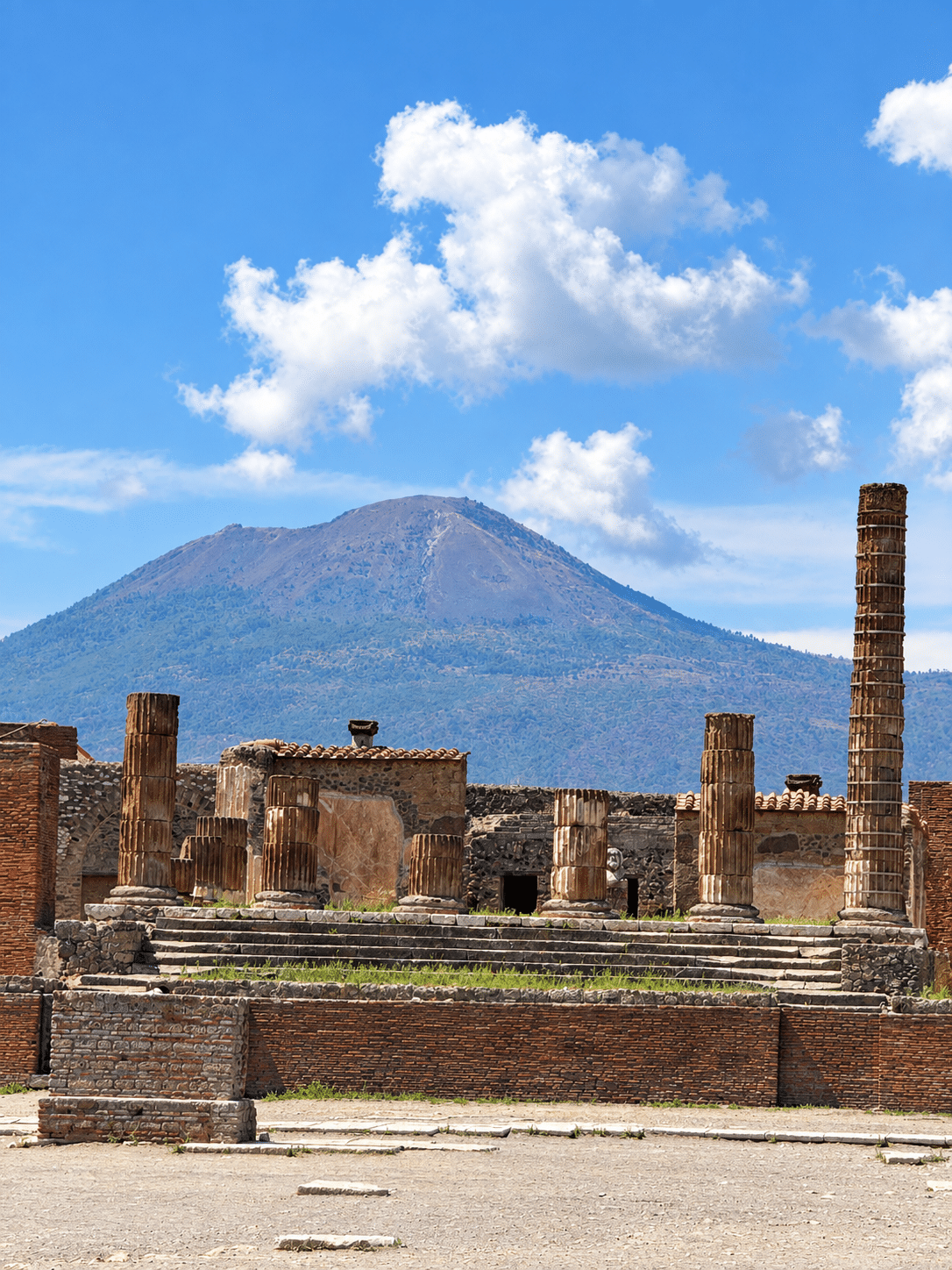
- The Forum & Iconic Views: The beating heart of the city is the Forum, a massive open square surrounded by temples, markets, and government buildings. Standing here gives you two of the best views in the park: the Temple of Apollo (complete with its original stone sacrificial altar and sundial column) and the Temple of Jupiter, which dramatically frames Mount Vesuvius looming directly behind it, a constant, slightly eerie reminder of the mountain we had just stood on that morning.

- A Time Capsule Under Ash: Because Pompeii was buried under up to 6 meters (20 feet) of ash and pumice rather than molten lava, everything from vibrant frescoes and mosaic floors (“Beware of the Dog” signs included) to loaves of bread still sitting in bakery ovens was remarkably preserved. Today, roughly a third of the city still remains unexcavated, meaning archaeologists are still making headline-grabbing discoveries.
Once we arrived at Pompeii, we entered the archaeological park as a group, and our guide wasted no time leading us straight to our first major stop: the Temple of Apollo (Tempio di Apollo), one of the oldest and most significant religious sites in the ancient city.
Temple of Apollo – Pompeii
Tucked right beside the Forum near the Porta Marina entrance, this is one of the oldest and most important religious sites in Pompeii, with roots stretching all the way back to the 6th century BC. Worshipping Apollo was a big deal in ancient Pompeii; he was the god of music, light, prophecy, and archery, and his cult was deeply woven into the city’s early Greek and Samnite history long before Rome officially took charge.
Even in ruins, the temple gives you a brilliant sense of its former grandeur. You can still clearly see the elevated stone podium where the main sanctuary stood, framed by elegant Corinthian columns and a white travertine sacrificial altar sitting right at the foot of the steps.

Just to the left of the staircase stands a shorter Ionic column that once held a marble sundial, proving the ancient Romans were keen on keeping track of the time between temple offerings.
Best of all, standing in the courtyard gives you a dramatic view of Mount Vesuvius looming right behind the ancient columns, setting the stage perfectly for the rest of our walk through the city.
The Forum – Pompeii
From the Temple of Apollo, we stepped straight into the Forum (Foro Civile), which was essentially the beating heart of ancient Pompeii.

If you want to picture what a Roman city centre actually looked like, this vast, rectangular open-air square is it. Surrounded by grand colonnades, temples, markets, and government buildings, the Forum was where Pompeii’s political, commercial, and religious life all collided.
Think of it as a bustling mix of town hall, shopping mall, and community noticeboard, all strictly pedestrianised (raised stone bollards at the entrances kept noisy carts and chariots firmly out).

At the northern end of the square stands the imposing Temple of Jupiter (Tempio di Giove), perched high on a stone podium.
Originally dedicated to Jupiter alone, it was later expanded to honour the Capitoline Triad, Jupiter, Juno, and Minerva, and was actually still undergoing repairs from a massive earthquake in 62 AD when Vesuvius struck seventeen years later.

Today, its ruined columns and wide-open square offer arguably the most iconic view in the entire park, framing Mount Vesuvius rising dramatically directly behind the ancient stone pillars.
We moved on to the next, and it was the famous “Bodies”.
The Bodies – Pompeii
Of course, no visit to Pompeii is complete without seeing one of its most haunting and famous sights: the plaster casts of the victims.

Our guide brought us past some glass display cases holding the preserved casts, set right against the backdrop of faded ancient frescoes. While the ruins give you a fascinating look at how the Romans lived, seeing these casts brings the human reality of the 79 AD eruption sharply into focus.

Created in the 19th century by pouring liquid plaster into the hollow voids left behind in the hardened volcanic ash after bodies decomposed, these casts capture the exact final moments, and even the tiny details of clothing and sandals, of the people who didn’t make it out in time. It is a genuinely sobering, unforgettable moment that immediately quiets even the busiest tour group

The Forum Baths – Pompeii
Next, our guide led us into the Forum Baths (Terme del Foro), which proved that the ancient Romans practically invented the modern luxury spa, minus the cucumber water and ambient whale music.

Because most private homes didn’t have indoor plumbing, public bathhouses were the ultimate daily hangout spot where citizens came not just to get clean, but to exercise, gossip, and strike business deals.
We strolled through the peaceful, collonaded courtyard where bathers once stretched and socialised, before heading inside to see how the Roman thermal circuit actually worked.

The absolute star of the show is the Frigidarium, a stunning circular room with a domed ceiling, faded red and yellow wall frescoes, and a sunken white-marble cold plunge pool right in the centre.

After sweating through the hot and warm rooms (caldarium and tepidarium), Romans would dive straight into this icy basin to close their pores. Having just hiked up a volcano in the Italian sunshine, I can confirm a cold plunge sounded pretty tempting, at that time!

House of the Tragic Poet – Pompeii
Our next stop was the House of the Tragic Poet (Casa del Poeta Tragico), a lavish Roman townhouse just around the corner that proves home security hasn’t changed all that much in two millennia.
Right inside the narrow entrance hallway sits one of Pompeii’s most famous, and surprisingly relatable treasures: the iconic “Cave Canem” mosaic.

Crafted from thousands of tiny black and white stone tiles, this ancient welcome mat features a fierce, chained guard dog lunging forward with bared teeth, complete with the Latin warning “Cave Canem” (“Beware of the Dog”) spelt out right beneath its paws.
While modern homeowners settle for a flimsy metal sign on the garden gate, wealthy Pompeians went all out with custom tilework to ward off unwanted guests, and double as a clever, subtle flex of their wealth and humour.
Beyond the threshold, the house was once decked out in dramatic mythological frescoes (which is how it earned its theatrical nickname), making it a brilliant snapshot of how Pompeii’s elite lived, entertained, and kept door-to-door salespeople at bay.

House of the Faun – Pompeii
From there, our guide led us to the House of the Faun (Casa del Fauno), which is less of a Roman house and more of an ancient mega-mansion.
Spanning an entire city block, roughly 3,000 square metres, it is the largest and most extravagant private residence in Pompeii, built to make sure anyone stepping across the threshold knew the owner had serious money.
Right in the centre of the main atrium sits the shallow, marble-lined rainwater basin (impluvium), paved with stunning geometric diamond stonework and crowned by the bronze statue that gives the villa its name.

It is a playful Dancing Faun caught mid-twirl (the one on display there is a replica, while the priceless original lives safely in the National Archaeological Museum in Naples).
Looking straight past the courtyard into the towering pillars and lush collonaded gardens beyond, it is easy to see how this place was designed for pure theatrical impact.
To top off the luxury flex, this was also the very villa where archaeologists uncovered the world-famous Alexander Mosaic, a jaw-dropping floor masterpiece depicting Alexander the Great in battle, crafted from over a million tiny stone tiles. The one in Pompeii is a replica; the original is indoors at the National Archaeological Museum in Naples. Clearly, subtlety was not high on the priority list for Pompeii’s ultra-rich.

House of the Vettii – Pompeii
Our next stop was the House of the Vettii (Casa dei Vettii), one of Pompeii’s most famous, and undeniably colourful, luxury residences.

Owned by two wealthy brothers who were former slaves turned wildly successful merchants, this townhouse was essentially their ultimate status symbol, decked out from floor to ceiling in vibrant artwork to show off their newfound fortune.

While the house is renowned for its lush courtyard and intricate mythological paintings, the undisputed crowd-pleaser is a small chamber just off the kitchen area that proves the ancient Romans were anything but prudish.

Painted onto the crisp white plaster walls with neat red borders are remarkably explicit erotic frescoes, complete with striped mattresses and cushions. These usually prompt a mixture of raised eyebrows, suppressed giggles, and very enthusiastic photo-taking from passing tour groups.

In ancient Rome, imagery like this wasn’t considered scandalous at all; it was viewed as a symbol of fertility, vitality, and good luck. Still, standing in a 2,000-year-old room admiring ancient bedroom art with a group of strangers certainly adds a memorable, and slightly cheeky, twist to a history tour!
This photo below shows the famous Hall of the Cupids (Oecus) a grand dining and reception room) inside the House of the Vettii (Casa dei Vettii) in Pompeii.

It is widely considered one of the finest surviving examples of Fourth Style Roman wall painting, famous for its vivid “Pompeian Red” (cinnabar) and glossy black panels
This photo shows the famous marble statue of Priapus standing in the lush peristyle garden of the House of the Vettii (Casa dei Vettii) in Pompeii.

Just like the famous fresco of Priapus near the house’s front entrance, this garden sculpture was all about bringing prosperity, fertility, and good luck to the home, while also warding off the “evil eye” (and any envious neighbours).
Bakery of Popidius Priscus – Pompeii
As we wandered further through the ancient streets, our guide pointed out some of Pompeii’s clever everyday infrastructure, including original folded lead water pipes still tucked right along the pavement.

It proved the Romans had pressurised running water sorted out long before most of Europe caught on, before leading us into the Bakery of Popidius Priscus.

If you ever wondered where Pompeiians grabbed their morning carbs, this is it. Standing proudly in the courtyard is a row of four giant, hourglass-shaped grain mills carved from rough volcanic lava stone.
The system was brilliantly simple: grain was poured into the top, while wooden beams wedged into the square sockets on the sides were harnessed to donkeys or mules, which spent their days walking in circles to grind wheat into flour.

Paired with a massive brick wood-fired oven right next door, bakeries like this operated on an industrial scale, churning out hundreds of round, segmented loaves (panis quadratus) every single day to keep the city fed.

Honestly, between the public spas, fast-food counters, indoor plumbing, and neighbourhood artisan bakeries, ancient Pompeiians were living a surprisingly modern lifestyle right up until the mountain ruined the party.

From there, our guide led us down the ancient basalt streets of Pompeii, throwing in a few final fascinating details along the way before bringing us back to the exit to wrap up our tour.
Slightly dusty, very well-educated, and thoroughly walked out, we hopped back onto the minibus and made the return journey to Naples, arriving around 6:00 pm, just in time to properly celebrate my husband’s birthday!
Even on our second visit, the sheer scale and detail of Pompeii left us completely captivated, and it made for an unforgettable birthday afternoon for my resident history buff.
For a Pompeii visit only with fast track tickets from Naples book this tour HERE.

The birthday dinner
For my husband’s birthday dinner, I had booked a table at 8:00 pm at Palazzo Petrucci, one of Naples’ renowned Michelin-starred restaurants. That left us with just enough time for a quick shower and a change of clothes before heading out.
We grabbed a taxi from the rank right on the corner of our hotel and headed across town to the waterfront neighbourhood of Posillipo, a scenic ride that took a good twenty minutes.
Upon arrival, we were ushered into a ground-floor lounge with huge glass windows looking straight out over the beach and the sea. The view was stunning, though the room itself felt surprisingly casual, with zero sign of a dining room anywhere; we did briefly wonder how this place had earned its Michelin reputation.

We ordered pre-dinner drinks and soaked up the coastal views until about ten minutes later when a waiter invited us to take the lift up to the first floor. Mystery solved: the downstairs lounge was simply the glamorous waiting room, and the real restaurant awaited upstairs.

Upstairs, it looked every bit the fine-dining establishment, complete with immaculate table settings, a lovely ambience, and truly first-class service. As for the food… well, let’s just say there were a few quirks.

The restaurant offers four tasting menus: a chef’s choice, a fish menu, a meat menu, or a vegetarian menu, available in five or seven courses. The catch? The whole table has to order the exact same menu. If I wanted fish, my husband had to have fish; if he wanted meat, I had to follow suit. It was a slightly frustrating rule, though we compromised and went with the five-course meat menu.


Honestly, while the meal was pleasant enough, it didn’t quite hit the culinary heights I was expecting from a Michelin-starred kitchen. Still, we enjoyed the evening, and the staff redeemed everything at the end by bringing out a birthday cupcake on a plate inscribed with “Buon Compleanno”, blissfully minus a chorus of waiters singing at our table to mortify my husband! It was a genuinely thoughtful finishing touch to his birthday celebration.

Once we wrapped up, we hopped into another taxi back to our hotel and toasted the end of a very long, memorable day with a nightcap on the rooftop before finally calling it a night.

Tomorrow’s itinerary? Exploring the ruins of Herculaneum in the morning before spending the afternoon ticking off more sights around Naples. Stay tuned for Day 3!

HOW TO MAKE THE MOST OF YOUR VISIT TO VESUVIUS/POMPEII
Below you will find a list of what to visit, where to stay and where to eat in Pompeii. I classified each place as follows:
BOLD – Visited, tried and recommended
NOT BOLD – Not visited or tried, but planning to visit or try and heard very good reviews
RED – Visited and tried but do not recommend, avoid or be cautious
*** – Excellent
** – Good
* – OK
£££ – Expensive
££ – Fair and affordable
PLEASE NOTE: Every hotel, restaurants and attractions I mention on my blogs are not sponsored reviews and we always paid the full price when visiting. We give our own opinion of the place and detail our experience, good or bad.
THINGS TO DO IN POMPEII/VESUVIUS
ATTRACTIONS
1 – To hike Mount Vesuvius – ***
2 – The Forum – ***
3 – Templo of Apollo – ***
4 – Temple of Jupiter – ***
5 – The Bodies – ***
6 – The Forum Baths – ***
7 – House of the Tragic Poet – ***
8 – House of the Faun – ***
9 – House of the Vettii – ***
10 – Bakery of Popidius Priscus – ***
WHERE TO STAY IN POMPEII
ACCOMMODATION
1 – Pompeii Central Home – 4* – £££
2 – Grand Hotel Royal – 4* – £££
3 – Pompeii Luxury Suites – 3* – ££
4 – B&B II Crepuscolo – Pompeii – 3* – ££
5 – Sofia Suites & Rooms – 4* – £££
6 – Casa Anfiteatro – 3* – ££
If you prefer to look for your own accommodation, search and book via the below widget:
I use affiliate links such as the links above for Booking.com, Get your Guide, Viator and others. It means that if you use any of my links to make a booking, I will get a small commission from the partners I’m affiliated with without any additional cost to you. Please, use the links provided when making a booking, this is a way of supporting blogs like this so we can continue writing informative and interesting posts. I’m very thankful for that.
BEST PLACES TO EAT IN POMPEII
RESTAURANTS
1 – Spinelli Bistro – ££
2 – La Bettola del Gusto – ££
3 – Na’Pasta – £
4 – Mercato Pompeiano – ££
5 – Cosmo – £££
6 – Giulia’s – £££
We only tried the ones in bold , the others are the result of my researches and ones that I would like to try. If you tried any of my recommendations above, please send me a message and tell me about your experience good or bad, so I can update the list accordingly. Thanks!
If you tried any of my recommendations above, please send me a message and tell me about your experience good or bad, so I can update the list accordingly. Thanks!
If you enjoyed reading this post you might also like to read:
On this trip to Italy:
1 – Naples
2 – Vesuvius and Pompeii
3 – Herculaneum and Naples
4 – Caserta
5 – Sorrento
6 – Ravello
7 – Amalfi
8 – The Path of the Gods
9 – Positano
10 – Capri
11 – Ischia
12 – Procida
13 – Naples

Leave a Reply