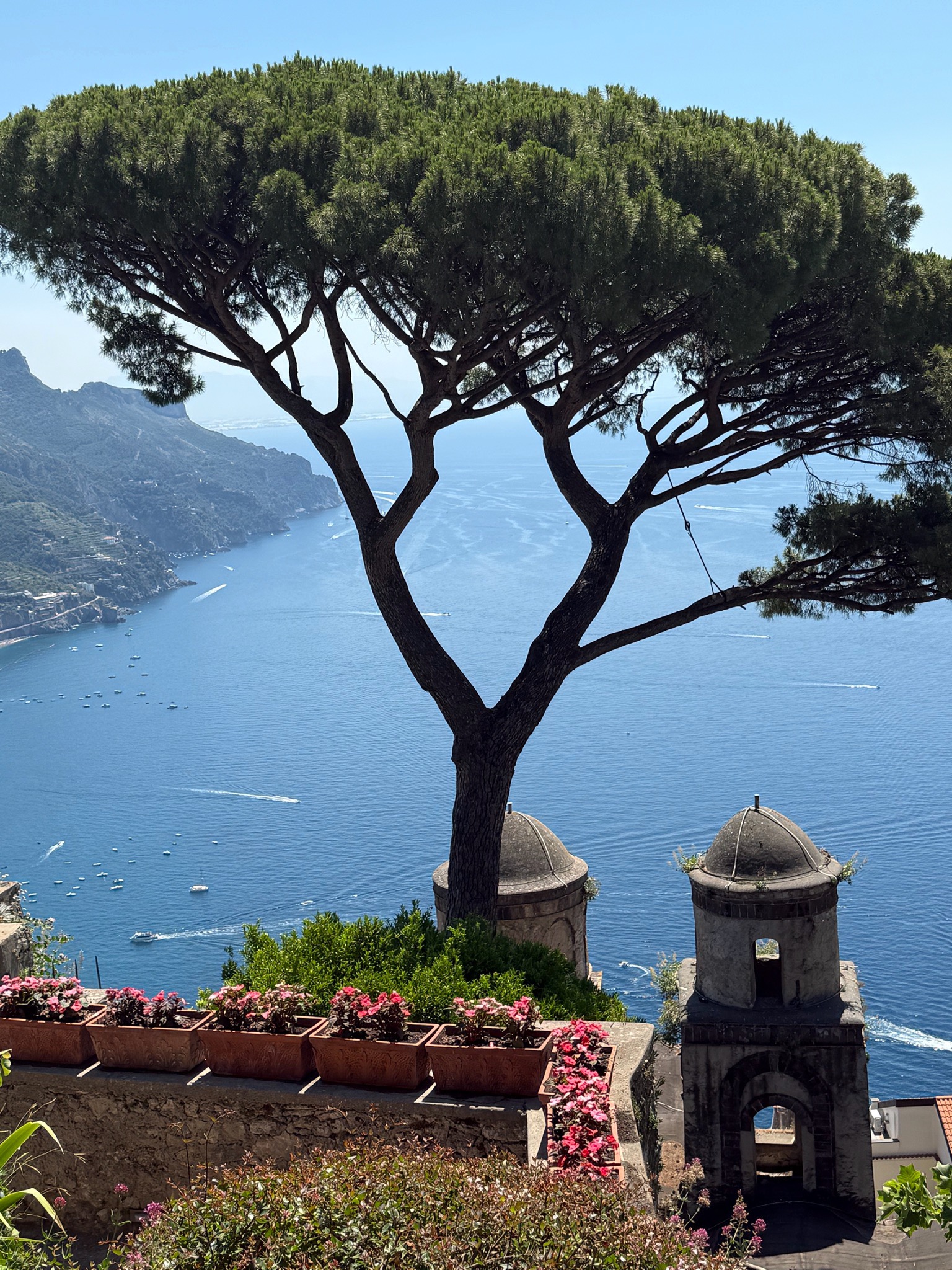

Dreaming of sun-drenched cliffs, lemon groves, and the sparkling Italian sea? If the Amalfi Coast is on your radar, you are in the exact right place. Consider this your ultimate guide to navigating this enchanting slice of Italy, minus the typical tourist stress.
We’ve been lucky enough to explore this stunning region multiple times. However, this past June, we raised the stakes with a two-week roadless adventure to celebrate my husband’s birthday. (And yes, Italian carbs are the absolute best way to celebrate another year around the sun!)

Our whirlwind itinerary kicked off in Naples, taking us through the historic wonders of Mount Vesuvius, Pompeii, Herculaneum, and Caserta. From there, we chased views in Sorrento, Ravello, Amalfi, Positano, and the breathtaking Path of the Gods, before island-hopping through Capri, Ischia, and Procida, finally looping back to Naples. It was a spectacular mix of revisiting old favourites and falling in love with brand-new spots.
To help you visualise the adventure, here is a quick map of our route:
In this intro post, I am giving you a grand tour of our journey. Think of it as the ultimate appetiser. Over the coming weeks, I’ll be releasing a dedicated, deep-dive post every single week for each destination. To make sure you don’t miss a single insider tip, go ahead and hit that subscribe button!
We were travelling independently; however, if you prefer to be part of a tour that will take care of all your accommodation, tours, meals, and transport, you should check the tours available at Tourradar.
Tourradar has tours that will fit every length of time and budget. If you book any tours via my links and use code RoseG50 you will get a discount on your booking.
Now, a quick word on logistics. For this trip, we completely ditched the idea of a rental car. Unless you actively enjoy hunting for non-existent parking spaces or testing your reflexes against manic Italian traffic, I highly recommend skipping the wheels.
Instead, we relied entirely on trains, local buses, and ferries, booking everything seamlessly through Omio. It was completely stress-free, worked like a charm, and we would do it again in a heartbeat.
If public transport sounds like your absolute nightmare and you’ve decided to brave the Italian roads anyway (godspeed!), we highly recommend using our go-to car rental company, DiscoverCars. You can grab your wheels using this link.

So, What’s the Deal with the Amalfi Coast?
If you’ve ever scrolled through travel photos and wondered if a place could actually be that beautiful in real life, the Amalfi Coast is the answer. It is a 50-kilometre stretch of sheer cliffs, pastel-coloured villages, and turquoise water that looks like a living postcard.

Located in the Campania region of Italy, this UNESCO World Heritage site is famous for its dramatic coastline, terraced vineyards, and lemons the size of footballs (seriously, the lemons here are practically a cultural requirement).

But let’s be real for a moment. While it looks like pure luxury, navigating it can sometimes feel like an extreme sport. The roads are narrower than a strand of spaghetti, the stairs are a mandatory daily leg workout, and the summer crowds are no joke.

But that is exactly why we are here! Behind the glamorous Instagram filters lies an incredibly rewarding region steeped in history, rich culture, and some of the best seafood you will ever taste.
Whether you are looking to hike rugged mountain trails, lounge on exclusive beach clubs, or just eat your weight in gelato while people-watching in a piazza, this coast has a rhythm that completely steals your heart.
Let’s start this adventure with Naples, the entrance door to the Amalfi Coast:
1 – Naples
Gloriously Chaotic and the Home of Pizza
Let’s talk about Naples. It is a city that doesn’t just greet you; it hits you like a double shot of espresso. Naples is Italy’s raw, energetic, and utterly unfiltered soul.
It is a place where laundry flutters between balconies like festive bunting, scooters zip through impossibly narrow alleyways with the precision of a ballet, and ancient history sits casually right on the street corner.
It can feel a bit overwhelming at first, but once you lean into the chaos, you realise it is one of the most vibrant, rewarding cities in the world.

First things first: you cannot talk about Naples without talking about the food. This is the birthplace of pizza, and tasting a true Neapolitan margherita is a borderline religious experience.
The crust is pillowy, the tomatoes are sweet from the volcanic soil of nearby Vesuvius, and the mozzarella is local perfection. Best of all? It costs less than a fancy coffee back home.

Between the street food, the fresh seafood, and pastries like “sfogliatella” that shatter perfectly with every bite, Naples is an absolute paradise for your taste buds.
Beyond the plate, the city serves as the ultimate cultural launchpad. Underneath the bustling modern streets lies a fascinating underground network of ancient Greek and Roman tunnels.
Up above, you have world-class museums, grand palaces, and a harbour view that looks straight out at the Mediterranean.
It is loud, it is passionate, and it has a character that you won’t find anywhere else in Italy. You might come for the transport links to the coast, but you will stay for the unforgettable energy.

- The best things to see and do in Naples:
This list will be in order of what we liked most: Museo Cappella Sansevero, San Martino Monastery, Palazzo Reale di Napoli, Santa Chiara Monastery, Duomo di Napoli, Napoli Soterranea, Museo Archeologico Nazionale di Napoli
- One of the best tours of Naples:
Naples: Guided Street Food Tour with Spritz
- One of the best 5* in Naples:
- One of the best 3* in Naples:
- One of the best restaurants in Naples:
- One of the best Pizzarias in Naples:
2 – VESUVIUS AND POMPEII
Vesuvius: The Giant with a View
If you like your holiday views with a side of dramatic history, Mount Vesuvius is an absolute must-visit. Vesuvius is the only active volcano on mainland Europe, famously responsible for freezing the ancient cities of Pompeii and Herculaneum in time back in AD 79.

Today, it sits quietly on the horizon of the Bay of Naples, looking incredibly photogenic, peaceful, and just a little bit imposing.
Hiking to the crater is an experience that is equal parts humbling and breathtaking. The trail itself is a bit of a steady gravel incline. Consider it a great way to work off yesterday’s pizza, but standing at the rim and looking down into the massive, smoking crater is surreal. It feels like standing on the edge of the world, or at least a very dusty movie set.

But the real reward for making it to the top? The panoramic views. On a clear day, you can see the entire Gulf of Naples stretching out below you, with the islands of Capri and Ischia shimmering in the distance. It’s the perfect reminder of nature’s sheer power, and a spectacular way to kick off the historical leg of any Amalfi Coast adventure.
Pompeii: The Ultimate Time Capsule
If you’ve ever wanted to literally walk through the pages of a history book, Pompeii is as close as you will ever get. Pompeii is one of the world’s most iconic archaeological sites, offering a mind-blowing window into daily life frozen exactly as it was when Mount Vesuvius erupted in AD 79.
It is not just a collection of ruins; it is an entire ancient Roman city preserved under meters of volcanic ash for nearly two millennia.

Walking down the original stone streets, complete with deep ruts worn down by ancient chariot wheels, is an eerie but utterly fascinating experience.
You can wander into fully intact fast-food joints (ancient Romans loved a takeaway), admire vibrant frescoes that look like they were painted yesterday, and peer into grand villas with beautiful central courtyards. It is massive, sprawling, and delightfully surreal.

The scale of the site can be a bit dizzying, and the midday sun is no joke, but the sheer historical weight of the place keeps you hooked.
Just make sure to wear your sturdiest walking shoes, bring plenty of water, and prepare to have your mind thoroughly blown by how advanced and relatable life was two thousand years ago.
- The Best things to see in Pompeii:
The Bodies, Garden of the Fugitives, The House of the Lovers, The Brothel, The House of the Tragic Poet, Granaries of the Forum, Temple of Isis, The House of Mysteries, The House of Julia Felix, Porta Marina, Temple of Apollo, House of Menander, House of Vettii, Thermopolium, Therme Stabiane, Teatro Piccolo, Large Theatre and many more sites.
- One of the best tours to Vesuvio and Pompeii:
Pompeii and Mount Vesuvius small-group excursion from Naples – (We’ve been to this tour)
- One of the best 4* in Pompeii:
Resort & Winery Bosco de Medici
- One of the best 3* in Pompeii:
- One of the best restaurants in Pompeii:
3 – HERCULANEUM
Pompeii’s Intimate, Well-Preserved Neighbour
If Pompeii is the blockbuster movie, Herculaneum is the critically acclaimed indie film you tell all your friends about.
Herculaneum was a wealthy seaside town buried by the same AD 79 eruption, but because it was covered in a different layer of volcanic material, the preservation here is absolutely next-level. While Pompeii lost its upper floors and roofs, Herculaneum kept them.

Walking down into the excavation site feels less like visiting ruins and more like stepping into a ghost town that residents left just this morning. Because of the unique way it was buried, organic materials survived. You can see carbonised wooden beds, intact staircases, and original ceiling beams that are two thousand years old.

The mosaics are brighter, the carbonised structural details are sharper, and the famous coastal boat houses offer a deeply poignant look at the town’s final moments.
The best part? It is a fraction of the size of Pompeii, making it incredibly walkable and far less exhausting. There are no massive tour bus crowds to dodge, meaning you can take your time soaking in the eerie, intimate atmosphere.
If you love history without the hiking-boots-and-headaches scale of larger sites, Herculaneum might just steal the show.

- The best things to see in Herculaneum:
Casa dei Cervi, Casa di Nettuno ed Anfitrite, House of skeletons, Casa dell’Albergo, Casa del Salone Nero, Sacellum of The Augustales, The House of the Bicentenary, The Tavern (Bottega ad Cuccumas), The Samnite House (Casa Sannitica), Women’s section of the Central baths (Terme centrale feminine), The House of the Wooden Screen
- The best tour of Herculaneum:
Herculaneum: Skip-the-Line Guided Tour with Archeologist – (We’ve been to this tour)
- The best 4* in Herculaneum:
- The best 3* in Herculaneum:
- The best restaurant in Herculaneum:
4 – CASERTA
Caserta: Italy’s Answer to Versailles
If you think Italy is all about rustic charm and ancient ruins, Caserta is here to completely change your mind.
The Royal Palace of Caserta is the largest royal residence in the world by volume, built in the 18th century by the Bourbon kings to rival, and secretly outdo, Versailles. It is a jaw-dropping monument to pure, unadulterated royal swagger.

The interior is a dizzying parade of marble staircases, gold-leaf ceilings, and throne rooms so opulent they will make your own living room feel like a broom closet. (In fact, it’s so cinematic that directors have used it as a stand-in for the Vatican in “Angels & Demons” and even the Naboo Royal Palace in “Star Wars”!)

But the real showstopper is the garden. It stretches for a casual three kilometres, culminating in a spectacular cascade of fountains fed by a dedicated aqueduct.
The best way to tackle it? Rent a bike or hop on the shuttle bus unless you want your feet to completely mutiny before you even reach the coast. It’s a spectacular, aristocratic detour that adds a serious dose of grandeur to any Campanian adventure.

- The best things to see in Caserta:
The Royal Palace and Park, Belvedere San Leucio, Caserta Old Town, The Aquaduct of Vanvitelli
- The best tour of Caserta:
Caserta Royal Palace & Gardens Small Group Tour with Shuttle – (We’ve been to this tour)
- The best 4* of Caserta:
- The best 3* of Caserta:
- The best restaurant of Caserta:
5 – SORRENTO, AMALFI COAST
The Gateway to Coastal Perfection
Perched dramatically on cliff tops looking out over the Bay of Naples, Sorrento is the ultimate base camp for an Amalfi Coast adventure.
It has all the cinematic charm of the smaller coastal towns but with the infrastructure of a real city, meaning smoother transport, less vertical climbing, and a fantastic buzz that kicks off the moment the sun starts to set.

The heart of Sorrento is its historic centre, a labyrinth of narrow lanes packed with artisan shops, bustling trattorias, and everywhere you look, lemons.
This is the undisputed capital of “Limoncello”, and you can’t walk five feet without being offered a sample of the sweet, frosty liqueur.

Down below, the historic harbours of Marina Grande and Marina Piccola offer postcard-perfect waterfront dining where you can watch the fishing boats bobbing in the water over a plate of “Gnocchi alla Sorrentina”.
What truly makes Sorrento a masterclass in travel planning, though, is its convenience. It’s the terminus for the train from Naples, and the main hub for the ferries and local buses.
It’s a town that manages to feel incredibly glamorous while remaining completely practical, making it the perfect place to catch your breath before tackling the wild cliffs further down the coast.

- The best things to see in Sorrento:
The Historic Centre, Peter’s Beach, Leonelslli’s Beach, Marina Grande, Sorrento Beach, Sorrento Cathedral, Basilica di Sant’Antonino, Chiostro di San Francesco and church, Bastione di Parsano, Vila Fiorentino Park, Museo Correale di Terranova, Sorrento Experience Museum, Villa Comunale, I Giardini di Cataldo (Lemon Grove), Vallone dei Mulini di Sorrento
- One of the best tours of Sorrento:
Sorrento: Secrets Walking Tour with a Local Guide
- One of the best 5* of Sorrento:
- One of the best 3* of Sorrento:
- One of the best restaurants of Sorrento:
6 – RAVELLO, AMALFI COAST
The Coast’s Elegant, High-Altitude Escape
If Positano is the glamorous starlet of the coast, Ravello is the sophisticated intellectual relaxing in a private garden. Perched high up in the clouds, Ravello sits nearly 350 metres above the Mediterranean, trading the bustling beach scene for sweeping, jaw-dropping panoramic views and a beautifully serene atmosphere.

It has been a sanctuary for artists, musicians, and writers for centuries, and the moment you arrive, you instantly see why.
The crown jewels of Ravello are its historic estates, Villa Rufolo and Villa Cimbrone. Wandering through Villa Cimbrone’s manicured gardens brings you to the “Infinity Terrace”, a cliffside balcony lined with marble busts that offers a view so impossibly beautiful it actually feels a bit unearthly.

If you visit during the summer, the town also plays host to the famous Ravello Festival, where you can watch world-class orchestral concerts on an open-air stage that looks suspended right over the sea.
Because it’s tucked away in the hills, Ravello requires a bit of an uphill bus ride or taxi climb to reach, but the payoff is absolute peace.
It is the perfect place to slow down, wander through quiet medieval alleys, sip an espresso in the elegant Piazza Duomo, and enjoy the Amalfi Coast from a spectacular bird’s-eye perspective.

- The best things to see in Ravello
Vila Rufulo, Vila Cimbrone, Duomo di Ravello, Piazza dei Duomo
- One of the best tours of Ravello:
- One of the best 4* of Ravello:
- One of the best 3* of Ravello:
- One of the best restaurants of Ravello:
7 – AMALFI, AMALFI COAST
The Historic Heart of the Coastline
Once a mighty maritime republic that rivalled Venice and Genoa for control of the Mediterranean, Amalfi is the historic powerhouse that gave this entire coastline its name.
Today, it has swapped naval warships for sun lounges, but it still feels grand, regal, and undeniably captivating. It is the perfect place to base yourself if you want a beautiful mix of beach life, deep history, and a bustling local atmosphere.

The showstopper here is the Cathedral of Saint Andrew (“Duomo di Amalfi”). Sitting majestically at the top of a grand flight of stairs right in the main piazza, its striking striped facade and Moorish architecture look like something out of a fairy tale.

After you’ve marvelled at the church, you can lose yourself in the labyrinth of whitewashed, tunnel-like alleyways that branch off the main street, a medieval design originally built to confuse invading pirates, but today excellent for finding hidden artisan shops.

Amalfi is also famous for its historic “Carta d’Amalfi”, a thick, handmade paper crafted from rags that kings used to write on. If you walk up into the lush Valley of the Mills just behind the town, you can still visit the old paper mills and the fascinating Museo della Carta.
It is a town that beautifully balances its glorious, seafaring past with the relaxed, sun-soaked romance of modern Italian coastal living.
- The best things to see in Amalfi:
Duomo di Amalfi, Historic Centre, Amalfi Beach, Porta della Marina, St Andrews Fountain, Paper Museum, Belvedere Viewpoint
- One of the best tours of Amalfi:
Amalfi Monumental Garden: Family-Led Lemon Tour & Views
- One of the best 5* of Amalfi:
Anantara Convento di Amalfi Grand Hotel
- One of the best 3* of Amalfi:
- One of the best restaurants of Amalfi:
8 – POSITANO, AMALFI COAST
The Vertical Paradise of Your Dreams
If there is one town that defines the glamorous, gravity-defying romance of the region, it is Positano. Positano is a breathtaking cascade of pastel-hued houses spilling down a sheer cliff face straight into the sea.

It is arguably the most photographed village in Italy, and the second you catch sight of it from the ferry or the winding coastal road, you will completely understand why. It looks less like a real town and more like a theatrical backdrop designed for pure cinematic impact.

But let’s be completely transparent: Positano is a serious leg workout. The town is built entirely on the vertical, meaning its “streets” are actually an endless labyrinth of steep stairs and winding slopes. (If you aren’t fond of steps, your glutes will certainly have an opinion by the end of the day!)

As you climb, you will wander past chic boutiques selling locally made “Moda Positano” linen clothing, vibrant canopies of blooming bougainvillaea, and stalls overflowing with fresh lemons.
Down at the bottom sits the “Spiaggia Grande”, the bustling main beach lined with iconic orange-and-blue umbrellas, lively seafood restaurants, and a glamour-fuelled people-watching scene.
Whether you are sipping a chilly Aperol Spritz on a waterfront terrace, hunting for handmade leather sandals, or simply watching the cliffside lights flicker to life at twilight, Positano delivers that intoxicating, quintessential Italian holiday magic that you will never forget.

- The best things to see in Positano:
Spiaggia Grande, Church of Santa Maria Assunta, Roman Arcaeological Museum and Villa, Historic Centre
- One of the best tours of Positano:
From Positano: Shared Amalfi Coast Sunset Boat Tour
- One of the best 4* of Positano:
Villa Santa Chiara Positano Suites
- One of the best restaurants of Positano:
9 – THE PATH OF THE GODS
Heaven Between the Cliffs and the Sea
If you want to experience the coast away from the glamorous crowds and closer to the heavens, you need to lace up your walking shoes for “Il Sentiero degli Dei”, The Path of the Gods.
This legendary cliffside trail links the mountain village of Bomerano/Agerola to Nocelle (just above Positano), and it more than lives up to its celestial name.

Hiking it feels like walking on a tightrope suspended between rugged limestone peaks and the impossibly blue Mediterranean Sea far below.
The scenery along this route is nothing short of operatic. You will trek past sheer vertical drops, deep gorges, ancient stone ruins, and terraced vineyards that seem to cling to the mountain by sheer willpower.
Around every winding corner, you are treated to staggering, bird’s-eye vistas of the entire coastline, stretching all the way out to the silhouette of Capri shimmering on the horizon.

The best part? Because you are walking mostly from East to West, the trail is a gentle, undulating downhill gradient that finishes with a spectacular descent into the upper edges of Positano.
It takes about three to four hours to complete, and while it will certainly test your knees, the pure, unadulterated alpine breeze and the million-dollar views make it a profound, unforgettable highlight of any Amalfi journey. Just don’t forget your camera, or your vertigo medication!

- One of the best tour of the Path of the Gods:
From Agerola: Amalfi Coast Path of the Gods Hike to Nocelle
10 – CAPRI
Glitz, Glamour, and Dramatic Cliffs
If the Amalfi Coast is a masterclass in Italian romance, Capri is its most exclusive VIP lounge. Capri is a dazzling limestone island that has been the playground of emperors, artists, and Hollywood elite since the days of Ancient Rome.
Sitting just off the tip of the Sorrentine Peninsula, it rises sharply from the sea like a jagged emerald, surrounded by water so brilliantly blue it looks like it has been digitally enhanced.

The island is famously divided into two halves. Down in Capri town, the heart of the action is the chic “Piazzetta”, an elegant open-air living room where you can sip an espresso (at luxury prices) and spot celebrities hiding behind oversized sunglasses.

It is a world of high-end designer boutiques, immaculate white lanes, and manicured gardens. But if you hop on a local convertible taxi and head up the winding cliff roads to Anacapri, the island’s higher town, the vibe shifts to something much quieter, more authentic, and delightfully rustic.

Of course, no trip to Capri is complete without experiencing its legendary coastline from the water. You can take a boat ride to see the towering “Faraglioni” rock formations, three massive stone sea stacks that are the island’s signature landmark, or brave the queues to peek inside the glowing neon waters of the famous Blue Grotto.
It is a place that feels unashamedly glamorous, wildly beautiful, and entirely intoxicating.

- The best things to see in Capri:
CapriTown via the funicular, The Piazzetta, Gardens of Augustus, Via Krupp, Faraglioni, Marina Piccola, Anacapri, Vila San Michelle, Monte Solaro Cablecar, Chiesa di San Michelle
- One of the best tours of Capri:
Private Boat Tour of Capri with Aperitif and Snorkelling
- One of the best 5* of Capri:
- One of the best 3* of Capri:
- One of the best restaurants of Capri:
11 – ISCHIA
The Green Island of Thermal Wonder and Relaxation
If Capri is where you go to be seen, Ischia is where you go to escape, unwind, and completely reset. Ischia is the largest island in the Bay of Naples, affectionately nicknamed “The Green Island” thanks to its lush, volcanic slopes and fertile pine forests.

Because it is a volcanic island, it is bubbling over with natural thermal hot springs, making it a world-famous wellness sanctuary since the time of the ancient Romans.
One of the absolute highlights here is spending a day at one of the island’s legendary thermal parks, like Negombo or Poseidon. Imagine lounging in a series of naturally heated mineral pools carved directly into cliff sides, surrounded by tropical gardens, with a private beach just steps away.
Amalfi It is the ultimate antidote to all those steep Amalfi stairs you’ve been climbing.

But Ischia isn’t just about spa days. The island is packed with character, from the bustling harbours of Ischia Porto to the dramatic “Castello Aragonese”, a breathtaking medieval castle perched on its own volcanic rock islet, connected to the mainland by a stone bridge.

Add in incredible local wines, authentic stone-oven dishes like “coniglio all’ischitana” (Ischian rabbit), and a delightfully unpretentious local vibe, and you have an island that feels like a massive, restorative breath of fresh air.

- The best things to see in Ischia:
Castello Aragonese, Gardens of La Mortella, Chiesa dei Soccorso, Historic centres of Porto, Ponte and Forio, Spiaggia di Sant’Angelo, Fumarole, Maronti Beach, Poseidon Spa, Ravino Gardens, Spiaggia degli Inglesi
- One of the best tours of Ischia:
Ischia: Aragonese Castle & Borgo di Celsa Historical Walk
- One of the best 5* of Ischia:
Mezzatorre Hotel & Thermal Spa
- One of the best 3* of Ischia:
- One of the best restaurants of Ischia:
12 – PROCIDA
A Vivid Splash of Authentic Island Life
If you want to experience an Italian island that feels completely untouched by the gloss of international tourism, Procida is your hidden gem. Procida is the smallest and oldest island in the Bay of Naples, and it is an absolute visual explosion.
It was even named Italy’s Capital of Culture in 2022, yet it has gracefully held onto its quiet, working-class charm and slow-paced fishermen’s rhythm.

The defining postcard image of the island is Marina Corricella, a breathtaking waterfront crescent of pastel-painted houses that looks like a giant bowl of mismatched candy spilt onto the cliffs.
Legend has it the houses were painted in these striking shades of pink, yellow, and blue so the local fishermen could recognise their own homes while out at sea.

There are no fancy luxury boutiques here, just weathered fishing nets drying in the sun, kids kicking around a football in the square, and quiet waterfront trattorias serving up the freshest catch of the day.
Because it is incredibly compact, you can easily explore the whole island on foot or via a tiny electric bus. Wandering up to the historic walled village of Terra Murata at the island’s highest point rewards you with dramatic views of the gulf and a sense of step-back-in-time isolation.

It is a wonderfully cinematic, deeply authentic place (it’s no wonder it was the backdrop for classic films like “The Talented Mr. Ripley” and “Il Postino”)that captures the pure, cinematic soul of southern Italy.

- The best things to see in Procida:
Marina Grande, Marina Pier and Pio Monte De Marinari, Piazza Marina Grande, Marina di Corricella, Mirador di Callia, Belvedere Piazza del Martiri, Casale Vascello, Salita Castello, Belvedere Terra Murata, Palazzo d’Avalos,
- One of the best tours of Procida:
Procida: Romantic and Evocative sunset tour with skipper and aperitif
- One of the best 4* of Procida:
- One of the best 3* of Procida:
- One of the best restaurants of Procida:
Ready to Plan Your Own Amalfi Coast Adventure?
There you have it, a whirlwind taste of the history, the islands, the cliffs, and the pure, unfiltered magic we experienced on our two-week June getaway.
Whether you are a history buff wanting to walk the ghostly streets of Herculaneum, an adventure seeker ready to conquer the Path of the Gods, or someone who simply wants to sit on a ferry with a lemon gelato in hand watching the pastel villages slide by, this region has a way of completely capturing your soul.

Planning a trip out here can definitely feel a bit like putting together a beautiful, chaotic Italian puzzle, but that is exactly why I’ve written this series. Over the next few weeks, we are going to break down every single one of these destinations into its own dedicated, bite-sized guide.
I’ll be sharing our exact transit routes, the best places to eat without paying tourist tax, how to navigate the ferry systems using Omio, and the hidden gems we stumbled upon along the way.

So, grab a glass of “limoncello” (or an espresso, depending on the time of day!), make sure you are subscribed so you don’t miss next week’s deep-dive into the energetic streets of Naples, and let’s get ready to travel. “Andiamo”!

There are other posts of different parts of Italy, posts such as: Portofino, Palermo and Monterosso. Feel free to explore the Italy page of the site.



Leave a Reply