
Are you planning a trip to Curitiba? Do you want to discover the best things to see and do in this vibrant city? Having visited Curitiba many times, I have already shared two other posts covering the city’s most popular attractions, Curitiba 1 and Curitiba 2. In this post, I am excited to take you along on another one of our journeys, giving you even more inspiration and ideas for your next itinerary.
For this trip, we were staying at my brother’s house in “Pontal do Paraná”. From there, we planned to take a two-day detour to Curitiba and stay with a local friend.
Our original itinerary was packed: leave Pontal early in the morning, head straight to the stunning sandstone formations at “Vila Velha” State Park and the dramatic waterfall at “Buraco do Padre”, and then stop by the historic Witmarsum Colony on our way into Curitiba.

As travel plans often go, things didn’t quite work out as expected. We quickly realised that both “Vila Velha” State Park and “Buraco do Padre” are closed on Tuesdays, which was exactly the day we were travelling! Pivoting on the fly, we skipped the parks and drove straight to Witmarsum Colony instead.

After spending some time exploring the colony, we made our way into the heart of Curitiba. I was eager to revisit a few iconic spots downtown to snap some fresh photos for the blog. We headed straight for the historic centre, exploring the cobblestone streets of “Largo da Ordem” with its beautifully preserved colonial houses and historic churches.

For lunch, we treated ourselves to a classic meal at the famous “Bar do Alemão” before finally heading to my friend’s house. We spent a wonderful evening catching up while she prepared the most delicious Japanese barbecue for us.

The next day, before returning to Pontal do Paraná, we still visited Museum Neimeyer and spent the morning exploring the museum.

Before we dive into the specific details of the places we visited on this trip, let me give you a proper introduction to this remarkable city.
A Little Bit About Curitiba
Curitiba is the capital of the southern Brazilian state of Paraná. Known internationally as a model for innovative urban planning, it effortlessly blends a bustling metropolis with an abundance of green spaces. It is a city where modern efficiency meets deep cultural heritage, making it one of the most unique destinations in Brazil.

The Geography: The Green Capital on a Plateau
Geographically, Curitiba sits on the First Paraná Plateau (First “Planalto Paranaense”) at an impressive elevation of around 934 metres (3,064 feet) above sea level. This high altitude heavily influences its subtropical highland climate. Unlike the tropical heat typically associated with Brazil, Curitiba experiences mild summers and noticeably chilly winters, occasionally seeing frost.
The city is highly praised for its commitment to the environment. It boasts over 50 square metres of green space per inhabitant, far exceeding the minimum recommendations by the World Health Organisation. This geography is defined by its extensive network of municipal parks and botanical gardens, designed not just for recreation, but as a brilliant natural drainage system to control urban flooding.

The History: From Gold Rush to Cultural Melting Pot
Curitiba’s story began in the late 17th century when “Bandeirantes” (Portuguese explorers) discovered gold in the region. Formally founded in 1693 as “Vila de Nossa Senhora da Luz dos Pinhais”, it was initially a small, isolated settlement. The name “Curitiba” itself is derived from the indigenous “Tupi-Guarani” words “kuri’ytjba”, which translates to “many pine nuts” or “land of the pines,” owing to the massive forests of “Araucaria” (Paraná pine) trees that blanketed the landscape.

The town became a crucial transit point in the 18th century along the “Caminho das Tropas” (Troop Way), a historic trade route where mule herders moved livestock between the southern plains and the markets of São Paulo.
The true transformation of Curitiba began in the late 19th and early 20th centuries with a massive wave of European immigration. The state government encouraged settlement by immigrants from Germany, Italy, Poland, Ukraine, and Japan.
This influx entirely reshaped the city’s identity, architecture, and culinary landscape, as seen in the diverse cultural neighbourhoods and historic colonies like the Witmarsum Colony we visited!

Fascinating Facts About Curitiba
- The Bus Rapid Transit (BRT) Pioneer: In the 1970s, under the guidance of visionary architect and mayor Jaime Lerner, Curitiba invented the Bus Rapid Transit system. The city’s iconic glass tube bus stations allow passengers to pay beforehand and board at floor level, a design that has been copied by cities all over the world, including Bogotá and Los Angeles.

- The “Green Exchange” Program: Curitiba solved a major waste management problem in its lower-income areas by introducing “Câmbio Verde” (Green Exchange). Residents can exchange recyclable trash directly for fresh, locally grown fruits and vegetables or seasonal school supplies.
- A Capital of Ecological Architecture: The city is home to architectural wonders that celebrate nature, such as the “Ópera de Arame” (Wire Opera House), a stunning theatre built from steel tubes and glass nestled inside a reclaimed quarry, and the iconic Art Nouveau greenhouse of the Curitiba Botanical Garden.

- Brazil’s Capital of Rock: Locally, Curitiba is often lightheartedly referred to as the “Capital of Rock” in Brazil due to its highly active independent rock music scene, underground pubs, and enthusiastic music festival culture.
VISITING CURITIBA
A Journey to Witmarsum Colony: A Piece of Europe in Paraná
Located in the municipality of Palmeira, just 60 kilometres (about 45 miles) west of Curitiba, lies “Colônia Witmarsum”. Stepping into this quiet, pastoral community feels less like rural Brazil and remarkably like a hidden corner of the European countryside.
With its rolling green hills, traditional Germanic architecture, and pristine local farms, it has grown into one of the most beloved day-trip destinations for anyone exploring Paraná.

The History: The Mennonite Heritage
The colony was officially founded in July 1951 by a group of German-Russian Mennonites. To fully appreciate Witmarsum, it helps to understand the incredible journey of its founders:
- The Origins: The community traces its heritage back to Friesland (a region spanning the northern Netherlands and Germany).
- The Great Migration: Seeking religious freedom, they migrated through Prussia to Russia in the 18th century. In 1929, fleeing the Soviet communist regime, they made their way to Brazil, initially establishing a settlement in the neighbouring state of Santa Catarina.
- Finding a Permanent Home: In 1951, several families relocated to Paraná, purchasing the historic Cancela ranch to set down permanent roots. They named their new sanctuary “Witmarsum” after the birthplace of Menno Simons, the historic leader of the Mennonite faith.
Today, the community has around 1,500 inhabitants. While the younger generations are proudly integrated into Brazilian culture and speak Portuguese, the community still fiercely preserves its deep ancestral pride, traditional values, and German linguistic roots.

What to See and Do in the Colony
Witmarsum has successfully transformed from an isolated farming community into a thriving hub for gastronomic and rural tourism. Here are the highlights you cannot miss when you visit:
- Heimat Museum (The Witmarsum Museum): Located in the historical heart of the town, this museum is housed inside the grand old estate building that originally sheltered the first families in 1951. It later served as the colony’s maternity hospital before becoming a museum. Inside, you will find a beautifully curated collection of old photographs, furniture, farm tools, and historical artifacts that vividly tell the story of the Mennonite migration. (Tip: Make sure to check their opening hours, as it is primarily open on weekends!)
- The Food and “Colonial Cafés”: The absolute star of Witmarsum tourism is its food. The village is packed with traditional German restaurants and charming tea rooms serving “Café Colonial” a massive, all-you-can-eat spread of artisanal breads, seasonal pies, traditional cakes (like “Streuselkuchen”), homemade jams, and savoury tarts.

- Artisanal Shopping at the Cooperativa: Through hard work, the early settlers formed a highly successful agricultural cooperative. Today, the local shops sell elite, regional products. Don’t leave without trying the famous Witmarsum Fine Cheeses (renowned across Brazil), alongside locally cured salamis, homemade biscuits, and fresh chocolates.

- Biergartens and Microbreweries: Capitalising on its German heritage, the colony has embraced a vibrant craft beer scene. You can spend a relaxing afternoon sitting outdoors under string lights at local breweries or a “Biergarten”, sampling locally brewed Witbiers and IPAs.
Our visit to Witmarsum Colony turned out to be a very quick stop. Because it was a Tuesday, most of the attractions and local businesses were closed. If you are planning a trip here, the absolute ideal time to visit is during the weekend, when you can easily spend an entire day exploring and enjoying lunch at one of the traditional German restaurants.
During our mid-week stop, the only places open were the local Cooperative which is a supermarket serving the locals; a fantastic shop selling a variety of regional products; and a charming nearby chocolate shop. A few local microbreweries were also open, but the rest of the village was completely quiet. Since it was still a bit too early for lunch, we didn’t get a chance to check if any of the main restaurants were serving.

However, we did make the most of what was open! We popped into the shop to buy several varieties of delicious local cheeses, and we couldn’t resist picking up some treats from the chocolate shop as well. After our quick shopping spree, we jumped back in the car to continue our journey to Curitiba, though if we ever return, I will absolutely make sure to schedule our visit for a weekend.
You can take a full day tour leaving from Curitiba and visiting “Vila Velha”, “Witmarsum Colony” and some Lavender Fields in an enchanting excursion. You can book this tour HERE.

Once we arrived in Curitiba, we parked the car in a central parking lot right near Osório Square and set off on foot to explore the historic centre. We spent a wonderful hour simply wandering through the historic streets, admiring the beautiful heritage buildings that give the area so much character.

By the time we worked up an appetite, it was finally lunchtime. We decided to head into the famous “Bar do Alemão,” a legendary spot in Curitiba’s food scene alongside another popular nearby venue called “Quintal do Monge.”


While our lunch was pleasant enough rather than extraordinary, the experience came with a really fun quirk: they serve your drink with a miniature souvenir beer cup tucked right inside your glass, which you get to take home with you. It was an incredibly cute and memorable touch!

Right next door to the bar sits the “Memorial de Curitiba,” so we decided to step inside and see what it had to offer. The memorial is a strikingly modern building filled with local artwork, paintings, and sculptures scattered throughout the space. Because it is completely free to enter, it is absolutely worth popping in for a few minutes to look around.

After soaking in a bit of local culture, we drove over to my friend’s house, where we happily settled in to relax for the rest of the day and evening.
There is a 3-hour walking tour in the historic centre of Curitiba with a small group. If you fancy joining them book this tour HERE.

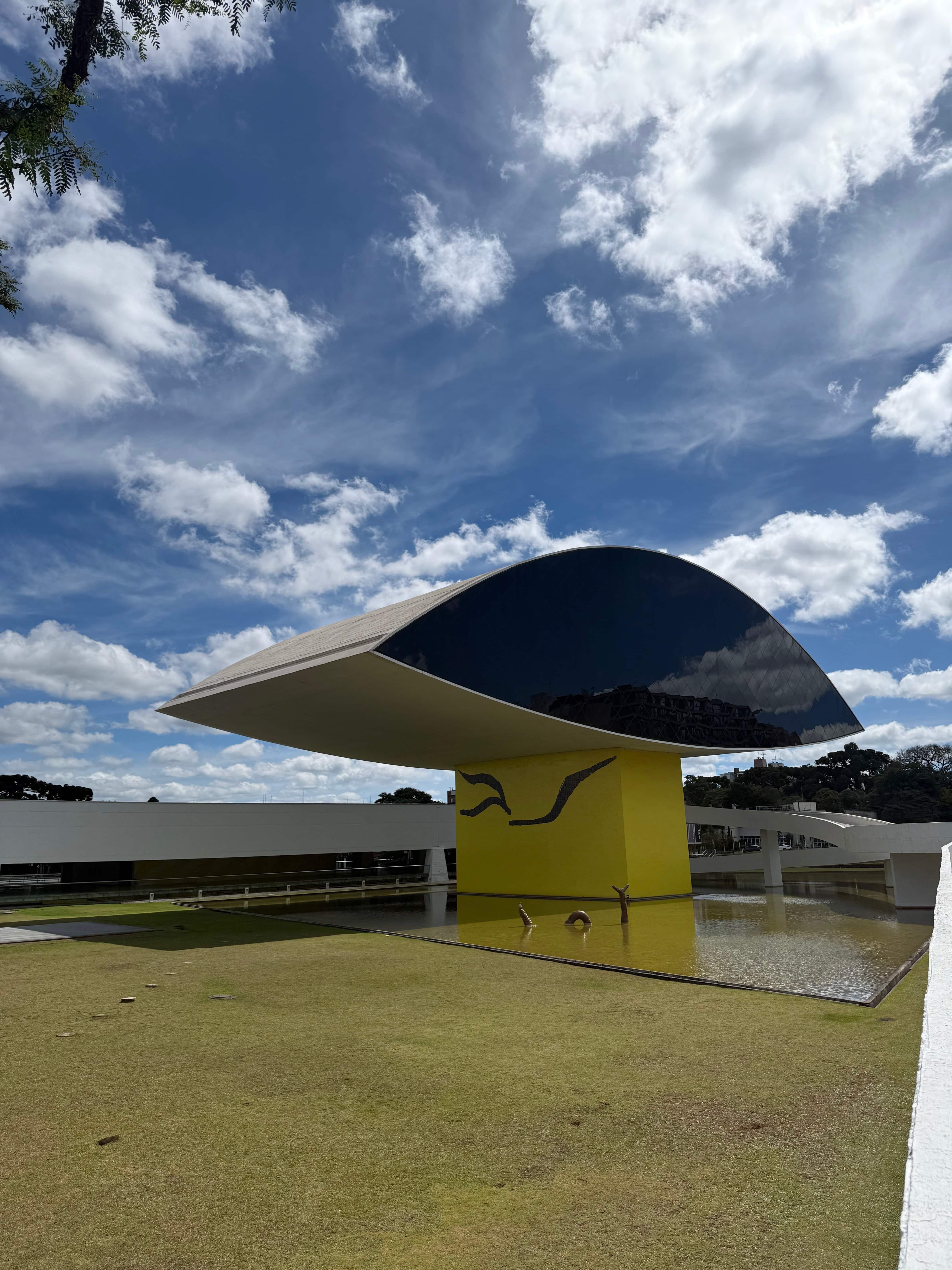
The following morning, after enjoying a lovely breakfast together, we said our goodbyes to our wonderful host and set off for our final stop: the spectacular Oscar Niemeyer Museum (famously known as the “Monumento” or “The Eye”). We spent a fascinating morning exploring its striking architecture and world-class art exhibitions.

Afterwards, we grabbed a delicious bite to eat at the museum’s café before hitting the road to head back to “Pontal do Paraná”, wrapping up an unforgettable two-day city escape.

The Oscar Niemeyer Museum: An Architectural Wonder – Curitiba
No trip to Curitiba is complete without a visit to the breathtaking Oscar Niemeyer Museum (locally abbreviated as MON). Located in the upscale civic centre neighbourhood, this is not just a world-class art gallery; it is one of the most spectacular architectural masterpieces in South America. Spread across a massive 35,000 square metres, it stands proudly as the largest art museum in Latin America.
The Architecture: The Story of ‘The Eye’
The museum is instantly recognisable due to its futuristic, gravity-defying design. Locally and internationally, it is widely nicknamed “O Olho” (The Eye), thanks to its iconic, eye-shaped tower that rises dramatically above a reflective pool of water.

The history of the building is a fascinating story of evolution:
- The Original Design (1967): The main rectangular building was originally designed by Brazil’s legendary modernist architect, Oscar Niemeyer, in 1967. It initially served as an educational institute.
- The Modern Rebirth (2002): Decades later, Niemeyer was invited to completely transform the complex into a state-of-the-art museum. At 94 years old, he added the magnificent 30-metre-high “Eye” tower.
- The Connection: The two buildings are connected underground by a beautifully lit, curved concrete tunnel, making a walk through the museum feel like stepping into a sci-fi film.

Niemeyer’s signature style is on full display here: bold minimalism, stark white structures contrasted with vibrant yellow accents, dramatic external ramps, and fluid, winding concrete curves that mirror the natural world.
What to See Inside and Around the Museum
Whether you are an avid art collector or just looking for the perfect travel photo, MON offers an incredible experience both inside and out:
- The Art Collections: The museum holds a vast permanent collection of over 14,000 pieces. It heavily features prominent Brazilian and international modern artists, alongside dedicated exhibits showcasing Niemeyer’s original architectural sketches and blueprints. There are also incredible wings dedicated to Asian and African art.
- The Tower Experience: Walking inside the reflective glass of “The Eye” itself is an unforgettable experience. The interior walls curve overhead, often playing host to breathtaking contemporary installations that make brilliant use of the natural light streaming through the massive windows.

- The MON Café and Gift Shop: After hours of exploring the galleries, you can do exactly what we did and pop into the museum’s charming café. It is the perfect spot to grab an artisanal Brazilian espresso and a slice of cake. Don’t forget to browse the gift shop, which sells beautiful design books, miniature scale models of the museum, and locally crafted souvenirs.
- The Vão Livre (The Open Plaza): The massive open-air concrete plaza beneath the main building is a lively cultural gathering spot. On any given afternoon, you will find locals sunbathing on the lawns, walking their dogs, reading, or watching skaters practice on the smooth concrete
If you want to book your ticket to the museum in advance and avoid any queues on arrival you can book your tickets HERE.
If you are a fan of architecture as I am, you can’t miss this 3-hour walking tour through Curitiba visiting 8 Architectural Monuments and listening to their stories. Book this tour HERE.

Curitiba is a city that never ceases to amaze me, and this quick two-day getaway was the perfect reminder of why I love returning here.

From the rich, old-world charm of the Witmarsum Colony to the futuristic lines of the Oscar Niemeyer Museum, it is a destination where history and innovation live side by side.

Whether you are a first-time visitor or looking to explore beyond the usual tourist trail, I hope this itinerary gives you plenty of inspiration for your own journey.

Now, I would love to hear from you! Have you ever been to Curitiba, or is it on your travel bucket list? Which of these spots would you want to visit first?

Let me know in the comments below, and don’t forget to check out my other posts for even more Curitiba travel tips!
HOW TO MAKE THE MOST OF YOUR VISIT TO CURITIBA
Below you will find a list of what to visit, where to stay and where to eat in Curitiba. I classified each place as follows:
BOLD – Visited, tried and recommended
NOT BOLD – Not visited or tried, but planning to visit or try and heard very good reviews
RED – Visited and tried but do not recommend, avoid or be cautious
*** – Excellent
** – Good
* – OK
£££ – Expensive
££ – Fair and affordable
PLEASE NOTE: Every hotel, restaurants and attractions I mention on my blogs are not sponsored reviews and we always paid the full price when visiting. We give our own opinion of the place and detail our experience, good or bad.
THINGS TO DO IN CURITIBA
ATTRACTIONS
2 – Buraco do Padre
3 – Colônia Witmarsum – ***
4 – Curitiba Historic Centre – ***
5 – Museu Oscar Niemeyer – ***
WHERE TO STAY
ACCOMMODATION
1 – NH Collection Curitiba – 5* – £££
2 – Radisson Hotel Curitiba – 5* – £££ (We stayed here in another trip)
3 – Novotel Curitiba Batel – 4* – ££
4 – Hotel Deville Curitiba – 4* – ££
5 – Hotel Bleev – 3* – £
6 – Ibis Curitiba Batel – 3* – £
If you prefer to look for your own accommodation, search and book via the below widget:
I use affiliate links such as the links above for Booking.com, Get your Guide, Viator and others. It means that if you use any of my links to make a booking, I will get a small commission from the partners I’m affiliated with without any additional cost to you. Please, use the links provided when making a booking, this is a way of supporting blogs like this so we can continue writing informative and interesting posts. I’m very thankful for that.
BEST PLACES TO EAT
RESTAURANTS
1 – Bierwit – Witmarsum Colony – ££
2 – Bar do Alemão – ££ – ** (We ate here)
3 – Quintal do Monge – ££
4 – Barolo – £££ – *** (We ate here in another trip)
5 – Calabouço – £££
6 – Taisho Yakiniku – ££ – *** (We ate here in another trip)
We only tried the ones in bold , the others are the result of my researches and ones that I would like to try. If you tried any of my recommendations above, please send me a message and tell me about your experience good or bad, so I can update the list accordingly. Thanks!
If you tried any of my recommendations above, please send me a message and tell me about your experience good or bad, so I can update the list accordingly. Thanks!
If you enjoyed reading this post you might also like to read:
Leave a Reply