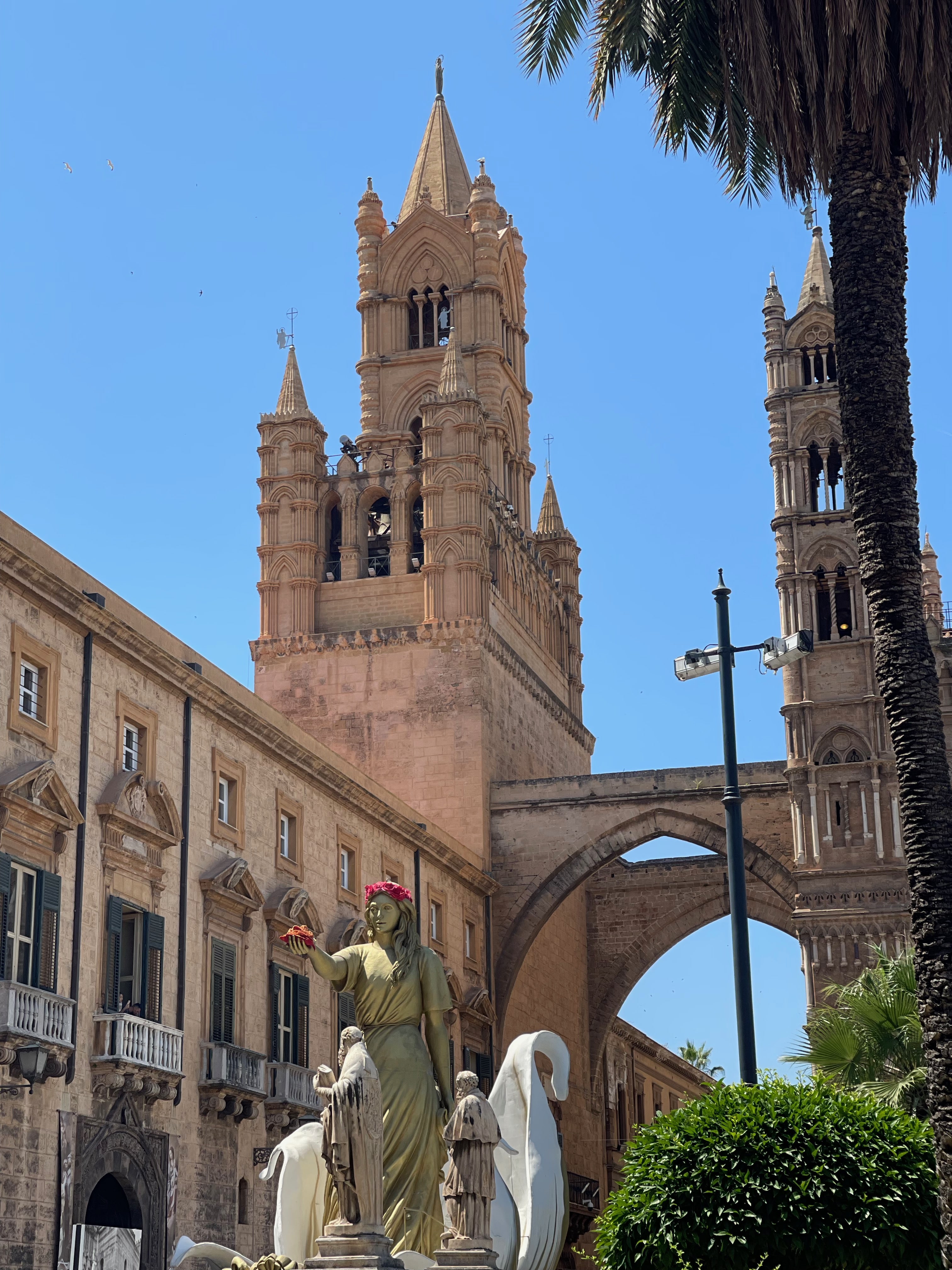

Are you planning a trip to Sicily? Are you curious about Palermo and what is there to see?
My husband and I were on a 16-day trip in Sicily, and after visiting Catania, Taormina and Cefalù, we arrived in Palermo. We stayed there for two days exploring the city, and I will tell you everything about it in this post and in the next one.

We were travelling independently around the island with a hired car we booked with Discover Cars, as we are confident travellers and speak a bit of the language. However, if you prefer to be part of a tour and to have everything organised for you, I advise you to book a complete tour of the island with Tourradar.
There is a very good tour on Tourradar that is called “Splendour of Sicily 8 days tour from Catania”. This tour will cover many places and goes around the island. It will include Palermo as well. Check this tour and all the others they have via this LINK.
If you book via my link you can get a discount using this code: RoseG50.
Below is a map showing the places we visited in Palermo on Day 1:
Don’t forget to subscribe to the site so you will not miss any of the future posts on Sicily or other places by The Travelling Surveyor.
We checked out of the B&B Panorama in Cefalù just after breakfast, loaded the car and headed to the west of the island, to Palermo. The trip from Cefalù to Palermo is about 1 hour via the E90 motorway. Easy drive with almost no traffic at all, like in all other motorways we drove so far.
When we arrived in Palermo, we could notice straight away the difference in the traffic. Traffic there is a bit mad and chaotic. People park in double lines on narrow roads, making the lives of drivers who want to pass through more difficult than they need to be.

We booked a B&B in the centre of town, to be near attractions and not need the car. As the B&B we booked didn’t have a car park, we looked for a car park in the centre. We found one called Garage San Matteo on Via Vittorio Emanuele, very close to the B&B.
It turned out to be very difficult to find, as there were no signs for it. After going around a few times on the narrow roads, I had to get out of the car and ask someone for directions. Luckily, we were in the right place and the car park was just in the underground of a block of flats in front of us.

We went down the entrance, and at the bottom, there was a locked metal gate. Nobody was there to open it, or an interphone to call someone. After waiting a few minutes to see if someone was coming, and nobody appeared, I had to get out of the car again and look for help in front of the building.
The janitor working there made a phone call to the responsible person, who came after a few minutes. He opened the gate and offered to park the car for us, which we gladly accepted. The entrance was very tight and in a 90-degree turn. We were already worried about how on earth we would turn and park in there. Phew! 🤣

He asked us how long we wanted to stay and gave us the price, which I can’t remember how much it was now, but I know it was not very expensive. We were told to ask the janitor to give him a call on the day we were leaving when we arrived to collect the car. All as simple as that.
The next challenge was to find our B&B, “Heritage Collection Palermo” on 5 Via dei Ponticello, which should be nearby. We quickly arrived at the address for it, but were very surprised as it was in a very run-down block of flats that looked more like a dangerous structure, with scaffolding on the side. My husband gave me a very dirty look that said: “Where did you book ourselves in?”.

I have been in communication with the lady from the B&B, and she said we could arrive early and leave our luggage there as the check-in was only after 2 pm. She gave us the code for the entrance door of the building, and we entered it.

The entrance hall was full of building materials, rubble and dust as they were clearly refurbishing the communal areas. It was an old building, but we could see that it was once a very beautiful building with a pink marble staircase and various architectural details that we only find in old buildings.

We went up the stairs to the second floor, where the B&B was supposed to be and halfway, the lady came to meet us and helped with my suitcase. She opened the front door of the B&B and told us that our room was ready, and we could check in straight away.

Once inside the B&B, it was a different world. Everything was new and beautiful. The entrance was straight into the communal breakfast room, which looked very nice. She explained to us how the access codes worked and took us to our room.
The Lady also told us that we needed to pay a daily fee if we wanted to use the car in the centre of Palermo, and as we arrived in the centre, we would need to pay for that day and for the day we were leaving, even if we were not using the car the rest of those days. She offered to organise that for us, and we accepted and paid her directly. It is a fee of 5 Euros per day to drive a car in the centre of Palermo.

Our room was lovely! It was a refurbished room that had the ceiling restored to its original condition, and it looked so beautiful! They furnished the room with antique pieces of furniture, and the room was very spacious with a balcony facing the road. The bathroom was also very nice, with a powerful shower and fluffy towels. We were very pleased with our accommodation, even though the building didn’t inspire any confidence when we first arrived.

After leaving the suitcases in the room and freshening up, we were ready to start exploring Palermo. However, before telling you what we did, let me tell you a little bit about Palermo:

A LITTLE BIT ABOUT PALERMO
Palermo, the vibrant capital of Sicily, is a city where layers of history, culture, and flavour come together in a dazzling mix. Set between the mountains and the Tyrrhenian Sea, Palermo has been shaped by Phoenicians, Greeks, Arabs, Normans, and Spaniards. Each leaving their mark on its architecture, cuisine, and spirit.

Palermo is a place of bold contrasts:
- Baroque churches rubbing shoulders with bustling street markets
- Ancient palazzi next to modern cafés
- Grand boulevards opening into narrow medieval alleys

It’s chaotic, colourful, loud, and endlessly captivating. Every corner is full of life.
One of the city’s greatest strengths is its architectural diversity. Highlights include:
- Palatine Chapel, a breathtaking fusion of Arab, Norman, and Byzantine artistry
- Palermo Cathedral, a symbol of the city’s multicultural history
- Teatro Massimo, Italy’s largest opera house
- The Quattro Canti, Palermo’s iconic Baroque crossroads

These sites reveal a city where cultures have mingled for over 3,000 years.
Food is central to Palermo’s identity. Street markets like Ballarò, Vucciria, and Capo offer a sensory explosion of colours and aromas. Local specialities include:
- Arancine (crispy rice balls)
- Panelle (chickpea fritters)
- Sfincione (Palermo-style pizza)
- Cannoli and granita for dessert

From lively piazzas to seaside promenades like Foro Italico, Palermo pulses with energy. Art enthusiasts can explore the Regional Archaeological Museum, Modern Art Gallery, or the stunning Church of the Martorana with its golden mosaics. As the sun sets, locals gather in squares and along the waterfront, filling the city with music, conversation, and the smell of evening pastries.
VISITING PALERMO
We left the B&B, and the first thing we did was to turn on Via Maqueda to walk down to Teatro Massimo di Palermo. On the way, we passed the famous “Quattro Canti” and part of the “Mercato di Capo”.

We had tickets that were valid throughout the day, allowing us to take a tour of the theatre. When we arrived there, we just had to wait for the next tour that was due to start in the next 10 minutes or so. You can only visit the inside of the theatre with a tour, and they have tours in English running throughout the day. We joined our group and started the visit.

Teatro Massimo di Palermo
The Teatro Massimo in Palermo, often mistakenly written as “Teatro Maximo”, is one of Italy’s most magnificent cultural landmarks and a symbol of the city’s artistic soul. Commanding the Piazza Verdi with its grand staircase and majestic neoclassical façade, it is not only the largest opera house in Italy but also one of the largest in Europe, rivalling the great theatres of Paris and Vienna.

Opened in 1897, the Teatro Massimo was designed by architects Giovanni Battista Filippo Basile and his son Ernesto Basile, who infused the building with a sweeping blend of Neoclassical, Renaissance, and Liberty (Art Nouveau) styles. Its construction was part of a forward-looking movement to position Palermo as a cosmopolitan capital at the turn of the 20th century.

Standing before it, you feel that ambition: colossal columns, an elegant dome, bronze lions guarding the steps, everything about the theatre declares cultural pride and grandeur.

Inside, the Teatro Massimo is nothing short of breathtaking.
- The main auditorium, shaped like a horseshoe and adorned with red velvet and gold leaf, seats about 1,300 people.
- The acoustics are legendary. So perfect that even a whisper onstage can carry to the highest tier.
- The ceiling, known as the “Wheel of the Sun,” features panels that can open to ventilate the hall, an innovative design at the time.

This is a theatre built for opera lovers, where every detail, murals, sculptures, and gilding, creates an atmosphere of drama and elegance.

Over the decades, the Teatro Massimo has hosted world-class performances, attracting leading conductors, singers, and orchestras from around the globe. It remains a major hub for:
- Opera
- Symphonic concerts
- Ballet
- Contemporary performances
The theatre’s schedule is lively year-round, making it a cultural cornerstone not just for Palermo, but for Sicily as a whole.

Despite its splendour, the Teatro Massimo experienced a long period of closure from 1974 to 1997 due to structural issues and political complications. Its reopening after 23 years of restoration was a moment of triumph for the city, celebrated as the revival of Palermo’s cultural heart.

Today, the theatre is more vibrant than ever, drawing both locals and visitors to its performances, guided tours, and architectural marvels.
Film lovers may recognise the Teatro Massimo from its dramatic appearance in “The Godfather Part III,” where it served as the backdrop for the film’s intense final scenes. The sweeping staircases and grand interiors gave the movie one of its most iconic settings.

To visit the Teatro Massimo is to witness the artistic heartbeat of Palermo, where history, architecture, and performance blend seamlessly. Whether you attend an opera, explore its opulent halls on a guided tour, or simply admire its façade at sunset, the theatre offers a powerful sense of Palermo’s identity: bold, cultured, and full of passion.

We were very impressed with our visit to the theatre and thought it was worth visiting. After the visit, we walked to the Palermo Cathedral, which was about a 10-minute walk.
You can book a tour to Teatro Massimo via this LINK.

Palermo Cathedral
The Palermo Cathedral (Cattedrale di Santa Maria Assunta) is one of Sicily’s most extraordinary architectural masterpieces. A place where centuries of history, cultures, and artistic styles overlap in a single monumental structure. Located in the heart of the city, the cathedral is both a spiritual centre and a visual symbol of Palermo’s layered identity.

The cathedral was founded in 1185 by Archbishop Gualtiero Offamiglio during the Norman period, but it didn’t stay frozen in time. Over the next 800 years, it underwent continuous additions and modifications inspired by the island’s shifting rulers and tastes.
The result? A building that looks almost like a timeline of Sicilian history carved in stone.

You’ll find:
- Arab-Norman elements from the 12th century
- Gothic additions from the Catalan period
- Baroque flourishes added by the Spanish
- Neoclassical touches from the 18th-century renovation
Every façade tells a different chapter.

The outside of Palermo Cathedral is nothing short of breathtaking. Its Arab-Norman portico, soaring towers, and intricate geometric carvings create a visual feast blending Christian and Islamic influences.

The southern façade, facing the wide piazza, is the most iconic view: elegant arches, delicate patterns, and sun-warmed stone set against the backdrop of Palermo’s blue sky. The cathedral’s exterior alone feels like a world tour through Mediterranean architecture.

The interior, largely remodelled in the 18th century, has a calmer, more classical feel than the ornate exterior. Wide aisles, marble floors, and clean neoclassical lines create a sense of light and space.

Highlights inside include:
- Royal Tombs: The cathedral houses the sarcophagi of King Roger II, Emperor Frederick II, and other members of Sicily’s royal families, making it a resting place for some of the island’s most important medieval figures.
- Treasury: A small but fascinating collection of religious art and precious objects, including the crown of Constance of Aragon.
- Crypt: Containing ancient sarcophagi from earlier eras.

One of the most unforgettable experiences in Palermo is the rooftop walk of the cathedral. A climb up narrow stone staircases leads you onto the terraces, offering panoramic views over the city, the mountains, and the sea. Seeing Palermo from above, domes, markets, medieval streets, and the shining bay, makes this one of the best vantage points in Sicily.

The Palermo Cathedral isn’t just a religious building; it’s a reflection of the city itself: multicultural, resilient, and endlessly fascinating. Its stones tell stories of kings and conquerors, of faith and art, of the many worlds that have touched Sicily.

To stand before it is to stand before 1,000 years of history woven into one extraordinary monument.
Curious fact: When you visit the cathedral, look for a bronze line that runs north-south on the floor of the cathedral, along with zodiac symbols on it. It is a meridian line; a type of sundial called a “heliometer”. It acts as a calendar to mark the seasons and the sun’s journey through the year.
There is a Audio guided Tour of Palermo Cathedral that includes tickets and rooftop tickets, book it HERE.

It was lunchtime, and we were hungry. We walked down Via Vittorio Emanuele and stopped at a café/restaurant/bakery called “I Cucci”. They have a large choice of what to eat, from sweet cannoli to savoury dishes to choose from.
We sat at a table outside and ordered some dishes from the menu. I chose stuffed calamari served with a fennel and orange salad, and my husband chose the stuffed sardines, also served with a fennel and orange salad. Delicious! The dishes looked delicious, but mine, the calamari was very chewy and a bit tasteless. My husband’s dish was OK, according to his report.


After lunch, we walked to the Palazzo dei Normanni, where the Capela Palatina is. We crossed Villa Bonanno Park, which is a beautiful park in front of the palazzo.

Palazzo dei Normanni
The “Palazzo dei Normanni”, also known as the Norman Palace, is one of Palermo’s greatest architectural treasures and a vivid symbol of Sicily’s multicultural past. Rising above “Piazza Indipendenza”, the palace is the oldest royal residence in Europe still in use today. Once home to kings, emirs, and medieval rulers, and now the seat of the Sicilian Regional Assembly.

The origins of the Palazzo dei Normanni date back to the 9th century, when it was built as a fortified palace by the Arab emirs who ruled Palermo. When the Normans conquered Sicily in the 11th century, they expanded and embellished the complex, transforming it into a glittering royal court.
What makes the palace so extraordinary is the blend of Arab, Norman, and Byzantine influences that coexist within its walls. It’s not just a building, it’s a meeting point of civilisations.

The palace’s crown jewel is undoubtedly the “Cappella Palatina” (Palatine Chapel), one of the most stunning religious spaces in the world.

Completed in 1143 under King Roger II, the chapel is a breathtaking fusion of:
- Byzantine gold mosaics that shimmer with scenes from the Old and New Testaments
- Arab-style muqarnas (honeycomb carvings) on the wooden ceiling
- Latin basilica architecture that unifies the space
At its centre is the iconic mosaic of Christ Pantocrator, whose radiant gaze fills the apse with an otherworldly light. The Palatine Chapel alone is worth a trip to Palermo. It is perhaps the most complete expression of Sicily’s multicultural golden age.

Beyond the chapel, the palace contains a series of courtyards, royal halls, and rooms that reflect additions made over the centuries. Highlights include:
- Sala dei Venti, with Islamic-inspired decorations
- Hall of Hercules, now used for government meetings
- Norman halls with elegant arches and stonework
- Neoclassical apartments added by later rulers
Each layer adds another chapter to the palace’s evolving story.

What sets the “Palazzo dei Normanni” apart from many historic sites is that it remains a living institution. The Sicilian Regional Assembly conducts its work here, giving the building a dual identity: a monument to the past and a functioning seat of modern governance.

Visitors walking through its halls experience both the grandeur of medieval kings and the pulse of contemporary political life.
You can visit Palazzo dei Normani and Cappella Palatina with a guide in a small group. You will admire the mosaics and architecture and delve into Sicilian heritage and history. Book this tour HERE.
Just outside the palace lie the Villa Bonanno gardens, a peaceful oasis of towering palms, fountains, and archaeological remains. They provide a refreshing contrast to the palace’s monumental stone walls and offer a glimpse into Palermo’s lush, Mediterranean landscape.

The Palazzo dei Normanni is more than a historic residence; it is the architectural embodiment of Sicily’s cultural fusion. Here, Arab craftsmanship, Norman ambition, and Byzantine spirituality come together to form something uniquely Sicilian.

Visiting the palace is like stepping into the golden age of Palermo, when the city was one of the most enlightened and cosmopolitan centres of the medieval world.

Next visit was to the “Chiesa di San Giovanni degli Eremeti”. This is the famous red-domed-roof church.
Chiesa di San Giovanni degli Eremeti
The “Chiesa di San Giovanni degli Eremiti” is one of Palermo’s most evocative and historically significant churches, celebrated for its striking Arab-Norman architecture and serene cloister gardens. Nestled in the heart of the city, it is a quiet jewel that reflects Sicily’s complex cultural tapestry.

The church was founded in the 6th century, but it gained its current form under Norman rule in the 12th century. Its dedication to Saint John of the Hermits hints at its original function as a small monastic retreat.

The Normans, who were consolidating their rule in Sicily at the time, incorporated elements of Arab, Byzantine, and Norman architecture, creating a distinctive style that would define Palermo’s skyline.
San Giovanni degli Eremiti is instantly recognisable by its red domes, which rise gracefully above a simple, square church structure. These domes, clearly influenced by Islamic architecture, are juxtaposed with Romanesque arches and Norman stonework, a visual metaphor for Sicily’s multicultural heritage.

Inside, the church is austere yet elegant. Brick walls and simple columns create a sense of serenity, while the arches and vaults recall the grandeur of medieval Palermo. Unlike larger, more ornate cathedrals, this church’s simplicity allows visitors to focus on its harmonious proportions and tranquil atmosphere.

One of the highlights of San Giovanni degli Eremiti is its cloister, a small, enclosed garden surrounded by arches. Palm trees, orange trees, and flowering shrubs fill the courtyard, offering a peaceful retreat from the bustle of Palermo’s streets.
The cloister is also an architectural marvel, with intricately carved capitals on the columns and a perfect example of the Arab-Norman style applied to everyday spaces.

The combination of stone, greenery, and filtered sunlight creates an almost meditative atmosphere, making it a favourite spot for photographers and quiet contemplation alike.

San Giovanni degli Eremiti exemplifies Sicily’s golden age under Norman rule, when art, religion, and culture flourished under a mix of Christian and Islamic influences. The church is part of the Arab-Norman Palermo UNESCO World Heritage Site, recognised for its role in shaping the island’s unique architectural identity.

Despite its relatively small size, the church offers an intimate experience of history: every stone, arch, and dome tells the story of a time when different cultures coexisted and influenced one another in Sicily.
Today, San Giovanni degli Eremiti is not used for regular services. The site is open as a tourist attraction. Visitors can explore the church’s interior, stroll through the peaceful cloister, and marvel at the harmonious blend of styles. Its quiet charm stands in stark contrast to Palermo’s bustling streets, providing a perfect example of the city’s hidden treasures.

It is a place where history, spirituality, and art converge, a meditative pause in the heart of Palermo, reminding visitors of Sicily’s rich, multicultural past.
When we finished the visit to the church, we went to the church next door, which is the Chiesa di San Giuseppe Cafasso.

Chiesa di San Giuseppe Cafasso
The “Chiesa di San Giuseppe Cafasso” in Palermo is a lesser-known but historically and architecturally interesting church, reflecting the city’s rich Baroque tradition and religious heritage. Though not as famous as Palermo’s Norman or Arab-Norman monuments, it offers insight into the local devotion and architectural trends of its period.

The church is dedicated to Saint Joseph Cafasso (1811–1860), an Italian priest known for his work with prisoners and his deep commitment to charity. His life of service made him a revered figure in Sicily, and the church bearing his name was established to honour his legacy and spiritual influence.
San Giuseppe Cafasso is characterised by Baroque elements, common in many Palermo churches built or refurbished during the 17th and 18th centuries. Its façade is modest yet elegant, typically featuring:
- A central portal framed by classical pilasters
- Simple decorative elements, emphasising verticality
- Stucco work and subtle ornamentation
Inside, the church often contains:
- A single nave, typical of smaller parish churches
- Altars dedicated to various saints
- Frescoes or paintings celebrating the life of Saint Joseph Cafasso

The interior is designed to foster an intimate and contemplative atmosphere, reflecting the humility and service of its patron saint.
Though small, the Chiesa di San Giuseppe Cafasso serves an important role in Palermo’s religious life. It is a place for prayer, reflection, and community gatherings, particularly among those devoted to the values of charity and social service that the saint embodied.

Besides the church itself, a major attraction is that you can climb to the rooftop of this church, and from there you have amazing views of Palermo and the red-domed roof of Chiesa di San Giovanni. We climbed to the rooftop and were rewarded with the lovely views from there.
You can have a private walking tour of Palermo which will take you to the most iconic places in Palermo mentioned on this post and in the following one.

It was a full day, and it was time to go back to our B&B for some rest before going out again for dinner. We had a reservation for 8 pm at a restaurant called “Taverna dei Canti” on Via Maqueda and close to our B&B.

At the time, we were at the restaurant and were promptly seated at an outside table. It was a busy restaurant on a busy road, and we noticed how quickly the tables were empty and busy again. We realised that it was more of a tourist restaurant due to the location, and we didn’t need to have made a reservation in advance, but we did.
The food was OK, but not remarkable. I had some bruschetta as a starter, followed by a dish of pasta, which was too hard for my taste as I prefer my pasta a bit softer.

After dinner, we just walked back to our B&B and had our first night in Palermo. The next day was promising to be very exciting. We had booked a tour called “No Mafia Walking Tour” for the morning and would spend the rest of the day visiting other places, monuments and churches that make Palermo the famous place it is. I will tell you all about Day 2 in Palermo in my next post, so keep an eye open for it.
I hope this post will give you some idea of what can be done in a day in Palermo and will help you plan your own visit there.
Below is a reel from the Travelling Surveyor Instagram account showing more photos of Palermo. Check it out and follow me on Instagram as well.
Don’t forget to check the tours of Sicily and other places available at Tourradar, I’m sure you will find the perfect tour that will fit your requirements and budget. If you book it via my link you can get a discount by using this code: RoseG50.
HOW TO MAKE THE MOST OF YOUR VISIT
Below you will find a list of what to visit, where to stay and where to eat around Palermo. I classified each place as follows:
BOLD – Visited, tried and recommended
NOT BOLD – Not visited or tried, but planning to visit or try and heard very good reviews
RED – Visited and tried but do not recommend, avoid or be cautious
*** – Excellent
** – Good
* – OK
£££ – Expensive
££ – Fair and affordable
Advertisement
£ – Cheap
PLEASE NOTE: Every hotel, restaurants and attractions I mention on my blogs are not sponsored reviews and we always paid the full price when visiting. We give our own opinion of the place and detail our experience, good or bad.
THINGS TO DO
ATTRACTIONS DAY 1
1 – Teatro Massimo – ***
2 – Palermo Cathedral – ***
3 – Palazzo dei Normanni – ***
4 – Chiesa di San Giovanni degli Eremeti – ***
5 – Chiesa di San Giuseppe Cafasso – ***
WHERE TO STAY
ACCOMMODATION
1 – Heritage Collection Palermo B&B – 4* – *** – ££ – (We ate here)
2 – Palazzo Ventimiglia Lodge & Suites – 4* – ££
3 – Grand Hotel Et Des Palmes – 5* – £££
4 – Rocco Forte Villa Igliea – 5* – £££
5 – Limes – 3* – ££
6 – Palermo Centro Affittacamere Spina – 3* – ££
If you prefer to look for your own accommodation, search and book via the below widget:
I use affiliate links such as the links above for Booking.com, Get your Guide, Viator and others. It means that if you use any of my links to make a booking, I will get a small commission from the partners I’m affiliated with without any additional cost to you. Please, use the links provided when making a booking, this is a way of supporting blogs like this so we can continue writing informative and interesting posts. I’m very thankful for that.
BEST PLACES TO EAT
RESTAURANTS
1 – Taverna dei Canti – *** – ££ – (We ate here)
2 – I Cucci – *** – ££ – (We ate here)
3 – Quattro Mani Ristorante – ££
4 – Quattro Venti – £££
5 – A’Cuncuma – £££
6 – Tannura Osteria – £££
We only tried the ones in bold , the others are the result of my researches and ones that I would like to try. If you tried any of my recommendations above, please send me a message and tell me about your experience good or bad, so I can update the list accordingly. Thanks!
If you enjoyed reading this post you might also like to read:
On this trip to Italy:
1 – Catania – Day 1
2 – Catania – Day 2
3 – Taormina
4 – Cefalú
5 – Palermo – Day 1
6 – Palermo – Day 2
8 – Punta Secca
9 – Ragusa – Day 1
10 – Ragusa – Day 2
11 – Modica
12 – Noto
13 – Siracusa – Day 1
14 – Siracusa – Day 2 – Coming soon
15 – Catania and Conclusion – Day – 3 – Coming soon
Leave a Reply