
Do you ever see those perfectly filtered photos of Noto and wonder, “Is it actually that beautiful, or is it just great marketing?”
If you’re planning a trip to Sicily, you’ve likely seen “Noto” pop up on every “must-visit” list. But if you’re like me, you want to know if it’s actually worth the detour, especially if you’re tight on time or worried about tourist traps.
In this post, I’m sharing our personal experience walking through the “Stone Garden” of Sicily. We’ll dive into the history that shaped these streets and the practical bits, like where to actually park without losing your mind, to help you decide if Noto earns a spot on your itinerary.

On this trip to Sicily we had already visited Catania, Taormina, Cefalù, Palermo, Corleone & Agrigento, Punta Secca, Ragusa and Modica. Check these posts via the links and don’t forget to subscribe to the site, so you will not miss any of the future posts on Sicily or other places by The Travelling Surveyor.
We were travelling independently around the island with a hired car we booked via Discover Cars, as we are confident travellers and speak a bit of the language. However, if you prefer to be part of a tour and to have everything organised for you, I advise you to book a complete tour of the island with Tourradar.
They have different kinds of tours that will fit your time and budget. If you book it via my link you can get a discount by using this code: RoseG50.
Below is a map showing the places we visited in Noto on that day:
Before we dive into our day in Noto, let’s learn a little bit about Noto:
A LITTLE BIT ABOUT NOTO
To understand Noto, you have to know its “why.” Back in 1693, a massive earthquake flattened the original town. Instead of giving up, the locals decided to rebuild a few miles away, turning tragedy into a masterpiece of Sicilian Baroque architecture.
When you walk down the main street, Corso Vittorio Emanuele, you aren’t just looking at old buildings; you’re looking at a 18th-century “designer city.” The limestone they used has a unique property, it glows a soft, buttery gold when the sun hits it. It’s the kind of place that makes you want to put your phone away and just breathe it in.

This is why Noto feels so unique. Because it was rebuilt all at once during the 18th century, the architects had a “blank canvas.” They used a local honey-coloured limestone and designed everything in the Sicilian Baroque style. It wasn’t just about building houses; it was about creating a “Stone Garden” full of curves, grand staircases, and those famous balconies with carved lions and monsters you see today.
The coolest part for me? That limestone is actually quite soft, which allowed the stonecutters to create those insane details you see on the Palazzo Nicolaci. Over the centuries, the sun has “baked” the stone, giving the city that warm, golden glow that makes you feel like you’re walking through a sunset, no matter what time of day it is.

It’s a city born from resilience, a reminder that sometimes, when things fall apart, you have the chance to build something even more beautiful than before.
VISITING NOTO – What We Actually Did (And Loved)
We arrived in Noto the previous day in the end of the afternoon, and in my previous post “Modica – Ultimate Travel Guide for a day”, I tell you about our troublesome arrival, while trying to find our B&B. Nevertheless, we managed to find the B&B and parked the car in a car park about a block away. Cars are not allowed in the centre of Noto, and parking is outside the centre in a private car park. We also finished the night by having dinner at a lovely restaurant in the centre of Noto. Read the Modica post as well.

The next day, after breakfast at the B&B, we started our explorations of Noto. We spent a full day there, and honestly, the best thing to do is “purposefully wander.” However, we visited the main attractions in town before wandering around town.
The first place we visited after leaving the B&B was the “Chiesa di San Francesco d’Assisi all’Imaculata”
Church of San Francesco d’Assisi all’Immacolata
If you walk down Noto’s main street, Corso Vittorio Emanuele, your eyes are going to be drawn upward. You can’t miss the enormous, three-flight staircase that leads up to this beautiful church. It stands there proudly, almost daring you to make the climb!

“Chiesa di San Francesco d’Assisi all’Immacolata” (which is a bit of a mouthful, so let’s just stick to San Francesco) is a huge part of Noto’s whole “rebuilt masterpiece” story.
My main takeaway? It is stunning, but you have to work a little for the beauty.
What to Know Before You Go
- The Vibe: Inside, it’s incredibly calm and peaceful, a nice break from the busy main street. The walls are a classic white, which makes the gilded accents pop, and the 18th-century paintings feel really dramatic.

- Accessibility Check: Here’s the real talk: that gorgeous, grand staircase is long. If you or someone you’re traveling with has mobility issues, this is one to admire from the bottom. It’s a proper workout!
- The Details: The church was built between 1704 and 1745. The architects, Rosario Gagliardi and Vincenzo Sinatra, really knew what they were doing, creating a façade that just screams Sicilian Baroque style.
- Don’t Miss: Look out for the 16th-century wooden statue of the Immaculate Conception in the apse. It’s one of the few items they managed to bring from the original, destroyed church in ancient Noto. It adds a genuine layer of history to a “new” building.

It’s free to enter and definitely worth a quick peek inside when you’re exploring the town.
Continuing on Corso Vittorio Emanuele and not very far is another beautiful church, the Chiesa di Santa Chiara.
The Church of Santa Chiara
While the “Duomo di San Giorgio” gets all the spotlight, the Church of Santa Chiara is that beautiful little surprise that made me exclaim, “Okay, this is actually worth seeing!”
Officially called “Santa Maria Assunta”, this church is a Baroque jewel located right on the main street, Corso Vittorio Emanuele. I’ll tell you the truth right away: the exterior is nice, but it’s the inside that will leave you breathless.

Why I Liked It So Much:
- The Surprise Interior: Many Baroque churches are lavish, but Santa Chiara has a different kind of elegance. The interior has an elliptical layout, a bit unusual for the time, and the decorations are a mix of white stuccoes and gilded details that seem to shine. It’s bright, airy, and has a truly peaceful atmosphere. The statues of the apostles decorating the 12 internal columns add a touch of drama.

- The Panoramic Terrace (The Real Reason to Pay the Ticket): Entry to the church itself is free, but for a few euros, you can climb up to the terraces of the adjacent old convent. Trust me, it’s the best spot in the city for that classic postcard photo of the Duomo and the golden rooftops of Noto. The view spans the whole city, all the way to the sea in the distance.
- A Jump into the Past: Going up to the terrace, you’ll pass through the rooms of the old Benedictine convent. Imagining the monastic life and the nuns singing from up there (the choir area, where they observed the church is still accessible) adds a level of human connection to the visit that I love.
Practical Tips:
- Ticket: Access to the church is free, but the path that includes the convent and the terrace has a symbolic cost (around 2-3 euros) that is worth every single cent.
- Hours: Generally, it’s open all day with a lunch break, until late evening in the summer. Check the exact hours for the day you go, as they can change.
- Logistics: Unlike San Francesco d’Assisi, there are no monumental stairs for the main entrance (which is on Via Pier Capponi), but to get to the top of the terrace, you’ll need to climb a few steps. Wear comfortable shoes, as always!

In short, if you only have time for one church in Noto (besides the Duomo), choose this one.
In front of the Church of Santa Chiara you will find another pretty church, it is the Church of San Salvatore, which we visited next.
Church of San Salvatore
The One Church in Noto You Absolutely Cannot Skip (Inside, Anyway!) is the Church of San Salvatore.
You might get a little “churched out” after a day in Noto, there are so many! But trust me, you need to step inside the Basilica del Santissimo Salvatore (Most Holy Saviour).
If you’re anything like me, you might just walk past it at first glance. The façade, completed in the late 1700s, is beautiful but maybe a bit more restrained than some of the others that scream “Baroque!” louder on the main street. Don’t be fooled.

The real magic happens the moment you walk through the door.
Why It’s a Must-See
- Heavenly Interior: This is widely considered the most impressive church interior in all of Noto. It’s surprisingly light-filled and airy. The stunning ceiling fresco, “The Descent of the Holy Spirit” by Antonio Mazza, is the crowning glory and makes the whole space feel celestial.

- The Nuns’ Secret View: This church was part of a huge Benedictine convent for wealthy women. Look up, and you’ll see balconies with intricate iron grillwork (gelosie). This is where the cloistered nuns would attend Mass, secretly watching the world without being seen themselves. It’s a fascinating peek into their private world!

- A View to the Sea: The adjacent convent building houses the seminary, and for a small fee (around 2.50 euros), you can usually climb the bell tower for a sweeping panoramic view of Noto and even the sea. It’s one of the best vantage points in the city!
- White Lotus Connection: For fans of “The White Lotus” Season 2, the famous staircase scene wasn’t actually at the main cathedral, like many think; it was filmed right here at the Church of San Salvatore!

The church’s style is a really cool blend of late Baroque and a slightly more formal Neoclassical look. It’s elegant, peaceful, and genuinely beautiful. It’s proof that sometimes the best things are hidden just behind an unassuming door.
We continued following the “Corso” until we arrived at the “Cattedrale di San Nicolo”.
San Nicolo Cathedral
You absolutely cannot miss the “Cattedrale di San Nicolò”. I’ve seen a lot of churches in my time, but this one? It’s got a bit of magic to it. It’s the heart and soul of the town, and honestly, standing at the bottom of those steps just takes your breath away.

Here’s everything you need to know to really appreciate it when you go:
That “Wow Factor” Look
- The Famous Stairs: You’ll see them before you see anything else., The massive, sweeping triple-flight staircase. My tip? Don’t just rush up. Turn around halfway and look at the Palazzo Ducezio across the way; the view is brilliant.
- Honey-Colored Stone: The cathedral is built from local tuff stone. In the middle of the day, it’s pale and elegant, but if you go at sunset, the whole building turns this warm, peachy, gold. It’s the perfect time for photos, trust me.

- Baroque Beauty: It’s a masterclass in Sicilian Baroque. Look closely at the towers, one has a clock and the other has bells. It’s all about that grand, dramatic symmetry.
The Story of a Survivor
- The 1996 Disaster: Most people don’t realize that this gorgeous place was almost lost. Back in ’96, the central dome just gave up and collapsed. It was a massive blow to the town.
- The Grand Reopening: They spent years rebuilding it using traditional techniques mixed with modern tech to make it earthquake-proof. It didn’t reopen until 2007. I love that about it, it’s not just an old building; it’s a symbol of Noto’s strength.
- UNESCO Recognition: It’s part of the UNESCO World Heritage list for a reason. The whole town was rebuilt after a 1693 earthquake, making it one of the most cohesive bits of architecture you’ll ever see.

Stepping Inside
- A Fresh Start: Because of the collapse, the inside is much brighter and simpler than you might expect for a Baroque church. It feels peaceful and airy.

- The Patron Saint: Make sure you look for the silver urn, it holds the relics of Saint Corrado Confalonieri. He’s the local hero, and the town goes wild for him during his feast days.

I reckon the best way to end your visit is to grab a granita from Caffè Sicilia nearby and just sit on the cathedral steps to people-watch. It’s the proper Sicilian experience!
Our next visit was to Palazzo Ducezio, just in front of the Cathedral.
Palazzo Ducezio
If you’ve just finished looking at the Cathedral, you only need to turn around to see its “better half.” “Palazzo Ducezio”. It is the town hall, but it looks more like a royal palace. It’s named after Ducezio, the old King of the Sicels, and it sits right there in the “Piazza del Municipio” looking absolutely regal.

Here’s why I think you’ll love it:
The Architecture
- The Curvy Front: Unlike the flat fronts of some old buildings, this one has a gorgeous convex façade. It’s got these twenty arches supported by columns that make it look incredibly light and airy for such a big stone building.

- The Terrace: My top tip? Go up to the balcony. You get the absolute best view of the Cathedral from across the street. It’s the perfect spot for a photo without a thousand tourists in your shot!
- The Material: Just like the rest of Noto, it’s made of that golden limestone. On a sunny day, it practically sparkles.
The “Hall of Mirrors“
- A Bit of Glitz: Inside, there’s a room called the “Salone degli Specchi” (Hall of Mirrors). It’s all gold leaf, velvet, and massive mirrors. It’s very “mini-Versailles” and still used for official town business and fancy weddings.

- The Ceiling: Look up! There’s a stunning fresco by Antonio Mazza showing an allegory of the King of the Sicels. It’s proper old-school drama.

A Little Bit of Trivia
- The Second Floor: Believe it or not, the top floor wasn’t even there originally! It was added in the 1950s. They did such a brilliant job matching the style that most people never even notice it’s “new.”
Honestly, standing between the Cathedral and the Palazzo makes you feel like you’re in the middle of a Baroque stage set. It’s just lovely.

From there we headed to the “Palazzo Nicolaci dei Principi di Villadorata” neaby.
Palazzo Nicolaci dei Principi di Villadorata
Right, if you really want to see the “soul” of Noto, you’ve got to head over to Palazzo Nicolaci di Villadorata. While the Cathedral is grand and the Town Hall is posh, this place is just pure, unadulterated Sicilian drama. It was the home of a wealthy noble family, and trust me, they weren’t shy about showing off!

Here’s the inside track on why this is one of my favourite spots in town:
Those Famous Balconies
- The Wildest Carvings: This is what everyone comes for! Look up at the wrought-iron balconies. They are held up by these incredibly detailed stone brackets called “mensoloni.”

- Creatures and Characters: You’ll see lions, sirens, winged horses, and even some slightly grumpy-looking faces. It’s like a stone zoo hanging over the street!
- The Infiorata: If you’re lucky enough to visit in May, the street right outside,Via Nicolaci, is covered in massive flower petal carpets for the Infiorata festival. It’s a bit crowded, but absolutely stunning.
A Peek into High Society
- The Piano Nobile: You can actually go inside and tour the “noble floor.” It’s got about 90 rooms in total, though only a few are open to us regulars.
- The Decor: It’s all about the frescoes, the original 19th-century furniture, and those gorgeous tiled floors. You can almost imagine the countess swishing through the rooms in a silk gown.

- The View: Standing on the inside of those famous balconies gives you a perfect perspective of the street below. You feel like the master of the house for five minutes!
Practical Tips from Me to You
- The Library: Part of the palace now houses the town library, which is a lovely, quiet contrast to the glitzy tour rooms.
- Timing is Everything: Try to go when the sun is hitting the façade. The yellow limestone glows, and the shadows make the carvings look even more alive.
It’s a bit eccentric, a bit over-the-top, and 100% Sicilian. You’re going to love it.

After leaving the palace, we entered yet another church! It was the “Chiesa di San Carlo al Corso”.
Church of San Carlo
If you’re looking for the absolute best view in Noto, you’ve got to stop by the “Chiesa di San Carlo al Corso”. It’s just down the main street from the Cathedral, and while it might look a bit smaller, it’s got a massive personality.
Here’s why I think it’s a must-visit for your list:
The Best View in Town
- The Bell Tower: This is the real secret. You can actually climb the narrow spiral staircase up to the bell tower. It’s a bit of a squeeze, but trust me, it’s worth it!
- The Perspective: Once you’re at the top, you get this unbeatable panoramic view of the Cathedral, the Town Hall, and all those terracotta rooftops. It’s the perfect spot to see how the whole town was laid out like a stage set.
Baroque Beauty (Inside and Out)
- The Curves: The front of the church is classic Baroque, with three different levels of columns that give it this lovely, wavy movement. It’s made of that same honey-coloured limestone that makes Noto so famous.

- The Interior: Inside, it’s shaped like a long Jesuit cross and feels very elegant. Look up at the barrel-vaulted ceiling, it’s covered in frescoes by Costantino Carasi that are just beautiful.

- The High Altar: It’s decorated with marble and gold, and it really shows off how much the Jesuits loved a bit of drama in their architecture.

A Little Bit of History
- The Rebuild: Like everything else in Noto, it was built after the big earthquake of 1693. It was actually the cathedral for a little while when the main one was being fixed!
- The Name: It’s dedicated to San Carlo Borromeo, and you can see a painting of him right there in the apse.

It’s such a peaceful spot to duck into when the main street gets a bit busy. Just remember to bring a couple of Euros for the tower climb, it’s the best money you’ll spend all day!
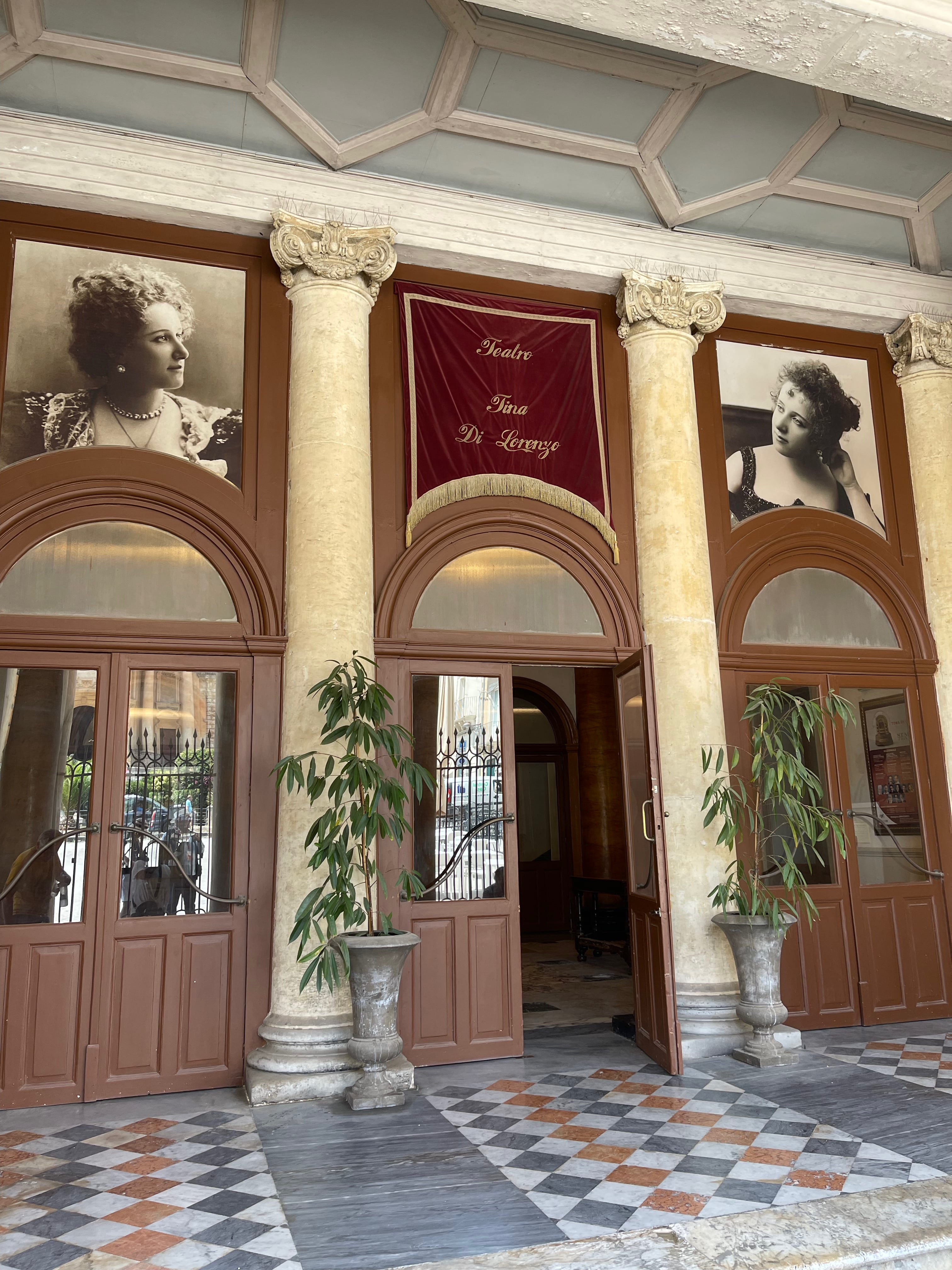
Our next stop was at “Teatro Comunale Tina di Lorenzo”.
Teatro Comunale Tina di Lorenzo
If you’ve been wandering around Noto thinking the whole town looks like a film set, wait until you see the “Teatro Comunale Tina di Lorenzo”. It’s the “Little Theatre” with a massive heart, and honestly, stepping inside feels like you’ve been invited to a private party in the 19th century.

I think it is one of the most charming spots in town. It’s elegant, confident, and a bit fancy without being “stuck up,” if you know what I mean.
The “Grand Lady” of the Main Street
- The Look: It’s sat right there on Corso Vittorio Emanuele. The outside is classic Neoclassical style, with these grand columns and statues of the Muses sitting right on top. It’s got that lovely golden stone that makes Noto so famous.
- The Name: It used to be named after King Vittorio Emanuele, but they renamed it to Tina di Lorenzo, who was a legendary Italian actress. I love that they chose to celebrate a woman who really owned the stage!
Stepping into the “Bonbonnière”
- Inside the Theatre: People call it a “bonbonnière” (a little candy box) because it’s so intricately decorated. It’s all plush red velvet, gold leaf, and four tiers of private boxes.

- The Ceiling: You have to look up! There’s a stunning frescoed ceiling with figures that look like they’re floating right above the audience.

- The Best Seat: If you take the tour, they’ll usually let you peek into the Royal Box. Standing there looking at the stage, you can almost hear the phantom applause from a hundred years ago.
Why It’s Worth a Visit
- Still Going Strong: This isn’t just a museum; it’s a working theatre. They still have concerts, plays, and operas here. If you can snag a ticket while you’re in town, do it, it’s an experience you’ll never forget.

- The Perfect Break: It’s just a short walk from the Cathedral. If the sun gets too hot, ducking into the cool, quiet lobby for a tour is a brilliant way to spend half an hour.
It’s such a proud little building, and it really shows how much the people of Noto value their art and culture. You’ll feel a bit more sophisticated just standing in the doorway!
After the visit to the theatre, we visited another church! Noto is famous as the town of 100 churches, so with so many beautiful ones, you just have to get in. This one was called “Chiesa di San Domenico”.
Church of San Domenico
If you’re looking for a bit of a quiet breather after the grandness of the Cathedral, you’ve got to visit the “Chiesa di San Domenico”. It sits right on Piazza XVI Maggio, and honestly, it’s one of the most elegant spots in the whole town. It’s got this confident, rounded look that just makes you want to stop and stare.

Here’s why it’s one of my top picks for a proper Noto wander:
The “Curvy” Façade
- A Masterpiece: This church was designed by Rosario Gagliardi, who was basically the “starchitect” of the Sicilian Baroque world.
- The Protrusion: You’ll notice it right away, the middle of the front protrudes outwards in a convex shape. It gives the building so much movement and makes it stand out from the flatter buildings nearby.
- The Hercules Fountain: Right in front of the church, you’ll see the Fontana d’Ercole (Hercules Fountain). It’s a lovely little spot to sit for a minute and just take in the view of the church and the theatre across the square.
Stepping into the “Treasure Chest”
- White and Bright: Inside, it’s a stunning Greek cross layout. The walls are mostly brilliant white, which makes all the intricate stucco decorations and gold details really pop.

- The Main Altar: Keep an eye out for the statue of the Madonna del Rosario and the gilded wooden ciborium. It’s incredibly detailed and shows off that 18th-century craftsmanship I’m always raving about.

- The Five Domes: Look up! The church has five domes that are all richly decorated. It feels much larger once you’re inside than it looks from the street.

A bit of History
- Dominican Heritage: It was built between 1703 and 1727 as a church for the Dominican Fathers. It survived the test of time and is now part of Noto’s UNESCO World Heritage collection.
- The Architect’s Rest: There’s a local story that Rosario Gagliardi himself is actually buried right here in the church he helped create.

It’s just a peaceful, beautiful place that feels a bit more “local” than the main cathedral. It feels a bit more relaxed after a quick duck-in there!
We continued our wanderings and next we visited the last church of the day,(for us). It was the “Chiesa di Montevergine”.
Chiesa di Montevergine
When you walk up and down the Nicolaci Palace street, you will notice a church at the end that looks like it’s giving the town a bit of a “hug.” That’s the “Chiesa di Montevergine”, and honestly, it’s a favourite spot for a bit of a quiet time. It’s sat right at the end of Via Nicolaci, you know, the street with the famous balconies, and it acts like a grand finale to that whole view.

Here’s why you shouldn’t just walk past it:
The “Curve” that Catches the Eye
- The Concave Façade: Most buildings are flat, but this one curves inwards. It’s another brilliant design by Sinatra, and it’s meant to draw you in. It’s got two bell towers that make it look incredibly symmetrical and balanced.

- The Best Photo Spot: If you stand at the bottom of the street and look up, the church frames the entire road. It’s the shot everyone wants for their holiday album, especially when the flowers are out!
A Look Inside the Sanctuary
- The Single Nave: Inside, it’s just one long room (a nave), which makes it feel much more intimate than the massive Cathedral.

- The Floor: My favourite part? The original majolica tile floor. It’s absolutely stunning, and it’s a miracle it’s stayed in such good nick.

- The Altars: The high altar is made of precious marbles and has a beautiful painting of the “Marriage of the Virgin”. It’s classic, elegant, and shows that you don’t need a massive dome to be impressive.
The Hidden History
- A Place for Women: It was originally part of a Benedictine convent for nuns. You can still see the grated galleries high up on the walls where the nuns could watch the mass without being seen by the public. It’s a bit of a “secret” side of Noto’s history.
- UNESCO Star: Just like its neighbours, it’s a key part of why Noto is a UNESCO World Heritage site. It’s that perfect example of how the town was rebuilt to be beautiful from every single angle.
It’s such a lovely, poised building. I find that a quick visit there makes you feel a bit more grounded before heading back into the busy crowds on the Corso.
If you would like to have a walking tour in Noto with a local guide, you can book this tour which will take you to most of the attractions I mention on this post and more. It is a small group of a maximum of 8 people with an archeologist and licensed guide.

It was well past lunchtime, and we were hungry, so we headed to Corso Vittorio Emanuele again, where we saw a nice place selling fish cones. We didn’t want to have a massive lunch, just something light to deceive our stomachs.
We stopped at “Putia del Coppo” where they serve seafood on a paper cone. You can sit at one of their tables outside or just walk away with your cone. We sat there for a while, but later continued on the “Corso” to the other side and finished our cones while walking.
If you are into cooking and tasting different food and if you have more time in Noto than we did, I advise you to take this lovely Sicilian Cooking Class on a regenerative farm near Noto. This experience is designed for food lovers, home cooks, and slow travellers who want to understand Sicilian cuisine beyond restaurants, through the land, the ingredients, and the people who cultivate them. Book this cooking class HERE.

We crossed “Porta Reale O Ferdinandea” and looked at the stalls selling souvenirs alongside the park. As it was getting late, we decided it was time to go back to our B&B and collect our luggage that was left there in their storage.

Our B&B, was close by and after collecting our suitcases, we walked up to the car park where our car was. We were going to Siracusa, which was about 40 minutes by car.
I will tell you about our arrival in Siracusa and what we did in my next post, coming soon.
The Practical Bits: What You Need to Know
- Getting There: If you’re driving, parking can be a bit of a puzzle. We were directed by our B&B to “Parchegio Città di Noto” and left our car there overnight and the whole day we spent in Noto. I think this is the easiest “low-stress” option.

- Timing Your Visit: Noto is small. You can see the highlights in 3–4 hours, but I’d recommend to spend at least a day and arriving in the late afternoon on the previous day as we did. The “Golden Hour” here isn’t just a cliché; it’s when the city truly comes alive.
- Accessibility: Like many Sicilian towns, there are steps and cobbles. Wear your most comfortable shoes, this isn’t the place for heels!
The Verdict: Should You Book It?
If you love history that you can feel under your feet and architecture that feels like a film set, Noto is non-negotiable. It’s grand, but because it was built with a unified vision, it feels incredibly cohesive and intentional.
I’d love to hear from you. Are you a fan of exploring grand cathedrals, or are you mostly in it for the world-class granita? Let me know in the comments!

I hope this post will give you some idea of what can be done in a day in Noto and will help you plan your own visit there.
Below is a reel from the Travelling Surveyor Instagram account showing more photos of Noto Check it out and follow me on Instagram as well.
HOW TO MAKE THE MOST OF YOUR VISIT TO NOTO
Below you will find a list of what to visit, where to stay and where to eat in Noto. I classified each place as follows:
BOLD – Visited, tried and recommended
NOT BOLD – Not visited or tried, but planning to visit or try and heard very good reviews
RED – Visited and tried but do not recommend, avoid or be cautious
*** – Excellent
** – Good
* – OK
£££ – Expensive
££ – Fair and affordable
PLEASE NOTE: Every hotel, restaurants and attractions I mention on my blogs are not sponsored reviews and we always paid the full price when visiting. We give our own opinion of the place and detail our experience, good or bad.
THINGS TO DO IN NOTO
ATTRACTIONS
1 – Church of San Francesco d’Assissi all’Immaculata – ***
2 – Church of Santa Chiara – ***
3 – Church of San Salvatore – ***
4 – San Nicolò Cathedral – ***
5 – Palazo Ducazio – ***
6 – Palazzo Nicolaci dei Princip di Villadorata – ***
7 – Church of San Carlo – ***
8 – Teatro Comunale Tina di Lorenzo – ***
9 – Church of San Domenico – ***
10 – Chiesa di Montevergine – ***
WHERE TO STAY
ACCOMMODATION
1 – B&B Zioli – 4* – ££ – *** – (We stayed here)
2 – La Dimora sotto le Stelle – 4* – ££
3 – Macramè in centro storico (House) – ££
4 – Hotel Porta Reale – 4* – £££
5 – Netum Hotel – 4* – £££
6 – Q92 Noto – 4* – £££
If you prefer to look for your own accommodation, search and book via the below widget:
I use affiliate links such as the links above for Booking.com, Get your Guide, Viator and others. It means that if you use any of my links to make a booking, I will get a small commission from the partners I’m affiliated with without any additional cost to you. Please, use the links provided when making a booking, this is a way of supporting blogs like this so we can continue writing informative and interesting posts. I’m very thankful for that.
BEST PLACES TO EAT
RESTAURANTS
1 – Anche gli Angeli – ££ – *** – (We had dinner here)
2 – Putia del Coppo – £ – *** (We had lunch here)
3 – Le Quattro Sorelle Ristorante Enoteca – ££
4 – Ritrovino Enoteca/restaurant – ££
5 – CasaMatta Pizzeria – ££
6 – Pescheria Spugnetti Sebastiano – ££
We only tried the ones in bold , the others are the result of my researches and ones that I would like to try. If you tried any of my recommendations above, please send me a message and tell me about your experience good or bad, so I can update the list accordingly. Thanks!
If you enjoyed reading this post you might also like to read:
On this trip to Italy:
1 – Catania – Day 1
2 – Catania – Day 2
3 – Taormina
4 – Cefalú
5 – Palermo – Day 1
6 – Palermo – Day 2
8 – Punta Secca
9 – Ragusa – Day 1
10 – Ragusa – Day 2
11 – Modica
12 – Noto
13 – Siracusa – Day 1
14 – Siracusa – Day 2 – Coming soon
15 – Catania and Conclusion – Day – 3 – Coming soon

Leave a Reply