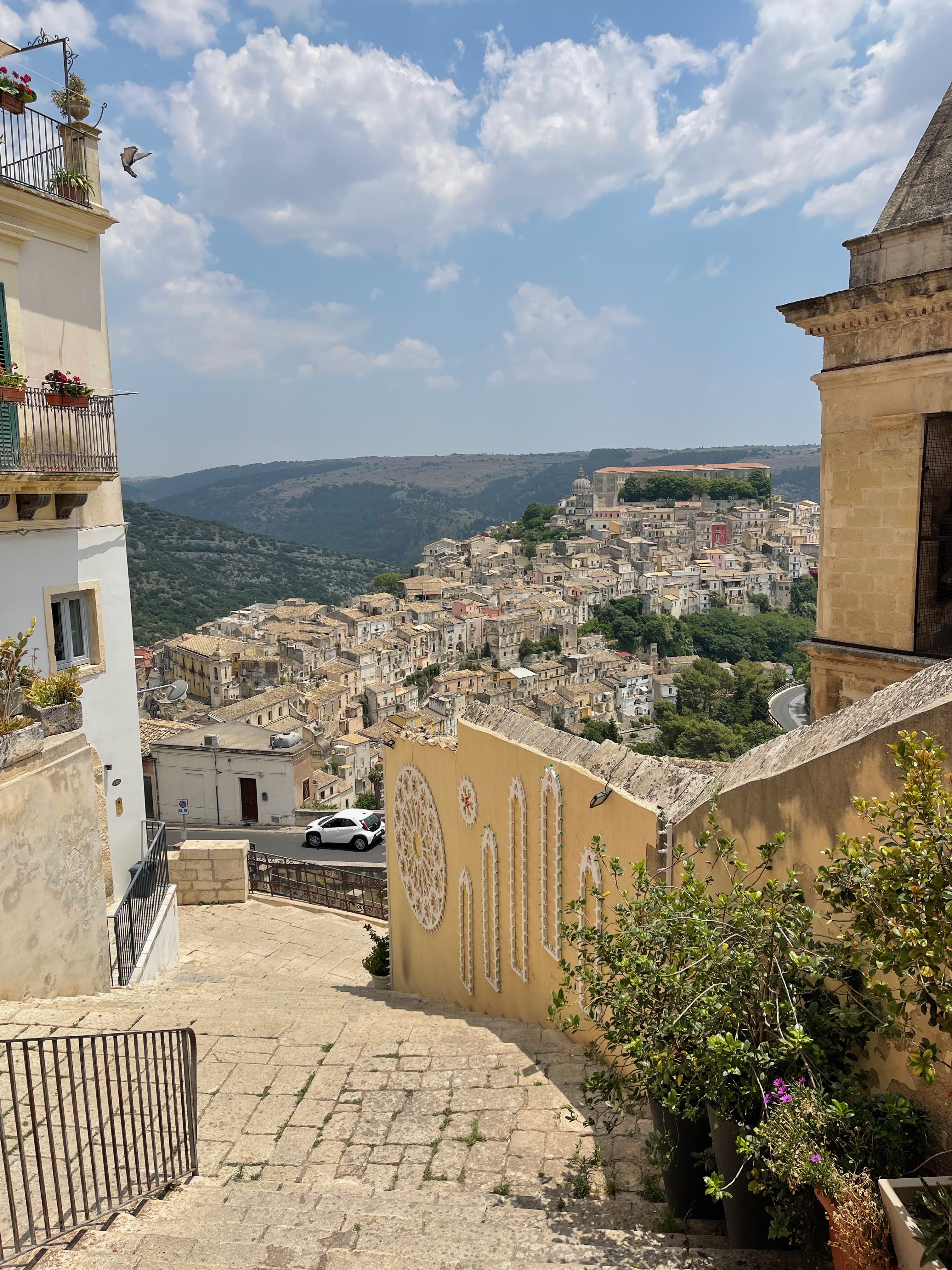

Are you planning your trip to Sicily? Would you like to know more about what to see on the island? Read on. In this post, I will tell you what we did on Day 2 in Ragusa and what is there to see and include in your own itinerary.
On this visit we had already visited Catania, Taormina, Cefalù, Palermo, Corleone & Agrigento and Punta Secca. Check these posts via the links.
Don’t forget to subscribe to the site so you will not miss any of the future posts on Sicily or other places by The Travelling Surveyor.
We were travelling independently around the island with a hired car we booked via Discover Cars, as we are confident travellers and speak a bit of the language. However, if you prefer to be part of a tour and to have everything organised for you, I advise you to book a complete tour of the island with Tourradar.
They have different kinds of tours that will fit your time and budget. If you book it via my link you can get a discount by using this code: RoseG50.
We woke up at “Giardino di Pietra B&B” after a peaceful and comfortable night. We went to the terrace for breakfast.

The owner serves breakfast at the tables, and besides the usual coffee, milk or tea, juices and bread, he also serves typical Ragusan dishes. It consists of local cheeses, olives and grilled vegetables. There were also some cakes and small treats.

After the very well-served breakfast, we left for the explorations of the day. On that day, we wanted to explore Ragusa Superiore on foot and started by going down to “Piazza della Repubblica”. That is where the “Chiesa delle Santissime Anime dei Purgatory” is. The plan was to visit the church, but at that time it was closed, so we pressed on and started climbing to Ragusa Superiore.
Below is a map showing the places we visited on that day in Ragusa:

VISITING RAGUSA
Chiesa delle Santissime Anime dei Purgatory
The “Chiesa delle Santissime Anime del Purgatorio” (Church of the Holy Souls in Purgatory) is one of the few historical landmarks in Ragusa Ibla that survived the devastating earthquake of 1693 mostly intact.
Located on Piazza della Repubblica, it sits at the entrance to the old town and is recognisable by the steep staircase leading to its entrance. This is also one of the filming sets of some episodes of the Inspector Montalbano series.

Key Architectural Features
- Façade: The late Baroque façade features a unique theological message: while there are three portals, the two side doors are “fake” (blind) doors, representing the belief that there is only one true path to heaven.
- Macabre Iconography: True to its dedication to souls in purgatory, the church is adorned with carvings of skulls wearing the insignia of kings, popes, and bishops. All reminders of the transience of earthly power (Memento Mori).
- The Bell Tower: Built around 1725, the tower incorporates ruins from the ancient Byzantine walls of Ragusa’s castle.
Notable Works of Art
- The Main Altar: Features the painting “Anime in Purgatorio” (1800) by Francesco Manno, depicting the Madonna and various saints praying for souls in purgatory.
- Interior Structure: The church is a three-nave basilica supported by ten stone columns with Corinthian capitals.
- Ancient Altars: The interior houses polychrome marble altars and statues. It includes a notable figure of a saint with a dog, often identified as Saint Roch.
We continued our climb to Ragusa Superiore, and our next stop was at “Chiesa di Santa Maria dell’Itria”.

Chiesa di Santa Maria dell’Itria
The “Chiesa di Santa Maria dell’Itria” is one of the most visually striking landmarks in Ragusa Ibla. Famous for its vibrant cobalt blue dome that stands out against the city’s golden limestone.
Located in the historic Cartellone district (the former Jewish quarter), it serves as a primary subject for photographers due to its unique silhouette.

Historical Significance
- Knights of Malta: Founded in the 14th century by the “Chiaramonte” counts, the church was granted to the Order of the Knights of Malta. Their symbolic eight-pointed cross is still visible on the main portal and throughout the interior.
- Survival and Evolution: It is one of the few structures that survived the 1693 earthquake with minimal damage. It was later updated with a late Baroque façade in 1740.
- The Name: Originally dedicated to San Giuliano, it was renamed for an effigy of the “Madonna dell’Itria” (from the Greek “Hodegetria”, meaning “Our Lady of the Way”).
Architectural Highlights
- The Bell Tower: The church’s defining feature is its “minaret-style” bell tower, crowned with polychrome Caltagirone ceramics in shades of blue and green.
- Intricate Interior: The interior consists of three naves separated by ten white stone columns with Corinthian capitals.
- Artistic Treasures:
- Altars: Five lateral altars sculpted by the local Cultraro family (1741–1758) feature exuberant floral and fruit garlands.
- Paintings: Notable works include an 18th-century painting of the “Madonna dell’Itria”, significant for depicting the port of Valletta under the Child Jesus’s feet, and a work attributed to Mattia Preti.

Our next stop was at “Palazzo Della Cancelleria” nearby.
Palazzo Della Cancelleria
The “Palazzo della Cancelleria” in Ragusa Ibla, also known as “Palazzo Nicastro”, is a significant UNESCO World Heritage Baroque palace located along the steep Via delle Scale (Salita Commendatore).
It is a prominent example of 18th-century architecture in the Val di Noto region, which was entirely rebuilt following the massive earthquake of 1693.

History and Name
Construction of the palace was commissioned by the wealthy Nicastro family in the first half of the 18th century and was completed around 1760.
The family was not a major noble house until later, but they were quite prosperous. In the second half of the 19th century, the City of Ragusa acquired the building to use as its records office, or Chancellery (Cancelleria), from which it derives its current name.
Architectural Features
The palace is noted for its masterful blend of architectural and sculptural elements.
- Main Façade: The façade is characterised by two tall pilasters that frame a large, overhanging balcony.
- Baroque Balcony: The main architectural highlight is the elaborate wrought-iron balcony railing, which is supported by five large, ornate corbels (stone brackets). These intricate decorations are typical of the Baroque style prevalent during the city’s reconstruction.
- Entrance Portal: The entrance features a semicircular arch with strongly projecting lines, framed by columns.

We continued climbing up the steps until we arrived at “Chiesa di Santa Maria delle Scale”, one of the best viewpoints to see Ragusa Ibla. The church, the steps, the road and the red house appeared in many episodes of Inspector Montalbano as well.

Chiesa di Santa Maria Delle Scale
The “Chiesa di Santa Maria delle Scale” (St. Mary of the Stairs) is one of Ragusa’s most significant architectural sites, serving as the symbolic and physical gateway between the modern upper town (Ragusa Superiore) and the historic lower town (Ragusa Ibla).

Historical Significance & 1693 Survival
- Original Gothic Foundation: Built in the 13th century by Cistercian monks, the original structure was primarily Gothic.
- The Great Earthquake: Unlike many other buildings in Ragusa, parts of this church survived the devastating 1693 earthquake. The nave and left aisle collapsed, but the right aisle and several original Gothic elements remained standing.
- Baroque Reconstruction: In the 18th century, the church was enlarged and largely rebuilt in the Baroque style to accommodate a growing population, resulting in a rare “half-medieval, half-baroque” hybrid.

Architectural Highlights
- The Three Chapels: Inside, the surviving right aisle features three original late Gothic chapels with ribbed vaulting and intricate stone carvings.
- The “Transit of the Virgin”: One of the church’s most valuable treasures is a 16th-century terracotta relief depicting the “Dormition of the Virgin Mary”, attributed to the renowned Gagini school.

- Gothic Portal: On the exterior, a pointed Gothic portal and the original bell tower still stand as reminders of the 13th-century construction.
- The Scalinata (Stairs): The church is located at the top of a famous winding staircase of approximately 340 steps that connects the two halves of the city.
- Panoramic Views: The terrace outside the church is widely considered the best viewpoint in Ragusa, offering a classic panoramic shot of Ragusa Ibla and the dome of the Duomo di San Giorgio.
After admiring the views and taking a lot of photos, we headed to “Belvedere di Santa Lucia” and “Chiesa di Santa Lucia”.

Chiesa di Santa Lucia
The “Chiesa di Santa Lucia” (also known as the Church of Santa Veneranda) is a historic religious site in Ragusa, highly regarded for its commanding panoramic views of the Ibla district.

Historical Background
- Original Foundation: The church was initially constructed around 1550 and was originally dedicated to Santa Veneranda.
- Survival and Rededication: It remained relatively intact following the massive earthquake of 1693 that levelled much of the region. It underwent significant renovations in 1797, which introduced its current Baroque elements.
- 19th Century Expansion: In 1819, the structure was expanded and rededicated to Saint Lucy (Santa Lucia).
Architectural and Interior Highlights
- The Façade: The exterior reflects the late Sicilian Baroque style typical of the reconstruction period in the Val di Noto.
- Interior Layout: The church features a single nave and contains five altars.
- The “Balcony of Santa Lucia”: The entrance hall or churchyard is famously referred to as the “Balcony of Santa Lucia.” It serves as one of the most picturesque panoramic terraces in Ragusa, offering a direct view over the rooftops and valleys of the Ibla district.
Visitor Information for 2025
- Location: Situated on Via Santa Lucia, the church is located on the winding road that descends from the upper town (Ragusa Superiore) toward the historic heart of Ibla.
- Accessibility: While the church interior may have restrictive opening hours, it is often noted by visitors as being closed during regular touring times in late 2025. This is what happened to us. When we visited the church, it was closed. However, the front yard remains accessible for photography and viewing the cityscape at all times.

- Photography Tip: It is widely considered one of the best spots for capturing the classic “split” view of the old and new town, especially during the golden hour.
- Festivals: Special events and masses may occur around December 13th, the feast day of Saint Lucy, which is a major traditional holiday in Sicily.

Our next stop was at “Palazzo Zacco”, however, we only admired the building from the outside as we didn’t have much time to see the inside, which was transformed into a museum nowadays.
Palazzo Zacco
Palazzo Zacco is a premier example of Sicilian Baroque architecture in Ragusa Superiore. Built around 1750 for Baron Melfi di San Antonio, it was later purchased by the Zacco family in the late 19th century. Today, it is recognised as a UNESCO World Heritage site.

Architectural Significance
The palace is renowned for its theatrical and ornate exterior, which showcases the “exuberance” of late Baroque design.
- The Corbels: The building’s most famous features are its six street-facing balconies supported by grotesque stone corbels. These carvings include whimsical and expressive figures such as musicians (one playing maracas), mermaids, and masks that appear to mock passersby with “burlesque grimaces”.
- Melfi Coat of Arms: A large stone shield of the Melfi family is prominently carved on the corner of the building, framed by acanthus leaves and supported by playful putti (cherubs).
- Entrance Portal: The main entrance is flanked by columns with Corinthian capitals supporting a central balcony adorned with intricate wrought-iron floral designs.

Museums and Collections
The interior of Palazzo Zacco has been transformed into a cultural hub housing several permanent exhibitions.
- Museum of Peasant Time: Located in the basement, this collection features historical tools and utensils used for traditional Sicilian farming, bread-making, and lace-work.
- Civic Collection of Carmelo Cappello: Features 15 sculptures and 20 graphic works by the local Ragusan artist.
- Photography Exhibit: The upper floor hosts a significant collection of black-and-white photography by Giuseppe Leone, documenting the history and landscape of Ragusa.
We pressed on and reached the top of Ragusa Superiore, to the “Poste Italiane”. We had a traffic fine to pay, remember? If you don’t know what I’m talking about, read my previous post, Ragusa Day 1, where I explain what happened to us that we ended up with a parking fine of 230 Euros to pay. The fine needed to be paid within 5 days; otherwise, it would turn into 350 Euros instead and should be paid at any post office.
We wanted to see the post office building in Ragusa Superiore anyway, because it is a remarkable building from the Fascist era and has its architectural values.

Poste Italiane
The “Poste Italiane” building in Ragusa Superiore, located in Piazza Matteotti, is a prominent example of Italian Rationalist architecture from the Fascist era. Completed around 1930 (or 1932 according to some sources), the monumental structure reflects the government’s push for functional and representative public buildings during that period.

Architectural Style and Features
The building was designed in a style typical of official government constructions of the 1920s and 1930s.
- Rationalist Design: In contrast to the elaborate Baroque architecture of Ragusa Ibla, the post office displays the severe, monumental style of Italian Rationalism, which was the preferred style for public works under Mussolini’s regime.
- Main Façade: The large façade features nine columns and a series of statues by sculptor Corrado Vigni.
- Sculptural Elements: Relief sculptures depicting a soldier and a sailor stand next to the main entrance, reflecting the regime’s nationalistic ideals.

- Piazza Matteotti: The building anchors the square, which features a fountain with stylised dolphins by the Ragusan sculptor Carmelo Cappello.
- Interior: The interior of such buildings from the era typically featured grand halls with high ceilings, marble cladding, and geometric designs to create a sense of state power and efficiency.
- Function: The building continues to serve as a functional post office and the general headquarters for Post & Telecommunications in the area.
- Location: It is located in the upper, modern part of the city (Ragusa Superiore), contrasting sharply with the older, Baroque lower town.

We spent about half an hour queuing up to pay that fine, but we managed to do that and forgot about it. We continued exploring Ragusa Superiore, and our next visit was to the “Cattedrale di San Giovani Battista”.
Cattedrale di San Giovani Battista
The “Cattedrale di San Giovanni Battista” (Cathedral of Saint John the Baptist) is the imposing centrepiece and primary attraction of Ragusa Superiore. This lavish Roman Catholic cathedral is a vital example of post-earthquake Sicilian Baroque architecture and is part of the UNESCO World Heritage Site designation for the Val di Noto region.

History
The original church of San Giovanni Battista was located in Ragusa Ibla, beneath the medieval castle. After the catastrophic earthquake of 1693, it was decided to rebuild the church in the new town that was developing on the plateau above.
Construction on the current, grander structure began in 1718 under architect Rosario Gagliardi and was consecrated in 1778. It was officially elevated to a Cathedral in 1950 with the establishment of the Diocese of Ragusa.

Architectural Features
The cathedral is a masterpiece of the late Baroque style, characterised by monumental scale and ornate details.
- Façade: The highly decorated facade is divided into five sections by large Corinthian columns and ashlar pilasters. It is preceded by a wide semi-elliptical staircase that heightens its imposing presence.
- Bell Tower: An asymmetrical touch is added by the 50-meter-high bell tower (campanile) on the left side; the one on the right remained unfinished. Visitors can climb the 129 steps for a panoramic view of the town.
- Sundials: The upper order of the facade features two large sundials dating from 1751, one measuring time in “Italic hours” (from sunset to sunset) and the other in “French hours” (from midnight to midnight).
Interior and Artworks
The interior has a Latin cross plan with three naves, divided by twelve columns with gilded capitals.

- Stuccowork: The vaults of the naves and presbytery feature fine gilded Rococo stuccoes created by the “Gianforma” brothers, students of the noted sculptor Giacomo Serpotta.
- Art: The cathedral houses several significant artworks, including the 19th-century wooden statue of Saint John the Baptist (carried in procession on August 29th) by Carmelo Licitra.
- Museum: The cathedral complex also includes a museum of religious art and relics, displaying liturgical dresses, gold artefacts, and episcopal texts across seven exhibition rooms.
Below the cathedral, next to the stairs to access it, there are a few shops and a nice café called Café Italia, where we stopped for a drink and a bite to eat.
After the café, we visited the church next to the cathedral called “Chiesa dei Collegio di Maria Santissima Addolorata”.
Chiesa dei Collegio di Maria Santissima Addolorata
The “Chiesa del Collegio di Maria Santissima Addolorata” (Church of the College of Our Lady of Sorrows), affectionately known by locals as the “Badia” (Abbey), is located in Piazza San Giovanni, in the heart of Ragusa Superiore, directly opposite the imposing Ragusa Cathedral.

History and Architecture
- Foundation and Purpose: The church was built between 1798 and 1806 following the will of the noblewoman Felicia Schininà di Sant’Elia. Its purpose was to establish a college to provide education for local orphans.
- Neoclassical Style: The building represents a transition from the late Sicilian Baroque to the more restrained Neoclassical style. The façade, although it retains Baroque influences, is divided into two orders and features an elegant portal flanked by pairs of Corinthian columns.

- Circular Plan: The interior, contrasting with the external shape, has a graceful circular (or elliptical) plan with five altars.

- Frescoes and Flooring: The interiors house paintings by the artist Tommaso Pollace and a valuable floor made of pitchstone (pietra pece) with geometric motifs.
- Current Status: In place of the annexed ancient college, there is now a cultural centre, the Centro Commerciale Culturale (CCC) dedicated to Mimì Arezzo.
After the visit, we entered the gardens of the Cathedral and wandered around the streets of Ragusa Superiore. Although it is the new part of the town, it is still an attractive part to explore and admire.

We saw “Ponte dei Cappuccini”, “Ponte Nuovo” and “Ponte Vecchio”, some of the bridges that link Ragusa Superiore to other parts of town.


After exploring the streets of Ragusa Superiore, we decided to start the descent and return to Ragusa Ibla. On the way down, we stopped at “Chiesa di Santa Maria delle Scale” again and took some more photos from different angles.


We went straight to Giardino Ibleo, which we had already visited, but our main goal was to try Risiu Café, which we had missed the previous day.

This time we found it, just in front of the “Portale di San Giorgio”. We ordered some drinks and an antipasti mixed board to share between us. The board had various local Ragusan dishes, cheeses and meats. It was the perfect lunch, trying different things without feeling too full. It is a lovely café, and it deserves all the hype I’ve heard about. I can only recommend a visit to this café.


After lunch, we wandered around the streets of Ragusa Ibla, passing the building of the “Circolo di Conversazione”, another famous trattoria called “Ai Lumi” featured in the series of Inspector Montalbano and yet another church called “Chiesa di Santa Maria Maddalena”. This church has a corridor on the left side of the main door that leads to an oratory from 1535.


We went back to our B&B and had some rest before going out again for dinner, to “Trattoria La Bettola”, which we had reserved the previous day.

At the time we booked, we arrived at the restaurant and were promptly seated at the terrace, which was very busy with all tables occupied. There was a queue of people waiting for a table, and we thought it was a good idea to have reserved the table in advance.
We were looking forward to eating there as the number of people there on the previous day and on that day was a sign that the food must have been really good.
Unfortunately, we were deeply disappointed with the food. The starters were OK, but nothing special; we both ordered Sicilian Caponata. The mains were a disaster. My husband ordered the grilled sausage, and I ordered the breaded pork chop.

This was exactly what was served to us, no vegetables, sauce or anything else to accompany the dishes. We were not warned by the waiter that a side dish was necessary to accompany the dishes, so we didn’t order any.

My husband got some roasted potatoes with his dish, but they were so dry and tasteless that he dismissed them. The pork shop was also very dry and lacking any kind of flavour. My husband managed to eat his sausage and gave me a piece to try, but I was unable to eat my dish and left it all. After the mains, we didn’t dare to order any dessert. The wine was good as usual, as you cannot go wrong with that. This ended up being the worst meal we had on this trip.
After dinner, we returned to our B&B for our last night in Ragusa. The following day, we went to Modica and ended the day in Noto. I will tell you all about that in my next posts.
I hope this post will give you some idea of what can be done in a day in Ragusa and will help you plan your own visit there.
Below is a reel from the Travelling Surveyor Instagram account showing more photos of Ragusa. Check it out and follow me on Instagram as well.

HOW TO MAKE THE MOST YOUR VISIT TO RAGUSA
Below you will find a list of what to visit, where to stay and where to eat in Ragusa. I classified each place as follows:
BOLD – Visited, tried and recommended
NOT BOLD – Not visited or tried, but planning to visit or try and heard very good reviews
RED – Visited and tried but do not recommend, avoid or be cautious
*** – Excellent
** – Good
* – OK
£££ – Expensive
££ – Fair and affordable
PLEASE NOTE: Every hotel, restaurants and attractions I mention on my blogs are not sponsored reviews and we always paid the full price when visiting. We give our own opinion of the place and detail our experience, good or bad.
THINGS TO DO IN RAGUSA
ATTRACTIONS
1 – Chiesa delle Santissime Anime dei Purgatory – ***
2 – Chiesa di Santa Maria dell’Itria – ***
3 – Palazzo della Cancelleria – ***
4 – Chiesa di Santa Lucia – ***
5 – Palazzo Zacco – ***
6 – Poste Italiene – ***
7 – Cattedrale di San Giovanni Battista – ***
8 – Chiesa dei Collegio di Maria Santissima Addolorata – ***
9 – Walk the streets of Ragusa Superiore – ***
10 – Walk the streets of Ragusa Ibla – ***
WHERE TO STAY
ACCOMMODATION
1 – Giardino di Pietra – 4* – ££ – *** (We stayed here)
2 – Dimora Bonafede Ibla Design Rooms – 4* – ££
3 – Giardino Sul Duomo – 4* – ££
4 – La Casa di Irene – 4* – ££
5 – Il Baiocco – 4* – ££
6 – Hybla Life Rooms – 4* – ££
If you prefer to look for your own accommodation, search and book via the below widget:
I use affiliate links such as the links above for Booking.com, Get your Guide, Viator and others. It means that if you use any of my links to make a booking, I will get a small commission from the partners I’m affiliated with without any additional cost to you. Please, use the links provided when making a booking, this is a way of supporting blogs like this so we can continue writing informative and interesting posts. I’m very thankful for that.
BEST PLACES TO EAT
RESTAURANTS
We only tried the ones in bold , the others are the result of my researches and ones that I would like to try. If you tried any of my recommendations above, please send me a message and tell me about your experience good or bad, so I can update the list accordingly. Thanks!
1 – I Banchi – ££ – *** – (We ate here)
2 – Risiu – £ – *** (We ate here)
3 – Trattoria La Bettola – ££ – * – (We ate here)
4 – Scale dei Gusto – ££
5 – Il Balcone sulla Vallata – ££
6 – Taberna dei Cinque Sensi – ££
I hope this post gives you some idea of what can be done in a day in Ragusa and will help you plan your own itinerary there.
If you enjoyed reading this post you might also like to read:
On this trip to Italy:
1 – Catania – Day 1
2 – Catania – Day 2
3 – Taormina
4 – Cefalú
5 – Palermo – Day 1
6 – Palermo – Day 2
8 – Punta Secca
9 – Ragusa – Day 1
10 – Ragusa – Day 2
11 – Modica
12 – Noto
13 – Siracusa – Day 1
14 – Siracusa – Day 2 – Coming soon
15 – Catania and Conclusion – Day – 3 – Coming soon
Leave a Reply