
If you’re planning a getaway to this ancient Sicilian gem, here are some of the best things to do in Syracuse, which should give you a real taste of its magic. We spent two days exploring the city and its history as part of a longer trek across Sicily, and this small selection of attractions is more than enough to fill up a day.
From getting lost in the honey-hued alleys of Ortigia (Siracusa Day 1) to standing in the massive Neapolis Archaeological Park, there is a lot to love. Whether you’re here for the world-class archaeology or just want to sit by the sea with a granita, Syracuse has a way of slowing you down in the best possible way.

On this trip to Sicily we had already visited Catania, Taormina, Cefalù, Palermo, Corleone & Agrigento, Punta Secca, Ragusa, Modica and Noto. Check these posts via the links and don’t forget to subscribe to the site, so you will not miss any of the future posts on Sicily or other places by The Travelling Surveyor.

We were travelling independently around the island with a hired car we booked via Discover Cars, as we are confident travellers and speak a bit of the language. However, if you prefer to be part of a tour and to have everything organised for you, I advise you to book a complete tour of the island with Tourradar.
They have different kinds of tours that will fit your time and budget. If you book it via my link you can get a discount by using this code: RoseG50.
Below is a map showing the places we visited in Syracuse on that day:
VISITING SYRACUSE
This was our second night at B&B “Dimore delle Zagare Molo”. We had our breakfast at their lovely terrace and checked out afterwards. We left our luggage at reception to free up the room and went out to enjoy our last day in Syracuse.

We had tickets and a guided tour booked for “Parco Neapolis” booked for 9 am. So, we left quite early. We also booked a typical tuk-tuk to take us to the park quickly in the morning, so we wouldn’t be late for our tour.

We arrived there about 10 minutes before 9 o’clock and just waited for the tour to start. When everybody joined, the tour started. The guide took us to the most important parts of the park and gave us lots of information about the history of the park and Syracuse. It was a very interesting and informative tour.

Parco Archeologico della Neapolis
Located on the Syracuse mainland, the “Parco Archeologico della Neapolis” is a 240,000-square-metre open-air museum that serves as the monumental heart of ancient Syracuse. While the city’s Baroque charm lives in Ortigia, the Neapolis is where you go to feel the sheer scale of the Greek and Roman empires.

The park is the crown jewel of Syracuse. It is one of the most significant archaeological sites in the Mediterranean, preserving the remains of the ancient Greek and Roman city of “Neapolis” (literally “New City”).
Spanning a massive limestone ridge, the park is a testament to Syracuse’s former status as one of the most powerful cities of the ancient world, rivalling even Athens.
What is There to See?
The park is divided into several distinct areas, each offering a different perspective on ancient life.
This is the park’s centrepiece. Carved directly into the rock of Temenite Hill in the 5th century BC, it is one of the largest and best-preserved Greek theatres in existence.
1. The Greek Theatre (Teatro Greco)
Originally built in the 5th century BC and later expanded by Hieron II, it is one of the largest and best-preserved theatres of the ancient world.

- Design: Carved directly into the limestone of the Temenite Hill, it once featured 67 rows of seats and could accommodate up to 15,000 spectators.
- Legacy: It premiered the works of masters like Aeschylus, who personally attended performances of “The Persians” here.
- Modern Use: Today, it still hosts world-class classical tragedies every May and June, though visiting outside of the festival allows you to see the original stone without modern seating coverings.
- Significance: It was here that the famous playwright Aeschylus premiered some of his tragedies.
- The View: From the top tiers, you can see across the city to the blue waters of the Ionian Sea.
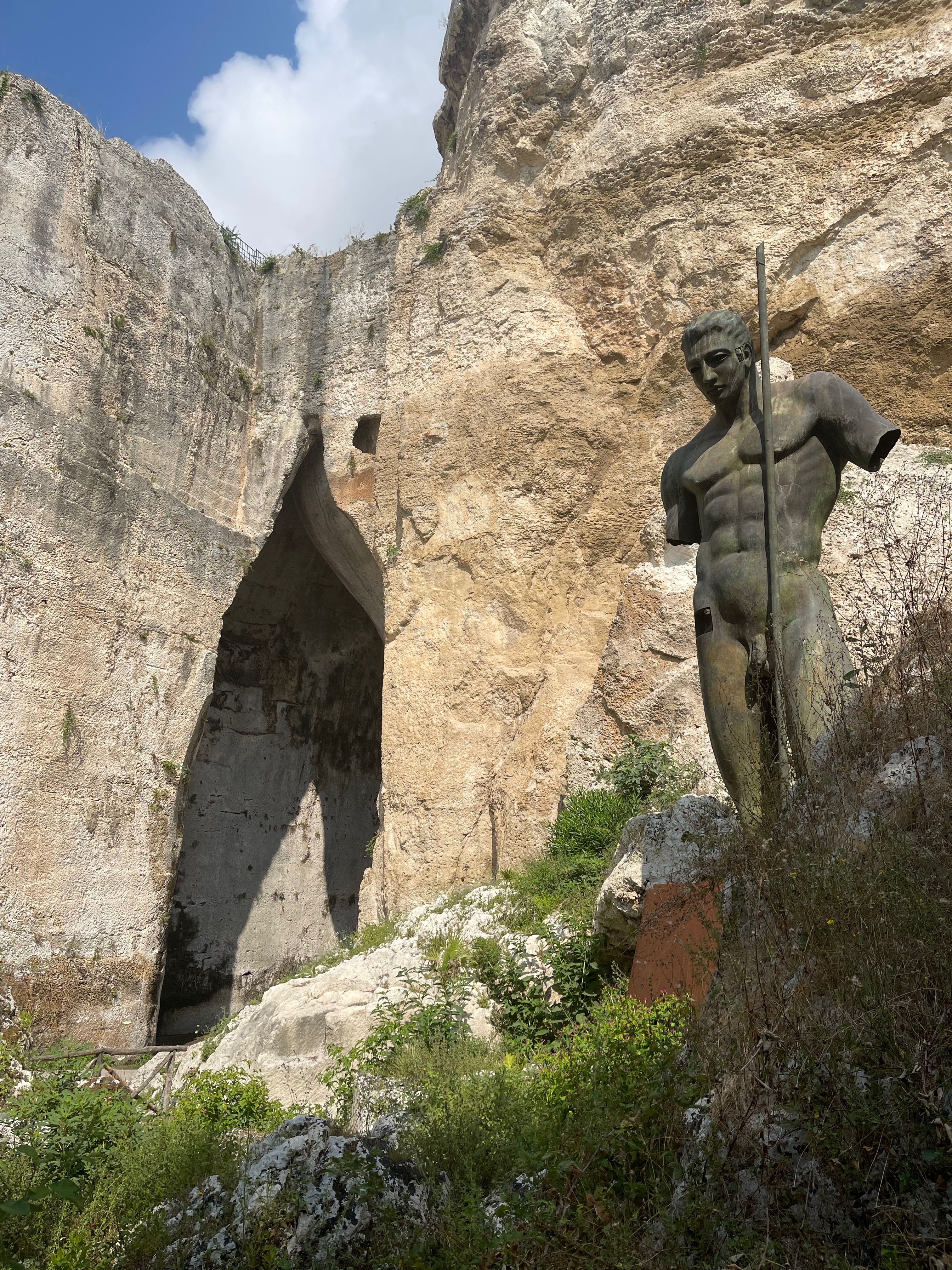
2. The Ear of Dionysius (Orecchio di Dionisio)
Located within the “Latomia del Paradiso” (an ancient limestone quarry), this is a massive, ear-shaped cave.

- The Legend: Known for its incredible acoustics, legend says the tyrant Dionysius used the cave as a prison, standing at the top to overhear the whispered secrets and plots of his captives.
- The Experience: The acoustics are so precise that a whisper at one end can be heard clearly at the other, and even a small sound like tearing paper produces a thunderous echo.
3. The Roman Amphiteatre
Unlike the Greek Theatre, which was for drama, this Roman arena (built in the 3rd century AD) was designed for gladiatorial combat and chariot races. You can still see the central rectangular pit that was likely used for the machinery and scenic effects. This arena reflects a shift from the arts to the spectacle of blood sports.

- Scale: Measuring roughly 140 metres long, it was used for gladiator battles and wild animal hunts.
- Hidden Details: Look for the rectangular hole in the centre of the arena; it is believed to have been a drainage system for the blood of fallen gladiators and animals.
- History: In the 16th century, Spanish rulers looted the site’s stone to build the fortifications of Ortigia, which is why much of the upper structure is missing today.
4. The Altar of Hieron II
This is a colossal stone structure, nearly 200 metres long, where it is said that 450 bulls were sacrificed simultaneously during major religious festivals to honour Zeus.
This was the largest sacrificial altar in the Greek world, stretching nearly 200 metres in length.

After the tour, we still walked around the park exploring other areas that we didn’t go with the guide. When we thought we had seen everything, we left the park and walked to the “Catacombs of San Giovanni”, which are about a 10-minute walk from the park and also in the mainland.
You can only visit the catacombs with a guide, so when we arrived, we joined the next English tour that was about to start. Photographs are not allowed in the catacombs, but are allowed in the ruined basilica.
Catacombs of San Giovanni
Located in the heart of Syracuse the Catacombs of San Giovanni offer a hauntingly beautiful journey into the city’s early Christian past. Unlike the famous catacombs in Rome, which are often narrow and claustrophobic, these are known for their grand scale, architectural precision, and historical significance as one of the largest burial complexes in the world.

What are the Catacombs of San Giovanni?
The Catacombs of San Giovanni are a vast underground necropolis dating primarily from the 4th to the 6th century AD. They were built after the Edict of Milan (313 AD), which granted religious freedom to Christians.
The site is unique because it was planned according to a strict orthogonal grid system, mirroring the layout of a city above ground. It consists of a main gallery (the decumanus) with several secondary galleries (the cardines) branching off it.
What is There to See?
The experience is divided into two main parts: the ruins of the basilica above and the labyrinthine tunnels below.
- The Basilica of San Giovanni
Before descending, you walk through the open-air ruins of a 6th-century Byzantine church. After being destroyed by an earthquake in 1693, only the perimeter walls, some majestic columns, and the apse remain. It is a stunning example of “architecture of silence.”

2. The Crypt of St. Marcian
Located beneath the basilica, this is said to be the spot where St. Marcian, the first bishop of Syracuse, was martyred.
- The Altar: Look for the stone altar where St. Paul is traditioned to have preached on his way to Rome.
- Frescoes: You can still see traces of vibrant Byzantine frescoes depicting religious scenes.

3. The Underground Galleries
As you enter the catacombs, you will see various types of burials:
- Loculi: Simple rectangular niches carved into the walls for single bodies.
- Arcosolia: More elaborate arched tombs, often used for entire families.
- Rotundae: Large circular chapels (converted from old Greek cisterns) used for communal prayer and more prestigious burials.
A Brief History
- Greek Origins: Before they were catacombs, the tunnels were part of a Greek aqueduct system.
- Christian Expansion: As the Christian community in Syracuse grew, they repurposed these tunnels. Syracuse was a major Mediterranean hub, and its catacombs eventually became second in size and importance only to those in Rome.
- Middle Ages & Beyond: During the Saracen invasions, the site was looted. In the 17th century, a massive earthquake brought down the roof of the main basilica, creating the dramatic ruins seen today.

When we finished the visit to the Catacombs, we stopped at a nearby café for some lunch, and after lunch we continued and walked to the “Santuario Madonna delle Lacrime” , a 5-minute walk away.
Basilica Santuario della Madonna delle Lacrime
Dominating the skyline of Syracuse, the “Basilica Santuario della Madonna delle Lacrime” (Sanctuary of Our Lady of Tears) is impossible to miss. It is a striking, controversial, and deeply emotional landmark that stands in sharp architectural contrast to the ancient Greek and Baroque styles found elsewhere in the city.

The Miracle: Why was it Built?
The sanctuary was built to commemorate a miraculous event that occurred in 1953.
In the humble home of a young couple (Angelo Iannuso and Antonina Giusto), a small plaster image of the Virgin Mary began to weep human tears. The phenomenon lasted for four days, attracted thousands of pilgrims, and was eventually verified by a panel of doctors and scientists. The Catholic Church officially recognised the miracle in 1954, and the sanctuary was commissioned to house the image and the vial containing the analysed tears.
Architecture: A Modernist Marvel
Designed by French architects Michel Andrault and Pierre Parat, the building was completed in 1994. Its design is polarizing. Some see it as a masterpiece of modernism, while others find its concrete bulk jarring against the historic city.
- The Shape: The structure is a massive conical “tent” made of reinforced concrete, rising to a height of 74 metres (about 243 feet).
- Symbolism: The architects intended the shape to represent a giant tear falling from heaven, or alternatively, a lighthouse guiding the faithful.
- The Interior: The vast, circular nave can hold up to 11,000 people. It features 22 small chapels around the perimeter and a striking play of light created by the vertical windows cutting through the concrete ribs.
- The Crypt: Beneath the main basilica is a large crypt, where you can see the foundations and even some ancient Roman remains discovered during construction.

Curiosities and Interesting Facts
- Visible from Space: Or at least, from almost everywhere in the province. Its sheer height makes it the tallest building in Syracuse, serving as a permanent geographical North Star for locals.
- Controversy: When the design was first unveiled, it was nicknamed the “upside-down ice cream cone” and even “the nuclear reactor” by critics who preferred traditional Sicilian Baroque architecture.
- The Relic: The small plaster plaque of the Virgin Mary is kept in a magnificent reliquary above the main altar. You can view the original image that supposedly wept in 1953.
- The Tears: The liquid collected from the image was scientifically tested in 1953. The laboratory results confirmed it had the same chemical composition as human tears.
Unfortunately, the basilica closes between 1 and 3 pm, and this was the time we were at the door, so we couldn’t get in. We decided to walk back to our B&B as we still had to drive to Catania on that day.
On the way back to the B&B, we also passed the “Chiesa di San Tommaso Apostolo al Pantheon” which has a very curious design, and we wanted to see. However, they were having some kind of refurbishment, and the site was fenced with no access to the church. We just took some photos from the outside and continued to our B&B.

We collected our luggage from the B&B and started our journey to Catania. It takes about an hour to get to Catania.
We booked a hotel near the airport because our flight back to the UK was very early in the morning, and we didn’t want to risk being far away, as we still needed to hand the car back before checking in and waiting for our flight.
I will tell you about our last night in Catania and our conclusion about this trip to Sicily in my next post.
I hope this post will give you some idea of what can be done in a day in Syracuse and will help you plan your own visit there.
Below is a reel from the Travelling Surveyor Instagram account showing more photos of Syracuse. Check it out and follow me on Instagram as well.
HOW TO MAKE THE MOST OF YOUR VISIT TO SYRACUSE
Below you will find a list of what to visit, where to stay and where to eat in Syracuse. I classified each place as follows:
BOLD – Visited, tried and recommended
NOT BOLD – Not visited or tried, but planning to visit or try and heard very good reviews
RED – Visited and tried but do not recommend, avoid or be cautious
*** – Excellent
** – Good
* – OK
£££ – Expensive
££ – Fair and affordable
PLEASE NOTE: Every hotel, restaurants and attractions I mention on my blogs are not sponsored reviews and we always paid the full price when visiting. We give our own opinion of the place and detail our experience, good or bad.
THINGS TO DO IN SYRACUSE – DAY 2
ATTRACTIONS
1 – Parco Archeologico della Neapolis – ***
2 – Catacombs of San Giovanni – ***
3 – Basilica Santuario della Madonna delle Lacrime – *** (outside)
4 – Chiesa di San Tommaso Apostolo al Pantheon – *** (outside)
WHERE TO STAY
ACCOMMODATION
1 – Dimore delle Zagare Molo – ££ – *** – (We stayed here)
2 – Dimore delle Zagare Ortigia – 4* – ££
3 – Serèsia Rooms – 3* – ££
4 – B&B Tre e 14 – 3* – ££
5 – Grand Hotel Ortigia – 5* – £££
6 – Caportigia Boutique Hotel – 5* – £££
If you prefer to look for your own accommodation, search and book via the below widget:
I use affiliate links such as the links above for Booking.com, Get your Guide, Viator and others. It means that if you use any of my links to make a booking, I will get a small commission from the partners I’m affiliated with without any additional cost to you. Please, use the links provided when making a booking, this is a way of supporting blogs like this so we can continue writing informative and interesting posts. I’m very thankful for that.
BEST PLACES TO EAT
RESTAURANTS
1 – Agape Restaurant
2 – La Terrazza del Grand Hotel Ortigia
4 – Ostaria
5 – Puros Restaurant and Pizzeria
6 – Àreus
We only tried the ones in bold , the others are the result of my researches and ones that I would like to try. If you tried any of my recommendations above, please send me a message and tell me about your experience good or bad, so I can update the list accordingly. Thanks!
If you enjoyed reading this post you might also like to read:
On this trip to Italy:
1 – Catania – Day 1
2 – Catania – Day 2
3 – Taormina
4 – Cefalú
5 – Palermo – Day 1
6 – Palermo – Day 2
8 – Punta Secca
9 – Ragusa – Day 1
10 – Ragusa – Day 2
11 – Modica
12 – Noto
13 – Siracusa – Day 1
14 – Siracusa – Day 2
15 – Catania and Conclusion – Day – 3 – Coming soon



Leave a Reply